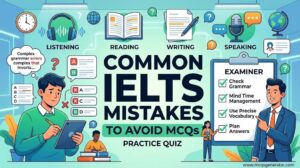
Achieving a Band 7.0 or higher in the IELTS Writing and Speaking modules requires an advanced command of the English language, evaluated under the assessment criterion known as “Lexical Resource.” This criterion measures a candidate’s ability to use a wide range of vocabulary flexibly, incorporate less common lexical items accurately, and utilize precise collocations and idiomatic phrasing. Relying on basic words or repeating repetitive terms can severely cap your score, making active vocabulary enhancement essential. The following multiple-choice questions test your understanding, recognition, and application of high-level academic vocabulary tailored for top-tier IELTS performance.
1. What is the meaning of the adjective 'ubiquitous', often used in IELTS to describe technology?
Correct Answer: b) Found or present everywhere
Explanation:
'Ubiquitous' means appearing or found everywhere (e.g., 'Smartphones have become ubiquitous in modern society.'). It is an excellent Band 8+ word.
2. Which of the following is a synonym for 'detrimental'?
Correct Answer: b) Harmful
Explanation:
'Detrimental' means tending to cause harm. It is a more advanced academic alternative to 'bad' or 'harmful'.
3. If a government decides to 'mitigate' a problem, what are they doing?
Correct Answer: c) Making the problem less severe or harmful
Explanation:
'To mitigate' means to make something less severe, harmful, or painful. (e.g., 'mitigate the effects of climate change').
4. What does the verb 'exacerbate' mean?
Correct Answer: a) To make a bad situation worse
Explanation:
'Exacerbate' is the opposite of mitigate. It means to make a problem, bad situation, or negative feeling worse.
5. Which word is the most appropriate academic synonym for 'important'?
Correct Answer: b) Paramount
Explanation:
'Paramount' means more important than anything else; supreme. It is highly effective in IELTS Writing Task 2.
6. What is the meaning of the noun 'proliferation'?
Correct Answer: c) Rapid increase in numbers or amount
Explanation:
'Proliferation' refers to rapid multiplication or increase (e.g., 'the proliferation of social media platforms').
7. If an argument is described as 'plausible', what does it mean?
Correct Answer: c) It is reasonable and likely to be true
Explanation:
'Plausible' means seeming reasonable or probable. It is often used when evaluating opinions in Task 2.
8. Which of the following describes a 'lucrative' business?
Correct Answer: a) A business that produces a great deal of profit
Explanation:
'Lucrative' means producing a great deal of profit or wealth, often used when discussing jobs or industries.
9. What is a synonym for 'ambiguous'?
Correct Answer: b) Open to more than one interpretation
Explanation:
If something is 'ambiguous', it does not have one clear meaning and can be understood in multiple ways.
10. In IELTS Task 1, if a graph shows figures that 'fluctuate', what are they doing?
Correct Answer: d) Rising and falling irregularly
Explanation:
'Fluctuate' is essential vocabulary for dynamic charts in Task 1, meaning to rise and fall irregularly in number or amount.
11. Which phrase is a stronger, more academic alternative to 'a lot of differences'?
Correct Answer: b) A significant disparity
Explanation:
'Disparity' means a great difference, often used when discussing inequality (e.g., 'income disparity').
12. What does the verb 'alleviate' mean?
Correct Answer: c) To make suffering, deficiency, or a problem less severe
Explanation:
Similar to mitigate, 'alleviate' means to make a negative situation less severe (e.g., 'alleviate poverty').
13. If an issue is 'contentious', it is:
Correct Answer: a) Causing or likely to cause an argument; controversial
Explanation:
'Contentious' is an excellent academic word meaning highly controversial or heavily debated.
14. What is the meaning of 'ramification'?
Correct Answer: b) A complex or unwelcome consequence of an action or event
Explanation:
'Ramifications' are the results or consequences of an action, typically negative and complex.
15. Which of these is a synonym for 'inevitable'?
Correct Answer: a) Unavoidable
Explanation:
If something is 'inevitable', it is certain to happen and cannot be avoided or prevented.
16. When describing a trend in Task 1, what does it mean if numbers 'plummet'?
Correct Answer: b) They decrease rapidly and steeply
Explanation:
'Plummet' means to fall or drop straight down at high speed. It is a powerful verb for describing a sharp decrease.
17. What does the noun 'consensus' mean?
Correct Answer: b) A general agreement among a group
Explanation:
A 'consensus' is a general agreement. Phrases like 'There is a growing consensus that...' are great for Task 2 introductions.
18. If a task is described as 'mundane', it is:
Correct Answer: b) Lacking interest or excitement; dull
Explanation:
'Mundane' refers to things that are ordinary, everyday, and often boring (e.g., 'mundane chores').
19. Which of the following is a strong collocation with the word 'impact'?
Correct Answer: a) Profound impact
Explanation:
A 'profound impact' is an excellent collocation meaning a very strong or deep effect.
20. What is the meaning of the phrasal verb 'bring about'?
Correct Answer: b) To cause something to happen
Explanation:
'Bring about' means to cause or result in something (e.g., 'The new policies will bring about positive changes').
21. In the context of the environment, what does 'depletion' refer to?
Correct Answer: b) The reduction in the number or quantity of something
Explanation:
'Depletion' (e.g., 'resource depletion') refers to exhausting or significantly reducing a supply.
22. What is a synonym for the verb 'hinder'?
Correct Answer: b) Obstruct
Explanation:
'To hinder' means to create difficulties for someone or something, resulting in delay or obstruction.
23. If a language is described as 'obsolete', it is:
Correct Answer: a) No longer produced or used; out of date
Explanation:
'Obsolete' means something is no longer in use, often replaced by something newer.
24. Which linking word is used to introduce a contrasting idea?
Correct Answer: c) Nevertheless
Explanation:
'Nevertheless' is a formal transition word used to show contrast or concession, similar to 'however'.
25. What does the idiom 'a double-edged sword' mean?
Correct Answer: b) Something that has both positive and negative consequences
Explanation:
This is a great idiom for Task 2 to describe a situation or technology (like social media) that has both pros and cons.
26. If you are 'on the fence' about an issue, you are:
Correct Answer: b) Undecided or unable to choose between two sides
Explanation:
Being 'on the fence' means you haven't made a decision yet. This is an excellent natural phrase for IELTS Speaking Part 3.
27. What does the adjective 'imperative' mean?
Correct Answer: a) Of vital importance; crucial
Explanation:
Saying 'It is imperative that...' is a high-level academic way to say 'It is very important that...'.
28. Which of these collocations is correct?
Correct Answer: b) Make a decision
Explanation:
In English, we 'make a decision', not 'do' or 'have' one. Correct collocations are essential for Lexical Resource Band 7+.
29. What does the noun 'paradigm' mean?
Correct Answer: a) A typical example or pattern of something; a model
Explanation:
A 'paradigm' is a standard, perspective, or set of ideas. A 'paradigm shift' means a fundamental change in approach.
30. If something is 'ephemeral', it:
Correct Answer: c) Lasts for a very short time
Explanation:
'Ephemeral' means transient or short-lived (e.g., 'the ephemeral nature of fashion trends').
31. To 'stem from' something means to:
Correct Answer: b) Originate in or be caused by it
Explanation:
'Stem from' is a phrasal verb meaning to be caused by something (e.g., 'Many social problems stem from poverty').
32. What is the meaning of the adjective 'feasible'?
Correct Answer: b) Possible to do easily or conveniently
Explanation:
'Feasible' means practical and possible to achieve. (e.g., 'a feasible solution').
33. Which phrase is a good alternative to 'Nowadays' for starting an essay?
Correct Answer: b) In the contemporary era
Explanation:
'Nowadays' is slightly overused. 'In the contemporary era' or 'In recent years' are more sophisticated alternatives.
34. If a government introduces a 'deterrent', what is its purpose?
Correct Answer: b) To discourage an action or event through instilling doubt or fear of the consequences
Explanation:
A 'deterrent' (like a harsh prison sentence) is meant to stop people from doing something bad.
35. What does the verb 'eradicate' mean?
Correct Answer: b) To completely destroy or put an end to something
Explanation:
'Eradicate' is an advanced verb meaning to wipe out completely, often used with disease or poverty (e.g., 'eradicate polio').
36. In Speaking, if you say something 'costs an arm and a leg', you mean it is:
Correct Answer: c) Extremely expensive
Explanation:
This is a common English idiom used to describe something very costly. It is great for showing idiomatic range in Speaking.
37. What does the noun 'anomaly' refer to?
Correct Answer: b) Something that deviates from what is standard, normal, or expected
Explanation:
An 'anomaly' is an exception to the rule or an oddity.
38. To 'attribute something to' someone or something means to:
Correct Answer: b) Regard something as being caused by someone or something
Explanation:
For example, 'He attributes his success to hard work' means he believes hard work caused his success.
39. Which word is an academic synonym for 'show' or 'display' in Task 1?
Correct Answer: c) Illustrate
Explanation:
'Illustrate', 'demonstrate', and 'depict' are high-level alternatives to the basic verb 'show'.
40. If an economy is 'stagnant', it is:
Correct Answer: b) Showing no activity or growth
Explanation:
A 'stagnant' economy or situation is one that is not moving, changing, or developing.
41. What does the idiom 'a blessing in disguise' mean?
Correct Answer: a) A good thing that seemed bad at first
Explanation:
This idiom is used in Speaking to describe a misfortune that unexpectedly results in a good outcome.
42. Which of these collocations is correct regarding an argument?
Correct Answer: a) To make a compelling argument
Explanation:
In academic writing, one 'makes an argument'. A 'compelling' argument is one that is very convincing.
43. What does 'sedentary' mean, often used in health-related IELTS topics?
Correct Answer: b) Tending to spend much time seated; somewhat inactive
Explanation:
A 'sedentary lifestyle' is a very common topic in IELTS, referring to a lifestyle with little or no physical activity.
44. To 'foster' a skill or feeling means to:
Correct Answer: b) Encourage or promote its development
Explanation:
Parents 'foster' independence in children, meaning they encourage it to grow.
45. What does the noun 'influx' mean?
Correct Answer: b) An arrival or entry of large numbers of people or things
Explanation:
An 'influx' is a massive arrival (e.g., 'an influx of tourists' or 'an influx of immigrants').
46. If a situation is 'unprecedented', it:
Correct Answer: b) Has never been done or known before
Explanation:
An 'unprecedented' event is one that has absolutely no historical precedent; it is entirely new.
47. Which linking phrase is best to show a result?
Correct Answer: b) Consequently
Explanation:
'Consequently' is a formal adverb meaning 'as a result'. It helps improve the Coherence and Cohesion score.
48. What is the meaning of 'pivotal'?
Correct Answer: a) Of crucial importance in relation to the development or success of something else
Explanation:
A 'pivotal' role or moment is one that is absolutely central and crucial to success.
49. In IELTS Speaking, if you say 'it happens once in a blue moon', what do you mean?
Correct Answer: c) It happens very rarely
Explanation:
'Once in a blue moon' is a natural idiom for expressing that something occurs very infrequently.
50. What does the verb 'diminish' mean?
Correct Answer: a) To make or become less
Explanation:
'Diminish' means to decrease or reduce. It is an excellent synonym for 'fall' or 'decrease'.
51. Which of the following is a synonym for 'compulsory'?
Correct Answer: b) Mandatory
Explanation:
If a subject in school is 'compulsory' or 'mandatory', students must take it; they have no choice.
52. To 'tackle' a problem means to:
Correct Answer: c) Make determined efforts to deal with it
Explanation:
'Tackle' is a strong verb often used in essays proposing solutions (e.g., 'The government must tackle this issue').
53. What does 'sustainable' mean, especially in environmental contexts?
Correct Answer: a) Able to be maintained at a certain rate or level without depleting natural resources
Explanation:
'Sustainable development' or 'sustainable energy' refers to practices that do not harm the future environment.
54. If a process is 'redundant', it is:
Correct Answer: b) Not or no longer needed or useful
Explanation:
In employment, being 'made redundant' means losing your job because it is no longer needed. Generally, it means unnecessary repetition or uselessness.
55. What is the meaning of the adjective 'vulnerable'?
Correct Answer: b) Susceptible to physical or emotional attack or harm
Explanation:
Groups like children, the elderly, or endangered animals are often described as 'vulnerable' in IELTS topics.
56. Which of these is the correct collocation?
Correct Answer: a) Pay attention
Explanation:
In English, we 'pay' attention. Using correct verb-noun collocations is critical for a high Lexical Resource score.
57. To 'embark on' something means to:
Correct Answer: b) Begin a course of action, especially one that is important or demanding
Explanation:
You can 'embark on a new career' or 'embark on a journey'. It is a formal phrasal verb.
58. If something is a 'catalyst' for change, what does it do?
Correct Answer: c) It causes or accelerates the change
Explanation:
A 'catalyst' is an event or person that causes great change or action.
59. In Speaking, if you are 'under the weather', how do you feel?
Correct Answer: a) Slightly unwell or sick
Explanation:
This is a natural English idiom meaning to feel mildly ill.
60. What does the noun 'disparity' refer to?
Correct Answer: b) A great difference or inequality
Explanation:
It is frequently used in essays about society or economics (e.g., 'the disparity between rich and poor').
61. Which of the following describes an 'empirical' study?
Correct Answer: b) Based on observation or experience rather than theory or pure logic
Explanation:
'Empirical evidence' is data gathered by actual observation or scientific experiment.
62. To 'surpass' expectations means to:
Correct Answer: b) Exceed or be greater than them
Explanation:
'Surpass' is an excellent academic verb meaning to go beyond what was expected.
63. What is the meaning of the adjective 'indispensable'?
Correct Answer: a) Absolutely necessary
Explanation:
If a tool or person is 'indispensable', you cannot function without them (e.g., 'Smartphones have become indispensable').
64. What does 'to beat around the bush' mean in spoken English?
Correct Answer: b) To avoid talking about what is important
Explanation:
This idiom refers to someone who is delaying coming to the point of a conversation.
65. If an idea is 'abstract', it is:
Correct Answer: b) Existing in thought or as an idea but not having a physical or concrete existence
Explanation:
Abstract concepts (like love, freedom, or justice) contrast with concrete, physical things.
66. To 'allocate' resources means to:
Correct Answer: b) Distribute them for a particular purpose
Explanation:
Governments often 'allocate funding' to specific departments, meaning they distribute or assign that money.
67. What is the meaning of the noun 'deterioration'?
Correct Answer: a) The process of becoming progressively worse
Explanation:
Environmental 'deterioration' or health 'deterioration' refers to a steady decline in quality or condition.
68. If a topic is 'multifaeted', it has:
Correct Answer: c) Many different aspects or features
Explanation:
A 'multifaceted' problem is complex and requires looking at from many different angles.
69. Which of these collocations is correct for 'damage'?
Correct Answer: b) Do damage
Explanation:
In English, actions 'do damage' to the environment, they do not 'make' damage.
70. To 'implement' a policy means to:
Correct Answer: b) Put a decision or plan into effect
Explanation:
'Implement' is a high-level verb used to describe taking action on a plan or law.
71. What is a synonym for 'abundant'?
Correct Answer: b) Plentiful
Explanation:
'Abundant' means existing or available in large quantities (e.g., 'abundant natural resources').
72. If someone is a 'proponent' of a theory, they:
Correct Answer: b) Advocate or support it
Explanation:
A 'proponent' is a supporter of an idea. It is the opposite of an 'opponent'.
73. In Speaking, if you say something is 'a piece of cake', you mean:
Correct Answer: b) It is extremely easy
Explanation:
This idiom is used to describe a task that is very simple to accomplish.
74. What does the verb 'fluctuate' specifically imply?
Correct Answer: b) An irregular rising and falling
Explanation:
In Task 1, if prices 'fluctuate', they go up and down repeatedly and unpredictably.
75. Which of these is a correct collocation?
Correct Answer: a) Heavy rain
Explanation:
'Heavy rain' is the correct, natural English collocation. Using 'strong rain' sounds unnatural and hurts the Lexical Resource score.
76. What does 'marginal' mean when describing a change in a graph?
Correct Answer: b) Very small or slight
Explanation:
A 'marginal increase' means the number went up by a very tiny, almost insignificant amount.
77. To 'foster' economic growth means to:
Correct Answer: b) Encourage and promote it
Explanation:
'Foster' means to help something grow or develop.
78. What is the meaning of the adjective 'susceptible'?
Correct Answer: a) Likely or liable to be influenced or harmed by a particular thing
Explanation:
If teenagers are 'susceptible to peer pressure', it means they are easily influenced by it.
79. Which linking word is used to add more information to a point?
Correct Answer: a) Furthermore
Explanation:
'Furthermore', 'moreover', and 'in addition' are used to add supporting points to an argument.
80. What does the noun 'implication' mean?
Correct Answer: b) The conclusion that can be drawn from something, although it is not explicitly stated
Explanation:
The 'implications' of a new policy are the unstated effects or consequences it will likely have in the future.
81. To 'curb' a bad habit or trend means to:
Correct Answer: b) Restrain or keep it in check
Explanation:
Governments try to 'curb inflation' or 'curb pollution', meaning they try to control or limit it.
82. In Speaking, if someone 'hits the nail on the head', they:
Correct Answer: b) Describe exactly what is causing a situation or problem
Explanation:
This idiom means someone is exactly right about their assessment of a situation.
83. What is a synonym for 'innovative'?
Correct Answer: b) Groundbreaking or inventive
Explanation:
An 'innovative' approach introduces new, advanced, and creative ideas.
84. If an action is 'prohibited', it is:
Correct Answer: b) Formally forbidden by law, rule, or other authority
Explanation:
'Prohibited' is a formal, academic word for 'banned' or 'not allowed'.
85. What does 'to reap the benefits' mean?
Correct Answer: b) To receive the positive results of past actions
Explanation:
This phrase means to get the good results that come from hard work or a good decision (e.g., 'reap the benefits of a good education').
86. Which word is an antonym for 'mandatory'?
Correct Answer: c) Optional
Explanation:
While mandatory means you *must* do something, 'optional' means it is your choice.
87. To 'devastate' an area means to:
Correct Answer: b) Destroy or ruin it completely
Explanation:
Natural disasters 'devastate' cities, leaving severe destruction in their wake.
88. What does 'unbiased' mean?
Correct Answer: b) Showing no prejudice; impartial
Explanation:
An 'unbiased' opinion is fair, objective, and not influenced by personal feelings.
89. Which of these collocations is correct when discussing research?
Correct Answer: b) Do research
Explanation:
In English, we 'do research' or 'conduct research'. We do not 'make' research.
90. If a government decides to 'subsidize' an industry, what are they doing?
Correct Answer: c) Supporting it financially
Explanation:
To 'subsidize' means to pay part of the cost of producing something to keep the prices low for consumers (e.g., 'subsidize public transport').
91. What does the noun 'infrastructure' usually refer to in IELTS essays?
Correct Answer: a) The basic physical and organizational structures (e.g., roads, power supplies) needed for a society to operate
Explanation:
'Infrastructure' includes the fundamental facilities and systems serving a country, city, or area.
92. If something is 'unfeasible', it is:
Correct Answer: b) Not practical or possible to achieve
Explanation:
Unfeasible (or impractical) means that a proposed solution cannot actually be put into practice successfully.
93. In Speaking, to be 'over the moon' means:
Correct Answer: a) To be extremely happy or delighted
Explanation:
This idiom is a great way to express extreme happiness or excitement in the Speaking test.
94. To 'alleviate poverty' means to:
Correct Answer: b) Make poverty less severe
Explanation:
This is a very common academic collocation. To alleviate is to ease or lessen suffering.
95. What is the meaning of 'cogent' when used to describe an argument?
Correct Answer: b) Clear, logical, and convincing
Explanation:
A 'cogent' argument is one that is very strong, logical, and persuasive.
96. What does 'to turn a blind eye to' something mean?
Correct Answer: b) To pretend not to notice a problem or bad behavior
Explanation:
This idiom describes ignoring something that you know is wrong (e.g., 'Authorities turned a blind eye to the illegal dumping of waste').
97. Which of these words is a high-level synonym for 'money' or 'funding'?
Correct Answer: b) Financial resources
Explanation:
In Task 2 essays, using terms like 'financial resources', 'capital', or 'funding' is much more academic than repeating 'money'.
98. To 'commence' means to:
Correct Answer: b) Begin or start
Explanation:
'Commence' is a formal synonym for 'start' (e.g., 'The project will commence next year').
99. If something is an 'integral' part of a process, it is:
Correct Answer: a) Necessary to make the whole complete; essential
Explanation:
An 'integral' component is a vital, fundamental piece of a system.
100. What does the phrasal verb 'rule out' mean?
Correct Answer: b) To eliminate or exclude as a possibility
Explanation:
If investigators 'rule out' a theory, they decide it is impossible and stop considering it.