

The Institute of Banking Personnel Selection (IBPS) is an autonomous recruitment body established in 1984 to encourage the recruitment and placement of young graduates in public sector banks in India. Originally starting in 1975 as Personnel Selection Services (PSS) under the National Institute of Bank Management (NIBM), it transitioned into an independent entity at the behest of the Reserve Bank of India (RBI). Today, IBPS conducts the centralized Common Recruitment Process (CRP) for Probationary Officers (PO), Clerks, Specialist Officers (SO), and Regional Rural Banks (RRBs). Its governing board includes nominees from the RBI, the Ministry of Finance, and the Indian Banks’ Association (IBA). Understanding the framework, history, and functions of IBPS is a crucial component of the Banking Awareness section for all banking competitive examinations.
Latest IBPS – Overview MCQs
1 min read
Correct Answer: b) Institute of Banking Personnel Selection
Explanation:
IBPS stands for the Institute of Banking Personnel Selection, an autonomous body that conducts recruitment exams for public sector banks in India.
Correct Answer: c) Mumbai
Explanation:
The headquarters of the Institute of Banking Personnel Selection (IBPS) is located in Mumbai, Maharashtra.
Correct Answer: b) 1975
Explanation:
IBPS originated as Personnel Selection Services (PSS) in 1975 to help public sector banks with their recruitment processes.
Correct Answer: c) 1984
Explanation:
At the behest of the Reserve Bank of India (RBI) and Public Sector Banks, IBPS became an independent entity in 1984.
Correct Answer: b) Dr. A. S. Deshpande
Explanation:
Dr. A. S. Deshpande played a foundational role in conceptualizing and establishing the Personnel Selection Services (PSS), which evolved into IBPS.
Correct Answer: c) State Bank of India (SBI)
Explanation:
The State Bank of India (SBI) does not participate in the IBPS Common Recruitment Process (CRP). It conducts its own separate exams for PO and Clerk.
Correct Answer: b) Societies Registration Act, 1860
Explanation:
IBPS is registered as a society under the Societies Registration Act, 1860, and also as a Public Trust under the Bombay Public Trust Act, 1950.
Correct Answer: b) Common Written Examination
Explanation:
CWE stands for Common Written Examination, which is the standardized testing mechanism implemented by IBPS for recruiting bank personnel.
Correct Answer: c) 2011
Explanation:
IBPS started the Common Written Examination (CWE) process for recruiting officers and clerks in Indian banks in 2011.
Correct Answer: b) Indian Banks' Association (IBA)
Explanation:
The Indian Banks' Association (IBA) represents bank management and plays a key role in guiding the recruitment policies executed by IBPS.
Correct Answer: b) 11
Explanation:
Following various bank mergers, there are currently 11 participating Public Sector Banks in the standard IBPS PO and Clerk recruitment processes.
Correct Answer: a) IBPS CRP PO/MT
Explanation:
The exam is officially called CRP PO/MT (Common Recruitment Process for Probationary Officers / Management Trainees).
Correct Answer: c) IBPS CRP Clerks
Explanation:
The IBPS CRP Clerks exam is conducted to recruit candidates for clerical cadre posts in participating public sector banks.
Correct Answer: a) IBPS CRP RRB
Explanation:
The Common Recruitment Process for Regional Rural Banks is termed IBPS CRP RRB.
Correct Answer: c) IBPS SPL (SO)
Explanation:
IBPS SPL or SO (Specialist Officer) is conducted to hire candidates with specialized skills such as IT, Law, HR, Agriculture, and Marketing.
Correct Answer: d) Punjab National Bank
Explanation:
Punjab National Bank is a public sector bank that participates in IBPS. HDFC, ICICI, and Axis are private banks.
Correct Answer: c) Interview
Explanation:
The IBPS PO selection process consists of three stages: Prelims, Mains, and the final Interview.
Correct Answer: c) No, there is no interview for the clerical cadre
Explanation:
As per Government of India guidelines, interviews for junior-level posts (clerical cadre) were discontinued. Selection is based entirely on the Mains exam.
Correct Answer: b) To provide orientation to SC/ST and Minority community candidates before the exam
Explanation:
PET is organized by nodal banks to help candidates belonging to SC/ST and Minority communities understand the exam pattern and clear their doubts.
Correct Answer: c) Merit-cum-preference basis
Explanation:
Provisional allotment is made based on the candidate's final merit position and the preference of banks they provided during the application.
Correct Answer: b) 20 years
Explanation:
The minimum age requirement to apply for the IBPS Probationary Officer (PO) exam is 20 years.
Correct Answer: b) 30 years
Explanation:
For general category candidates, the maximum age limit to apply for IBPS PO is 30 years (with relaxations for reserved categories).
Correct Answer: b) A Degree (Graduation) in any discipline from a recognized University
Explanation:
A valid bachelor's degree in any discipline from a recognized university or equivalent is the basic educational requirement for IBPS PO.
Correct Answer: b) 100
Explanation:
The IBPS PO Prelims exam consists of 100 questions carrying a total of 100 marks.
Correct Answer: b) 60 minutes
Explanation:
The total duration of the IBPS PO Prelims exam is 60 minutes, divided into 20 minutes per section.
Correct Answer: d) Computer Awareness
Explanation:
The IBPS PO Prelims exam tests only English Language, Quantitative Aptitude, and Reasoning Ability. Computer Awareness is not included.
Correct Answer: c) 30
Explanation:
The English Language section in the IBPS PO Prelims consists of exactly 30 questions.
Correct Answer: b) 35
Explanation:
There are 35 questions in the Quantitative Aptitude section of the IBPS PO Preliminary examination.
Correct Answer: b) 35
Explanation:
The Reasoning Ability section contains 35 questions in the IBPS PO Prelims.
Correct Answer: b) 20 minutes
Explanation:
Each section (English, Quant, Reasoning) is allocated exactly 20 minutes, totaling 60 minutes.
Correct Answer: b) 0.25 (or 1/4th) of the marks assigned to that question
Explanation:
For every incorrect answer, 0.25 (or one-fourth) of the marks assigned to the question are deducted as a penalty.
Correct Answer: c) 200
Explanation:
The objective test of the IBPS PO Mains exam carries a maximum of 200 marks.
Correct Answer: b) 25
Explanation:
The English Language Descriptive Paper (Letter Writing & Essay) in the IBPS PO Mains carries 25 marks.
Correct Answer: c) 30 minutes
Explanation:
Candidates are given exactly 30 minutes to type their Letter and Essay in the Descriptive Paper.
Correct Answer: b) Letter Writing and Essay
Explanation:
The descriptive test assesses English language skills through two tasks: writing a Letter and writing an Essay.
Correct Answer: c) 80:20
Explanation:
The marks obtained in the Mains exam and the Interview are weighted in the ratio of 80:20, respectively, to form the final merit list.
Correct Answer: c) 100
Explanation:
The total marks allotted for the personal interview stage in the IBPS PO exam are 100.
Correct Answer: c) 40%
Explanation:
A General category candidate must score a minimum of 40% (40 out of 100 marks) to qualify in the IBPS PO interview.
Correct Answer: b) 20 years
Explanation:
The minimum age limit for the IBPS Clerk exam is 20 years.
Correct Answer: b) 28 years
Explanation:
For general category candidates, the maximum age limit to apply for IBPS Clerk is 28 years.
Correct Answer: b) Proficiency (reading, writing, speaking) in the official language of the State/UT
Explanation:
IBPS Clerk is a state-level vacancy. Candidates must be proficient in reading, writing, and speaking the official language of the state they apply for.
Correct Answer: c) Language Proficiency Test
Explanation:
LPT stands for Language Proficiency Test, which banks conduct before joining to verify if the candidate knows the local language of the state applied for.
Correct Answer: c) 100
Explanation:
The IBPS Clerk Prelims exam consists of 100 questions carrying a total of 100 marks.
Correct Answer: c) 200
Explanation:
The IBPS Clerk Mains exam carries a maximum of 200 marks.
Correct Answer: b) 190
Explanation:
The IBPS Clerk Mains examination consists of exactly 190 questions that account for 200 marks.
Correct Answer: c) 160 minutes
Explanation:
The total duration of the IBPS Clerk Mains exam is 160 minutes, distributed across various sections.
Correct Answer: b) General/Financial Awareness
Explanation:
General/Financial Awareness is tested only in the Mains examination of IBPS Clerk, not in the Prelims.
Correct Answer: c) No, it does not have a descriptive paper
Explanation:
Unlike IBPS PO, the IBPS Clerk Mains exam is purely objective and does not include a Descriptive English paper.
Correct Answer: c) Must have a Certificate/Diploma/Degree in computer operations/Language or studied IT in High School/College
Explanation:
Candidates applying for IBPS Clerk must have documentary evidence of computer literacy, such as a certificate, diploma, degree, or having studied it as a subject in high school/college.
Correct Answer: c) No, a candidate can apply for vacancies in only one State/UT
Explanation:
An applicant is allowed to apply for clerical vacancies in only one State or Union Territory per recruitment cycle.
Correct Answer: b) Regional Rural Banks
Explanation:
In IBPS terminology, RRB refers to Regional Rural Banks, for which a separate CRP is conducted.
Correct Answer: c) Office Assistant (Multipurpose)
Explanation:
The post of Office Assistant (Multipurpose) in Regional Rural Banks is equivalent to a Clerk in standard public sector banks.
Correct Answer: b) Officer Scale I
Explanation:
Officer Scale I in Regional Rural Banks is an entry-level managerial post, equivalent to a Probationary Officer (PO) in commercial banks.
Correct Answer: b) Reasoning and Quantitative Aptitude / Numerical Ability only
Explanation:
A unique feature of the IBPS RRB Prelims is that it does not test language (English/Hindi). It only has two sections: Reasoning and Quantitative Aptitude (or Numerical Ability).
Correct Answer: b) 80
Explanation:
The IBPS RRB Prelims exam consists of 80 questions in total (40 for Reasoning and 40 for Quant).
Correct Answer: a) 45 minutes
Explanation:
Candidates are given a composite time of 45 minutes to solve the 80 questions in the IBPS RRB Prelims.
Correct Answer: c) No, there is a composite time for the entire test
Explanation:
Unlike the PO and Clerk exams, the IBPS RRB Prelims offers a composite time of 45 minutes without any strict sectional time limits.
Correct Answer: c) Candidates can choose either English Language or Hindi Language
Explanation:
In the RRB Mains exam, candidates are given the choice to attempt either the English Language section or the Hindi Language section.
Correct Answer: b) Officer Scale II (General Banking Officer)
Explanation:
To apply for the RRB Officer Scale II (General Banking Officer) post, a candidate must have at least two years of experience as an officer in a bank or financial institution.
Correct Answer: c) Officer Scale III
Explanation:
The post of Officer Scale III (Senior Manager) in Regional Rural Banks requires a minimum of 5 years of experience as an officer in a bank or financial institution.
Correct Answer: c) No, selection is based purely on the Mains exam marks
Explanation:
Similar to the IBPS Clerk, the RRB Office Assistant (clerical) recruitment does not include an interview stage.
Correct Answer: b) 28 years
Explanation:
The maximum age limit for applying to the RRB Office Assistant post is 28 years for the general category.
Correct Answer: b) 30 years
Explanation:
For the post of Officer Scale I (Assistant Manager) in RRBs, the maximum age limit is 30 years for general category candidates.
Correct Answer: b) 32 years
Explanation:
Candidates applying for Officer Scale II (Manager) must not have crossed 32 years of age (general category).
Correct Answer: b) 40 years
Explanation:
The maximum age limit for Officer Scale III (Senior Manager) is 40 years for general category candidates.
Correct Answer: c) 6
Explanation:
IBPS conducts the SO exam for 6 specialist posts: IT, Agriculture, Rajbhasha, Law, HR/Personnel, and Marketing.
Correct Answer: b) 20 years
Explanation:
The minimum age limit across all posts for the IBPS Specialist Officer (SO) exam is 20 years.
Correct Answer: b) 30 years
Explanation:
The maximum age limit for general category candidates appearing for IBPS SO is 30 years.
Correct Answer: c) IT Officer (Scale I)
Explanation:
The IT Officer (Scale I) post requires candidates to hold a relevant 4-year engineering degree or post-graduate qualification in IT-related fields.
Correct Answer: b) Agricultural Field Officer (AFO)
Explanation:
The Agricultural Field Officer (AFO) post requires a bachelor's degree in agriculture and allied sciences.
Correct Answer: d) Rajbhasha Adhikari (Scale I)
Explanation:
The Rajbhasha Adhikari (Official Language Officer) is responsible for translation and implementation of the official language policy, requiring PG in Hindi with English at graduation, or vice versa.
Correct Answer: b) Law Officer (Scale I)
Explanation:
The Law Officer post requires candidates to have a degree in Law (LLB) and be officially enrolled as an advocate with the Bar Council.
Correct Answer: c) HR/Personnel Officer
Explanation:
The HR/Personnel Officer post demands specialized postgraduate qualifications in Human Resources or Personnel Management.
Correct Answer: a) Marketing Officer (Scale I)
Explanation:
The Marketing Officer post specifically requires a 2-year full-time degree or diploma specializing in Marketing.
Correct Answer: b) They have General Awareness with special reference to Banking Industry instead of Quantitative Aptitude
Explanation:
While IT, Agriculture, HR, and Marketing Prelims include Quantitative Aptitude, the Prelims for Law and Rajbhasha substitute it with General Awareness (banking focus).
Correct Answer: c) 150
Explanation:
The IBPS SO Prelims exam consists of 150 questions (50 English, 50 Reasoning, and 50 Quant or General Awareness).
Correct Answer: b) 125
Explanation:
Despite having 150 questions, the SO Prelims is out of 125 marks, because the 50 English questions are worth only 0.5 marks each (25 marks total).
Correct Answer: c) Professional Knowledge relating to the specific post
Explanation:
The IBPS SO Mains exam focuses entirely on testing the Professional Knowledge relevant to the candidate's applied specialty (e.g., IT, Law, HR).
Correct Answer: b) Rajbhasha Adhikari
Explanation:
Only the Rajbhasha Adhikari Mains exam includes both an objective test (45 questions) and a descriptive test (2 questions) to evaluate language translation skills.
Correct Answer: c) Mains marks and Interview marks combined
Explanation:
The final merit list for Specialist Officers is drawn based on the combined marks obtained in the Mains Examination and the Personal Interview.
Correct Answer: b) Equi-percentile Normalization
Explanation:
IBPS uses the equi-percentile method of normalization to ensure fairness when an exam is conducted in multiple shifts with varying difficulty levels.
Correct Answer: b) Yes, candidates must clear both sectional cut-offs and the overall cut-off
Explanation:
Candidates must achieve a minimum score in each individual section as well as a minimum total score to qualify for the next stage.
Correct Answer: c) No, the Preliminary exam is only qualifying in nature
Explanation:
Prelims marks are strictly used to shortlist candidates for the Mains exam and are not factored into the final merit list.
Correct Answer: c) General / Financial / Banking Awareness
Explanation:
This section tests a candidate's knowledge of current events, banking terminology, the Indian economy, and financial systems.
Correct Answer: b) 3 years
Explanation:
OBC (Non-Creamy Layer) candidates are entitled to an upper age limit relaxation of 3 years as per government norms.
Correct Answer: b) 5 years
Explanation:
SC and ST category candidates receive an upper age limit relaxation of 5 years in IBPS recruitment processes.
Correct Answer: c) 10 years
Explanation:
Candidates falling under the PwBD category are eligible for an upper age limit relaxation of 10 years.
Correct Answer: b) Biometric thumb impression and/or Iris scan
Explanation:
To ensure security and prevent impersonation, IBPS captures biometric data (thumb impressions and/or Iris scans) and photographs at the exam venue.
Correct Answer: c) Online mode only through the official IBPS website
Explanation:
IBPS accepts applications strictly through the online mode via its official website. No other mode of application is entertained.
Correct Answer: c) By date of birth (the older candidate is placed higher)
Explanation:
In case of a tie in scores, IBPS resolves it by placing the candidate who is senior in age (according to Date of Birth) higher on the merit list.
Correct Answer: b) 10th Standard Marksheet/Certificate or Birth Certificate
Explanation:
The SSLC/10th Standard certificate bearing the date of birth, or a legally issued Birth Certificate, is required to prove Date of Birth.
Correct Answer: b) State-wise vacancies and candidate's preference of banks in that state
Explanation:
Allotment is done based on the merit-cum-preference principle, strictly keeping in mind the state-wise vacancies for which the candidate applied.
Correct Answer: b) Till the completion of the recruitment process for that specific financial year (typically March 31 of the subsequent year)
Explanation:
The IBPS scorecard is valid only for the recruitment process of the current financial year cycle and expires on March 31 of the following year.
Correct Answer: c) No, calculators are strictly prohibited
Explanation:
IBPS strictly prohibits the use of calculators, mobile phones, or any other electronic devices inside the examination hall.
Correct Answer: b) NABARD (National Bank for Agriculture and Rural Development)
Explanation:
NABARD is the apex regulatory body for Regional Rural Banks (RRBs) in India and oversees their functioning and policies.
Correct Answer: b) Reasoning & Computer Aptitude
Explanation:
The IBPS PO Mains exam merges Reasoning and Computer Aptitude into a single section comprising 45 questions for 60 marks.
Correct Answer: d) 3 hours 30 minutes
Explanation:
The objective portion lasts for 3 hours, and the descriptive test takes 30 minutes, bringing the total time to 3.5 hours.
Correct Answer: c) Data Interpretation (DI)
Explanation:
Data Interpretation (DI) involving charts, graphs, and tables forms a major and high-weightage part of the Quantitative Aptitude/Data Analysis section.
Correct Answer: b) 10%
Explanation:
As per Government of India guidelines, a 10% reservation in vacancies is provided to candidates belonging to the Economically Weaker Sections (EWS).
Correct Answer: c) Original Photo ID Proof (matching the name on the call letter) and its photocopy
Explanation:
Candidates must present a valid original photo ID (like Aadhar, PAN, Passport) along with a photocopy, matching exactly with the name on the admit card, to enter the exam venue.
Correct Answer: b) SC, ST, and Religious Minority community candidates
Explanation:
PET is a government-mandated initiative aimed at providing free training to candidates from SC, ST, and minority communities to level the playing field.
Correct Answer: c) A light-colored, preferably white, background
Explanation:
IBPS guidelines clearly state that the uploaded passport-size photograph must be a recent color photo against a light-colored, preferably white, background.
Correct Answer: b) The fee is not refunded, and only the latest completed application is retained
Explanation:
IBPS processes only the most recent complete application. Application fees are non-refundable under any circumstances.
Correct Answer: b) The candidate has been allotted a bank, but final appointment is subject to document verification and fulfilling eligibility criteria by the respective bank
Explanation:
Allotment is strictly 'provisional.' The participating bank will conduct document verification and medical tests before issuing the final offer letter.
Correct Answer: c) The specific participating bank to which the candidate is allotted
Explanation:
Once IBPS completes the provisional allotment, its role ends. The respective allotted bank takes over for document verification, medicals, and onboarding.
Correct Answer: c) No, the request for a change of center is not entertained under any circumstances
Explanation:
IBPS strictly states in its notification that no request for a change of center for Prelims, Mains, or Interview will be entertained.
Correct Answer: b) 35%
Explanation:
While general candidates need 40%, reserved category candidates (SC/ST/OBC/PwBD) have a relaxed minimum qualifying requirement of 35% in the interview.
Correct Answer: c) No, it is an autonomous body registered as a Society and Public Trust
Explanation:
IBPS is not a statutory body. It is an autonomous, non-profit organization registered under the Societies Registration Act and the Bombay Public Trust Act.
Correct Answer: c) 20 minutes
Explanation:
As per government guidelines implemented by IBPS, eligible PwBD candidates are allowed compensatory time of 20 minutes for every hour of the examination.
Related Posts
New New
New New
New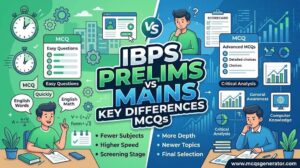
Logical Reasoning for UGC NET MCQs
Logical Reasoning is a high-scoring, analytical unit in Paper 1 of the University Grants Commission National Eligibility Test (UGC NET),…
October 16, 2026By MCQs Generator
Mathematics Pedagogy for CTET MCQs
Mathematics Pedagogy is a critical component of the Central Teacher Eligibility Test (CTET), accounting for half of the mathematics section…
October 14, 2026By MCQs Generator
IBPS Prelims vs Mains – Key Differences MCQs
The Institute of Banking Personnel Selection (IBPS) conducts multi-tier examinations primarily Preliminary (Prelims) and Main (Mains) to recruit candidates for…
October 16, 2026By MCQs Generator
Related Categories

AI & Data Science MCQ
5 topics
By MCQs Generator

Arts & Humanities MCQ
4 topics
By MCQs Generator

Civil Engineering MCQ
4 topics
By MCQs Generator

Commerce & Business MCQ
4 topics
By MCQs Generator

Computer Science MCQ
8 topics
By MCQs Generator

Electrical & Electronics Engineering MCQ
3 topics
By MCQs Generator

General Knowledge MCQ
2 topics
By MCQs Generator

General Science MCQ
4 topics
By MCQs Generator

Law & Judiciary MCQ
3 topics
By MCQs Generator

Mechanical Engineering MCQ
4 topics
By MCQs Generator

Medical & Health Sciences MCQ
4 topics
By MCQs Generator

Modern Tech Fields MCQ
3 topics
By MCQs Generator

