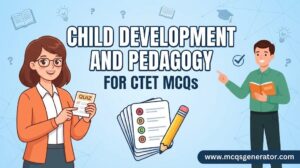
The Central Teacher Eligibility Test (CTET) is a national-level examination conducted by the Central Board of Secondary Education (CBSE) to determine the eligibility of prospective teachers for Classes I to VIII. Divided into Paper I (for primary stage teachers) and Paper II (for elementary stage teachers), the test evaluates candidates on child development and pedagogy, language proficiencies, and subject-specific content competencies. Understanding the exam structure, marking scheme, and practicing targeted multiple-choice questions is essential for clearing the qualifying thresholds required for teaching positions in central and state-affiliated schools.
1. What does the acronym CTET stand for in the context of Indian education?
Correct Answer: a) Central Teacher Eligibility Test
Explanation:
CTET stands for Central Teacher Eligibility Test, which is a national-level entrance exam conducted by CBSE to determine the eligibility of prospective teachers.
2. Which body is responsible for conducting the Central Teacher Eligibility Test (CTET)?
Correct Answer: c) CBSE
Explanation:
The Central Board of Secondary Education (CBSE) conducts the CTET exam periodically on behalf of the Ministry of Education.
3. For which classes is CTET Paper I conducted?
Correct Answer: b) Classes I to V
Explanation:
CTET Paper I is designed for candidates who intend to teach primary stage classes, i.e., Classes I to V.
4. For which classes is CTET Paper II conducted?
Correct Answer: b) Classes VI to VIII
Explanation:
CTET Paper II is meant for candidates aspiring to teach upper primary stage classes, i.e., Classes VI to VIII.
5. What is the total number of multiple-choice questions in each CTET paper?
Correct Answer: c) 150
Explanation:
Both CTET Paper I and Paper II consist of a total of 150 multiple-choice questions carrying 1 mark each.
6. What is the duration of time allotted to complete a CTET paper?
Correct Answer: b) 2 hours and 30 minutes
Explanation:
Candidates are given 2 hours and 30 minutes (150 minutes) to attempt the 150 questions in the exam.
7. Is there any negative marking for incorrect answers in the CTET examination?
Correct Answer: d) No, there is no negative marking
Explanation:
There is no negative marking in CTET, encouraging candidates to attempt all questions.
8. What is the passing percentage required for general category candidates to qualify CTET?
Correct Answer: c) 60%
Explanation:
General category candidates need to secure a minimum of 60% (90 out of 150 marks) to successfully qualify the CTET.
9. What is the validity period of the CTET qualifying certificate?
Correct Answer: d) Lifetime
Explanation:
The National Council for Teacher Education (NCTE) extended the validity of the CTET certificate to a lifetime across the country.
10. How many sections are there in CTET Paper I (Primary Level)?
Correct Answer: c) 5
Explanation:
CTET Paper I comprises 5 sections: Child Development and Pedagogy, Language I, Language II, Mathematics, and Environmental Studies.
11. How many sections are common or compulsory in CTET Paper II (Upper Primary Level)?
Correct Answer: c) 3
Explanation:
Paper II has 3 compulsory sections (Child Development & Pedagogy, Language I, and Language II) and 1 choice-based subject section (Maths/Science or Social Science).
12. What is the weightage in marks given to the Child Development and Pedagogy section in both papers?
Correct Answer: c) 30 marks
Explanation:
The Child Development and Pedagogy section carries 30 questions for 30 marks in both Paper I and Paper II.
13. According to Jean Piaget's theory of cognitive development, the stage where a child begins to use logical thought about concrete events is:
Correct Answer: c) Concrete operational stage
Explanation:
The concrete operational stage (approx. 7 to 11 years) is characterized by the development of logical thinking regarding concrete physical objects and operations.
14. Who proposed the Socio-Cultural Theory of cognitive development, emphasizing the role of culture and social interaction?
Correct Answer: b) Lev Vygotsky
Explanation:
Lev Vygotsky stressed that cognitive development is a social process and heavily influenced by cultural context and language interaction.
15. Lawrence Kohlberg is internationally known for his research on the stages of development in:
Correct Answer: b) Moral reasoning
Explanation:
Kohlberg proposed a stage theory of moral development outlining how individuals judge right and wrong through pre-conventional, conventional, and post-conventional levels.
16. What term does Lev Vygotsky use to describe the zone where learning takes place with the help of a more knowledgeable other (MKO)?
Correct Answer: b) Zone of Proximal Development (ZPD)
Explanation:
ZPD defines the difference between what a learner can do independently and what they can achieve with guidance and encouragement from an MKO.
17. Temporary support given by a teacher or peer to help a student master a task is known in pedagogy as:
Correct Answer: b) Scaffolding
Explanation:
Scaffolding refers to the instructional adjustments and support provided by a teacher during the learning process, which is gradually tapered off.
18. Child-centered education strongly advocates for which of the following practices?
Correct Answer: c) Active participation and experiential learning of children
Explanation:
Child-centered education places the child at the core of the learning environment, promoting active inquiry, exploration, and experiential understanding.
19. Inclusive education primarily means:
Correct Answer: b) Including children with diverse needs and backgrounds in regular mainstream classrooms
Explanation:
Inclusive education ensures that all children, regardless of physical, intellectual, social, or linguistic differences, learn together in regular classrooms.
20. The Rights of Persons with Disabilities (RPWD) Act in India was enacted in which year?
Correct Answer: c) 2016
Explanation:
The RPWD Act was passed in 2016, replacing the older 1995 Act and expanding the types of recognized disabilities from 7 to 21.
21. According to Howard Gardner's Theory of Multiple Intelligences, intelligence is:
Correct Answer: b) Composed of multiple independent modalities or faculties
Explanation:
Gardner proposed that human intelligence comprises several distinct modalities such as linguistic, logical-mathematical, spatial, musical, and bodily-kinesthetic.
22. Assessment *for* learning is primarily designed to:
Correct Answer: b) Monitor student learning to provide ongoing feedback that improves teaching and learning
Explanation:
Assessment for learning is formative in nature, aiming to identify learning gaps and adjust instructional strategies while learning is actively happening.
23. Continuous and Comprehensive Evaluation (CCE) emphasizes:
Correct Answer: b) Evaluation of both scholastic and co-scholastic aspects of a child's growth
Explanation:
CCE is designed to evaluate all domains of a student's development—cognitive, affective, and psychomotor—continuously throughout the academic session.
24. In the context of learning, errors made by children should be viewed as:
Correct Answer: c) Important windows into children's thinking and a natural part of the learning process
Explanation:
Constructivist pedagogy treats errors as significant diagnostic clues revealing how children conceptualize concepts and construct knowledge.
25. What is intrinsic motivation in education?
Correct Answer: c) Motivation arising from internal interest, curiosity, and personal satisfaction
Explanation:
Intrinsic motivation stems from within the learner, fueled by genuine curiosity, enjoyment of the task, and a desire to master a skill.
26. Socialization of a child begins primarily within which social unit?
Correct Answer: c) Family
Explanation:
Family is considered the primary agent of socialization where an infant first learns cultural norms, values, and language.
27. Which of the following is categorized as a secondary agent of socialization?
Correct Answer: c) Schools and peer groups
Explanation:
Schools, peer groups, mass media, and community institutions act as secondary agents expanding the child's social environment.
28. Gender is best defined as a:
Correct Answer: b) Socially constructed set of roles, behaviors, and expectations associated with women and men
Explanation:
While sex refers to biological differences, gender is a social construct reflecting cultural attitudes toward masculinity and femininity.
29. Divergent thinking is closely associated with:
Correct Answer: b) Creativity
Explanation:
Divergent thinking involves generating multiple unique ideas, solutions, or approaches to a single problem, which is a core hallmark of creativity.
30. A teacher who adapts instruction to meet the diverse linguistic and cultural needs of students in the classroom is practicing:
Correct Answer: b) Differentiated instruction
Explanation:
Differentiated instruction tailors teaching methods, tasks, and materials to accommodate the varied learning styles and backgrounds of students.
31. How many questions are included in the Language I and Language II sections respectively in CTET papers?
Correct Answer: c) 30 questions each
Explanation:
Both Language I and Language II consist of 30 multiple-choice questions each, combining reading comprehension and language pedagogy.
32. Language acquisition refers to the process of learning a language:
Correct Answer: b) Naturally and subconsciously through exposure and communication
Explanation:
Language acquisition happens naturally in an immersive environment without explicit formal instruction, much like acquiring a mother tongue.
33. Language learning, unlike language acquisition, is characterized as a:
Correct Answer: b) Conscious and deliberate process of mastering rules
Explanation:
Language learning involves formal instruction, studying grammar rules, and conscious effort, typically occurring in school settings.
34. What is the primary objective of teaching Language I in CTET curriculum?
Correct Answer: b) To evaluate proficiencies related to the medium of instruction and communication
Explanation:
Language I focuses heavily on communication proficiency, comprehension, and language usage as a medium of instruction.
35. What does Language II primarily test in candidates?
Correct Answer: b) Elements of language, communication, and comprehension abilities in a secondary language
Explanation:
Language II assesses a candidate's grasp of grammar, communication skills, and comprehension in an additional or second language.
36. Reading comprehension passages in CTET language papers generally include:
Correct Answer: b) Prose/drama passages and poems with inference and grammar questions
Explanation:
Unseen passages comprise prose, drama, or narrative texts alongside poems to test direct comprehension, vocabulary, and verbal ability.
37. Which language skills are known as receptive skills?
Correct Answer: a) Listening and Reading
Explanation:
Listening and reading are receptive skills because the learner receives and interprets information from an external source.
38. Which language skills are classified as productive or expressive skills?
Correct Answer: b) Speaking and Writing
Explanation:
Speaking and writing are productive skills because the learner actively generates language to express meaning to others.
39. Remedial teaching in language classrooms is conducted to:
Correct Answer: b) Identify specific learning difficulties and help students overcome learning gaps
Explanation:
Remedial teaching follows diagnostic testing to address specific weaknesses and provide targeted support so students can catch up.
40. Multilingualism in a classroom should be treated by a teacher as a:
Correct Answer: b) Resource and asset to enrich teaching-learning experiences
Explanation:
Modern pedagogy views multilingualism as a rich cognitive and pedagogical resource that enhances communication and inclusivity.
41. What is the role of grammar in language learning according to constructivist principles?
Correct Answer: b) It helps in communicating ideas effectively in both spoken and written forms
Explanation:
Grammar is best taught functionally in context to support clear communication rather than as isolated, abstract rules.
42. How many total questions are dedicated to Mathematics in CTET Paper I?
Correct Answer: c) 30
Explanation:
CTET Paper I includes 30 questions on Mathematics, divided evenly between content and pedagogy.
43. Which of the following is a primary content topic in Paper I Mathematics?
Correct Answer: b) Geometry, shapes, numbers, and measurement
Explanation:
Paper I mathematics covers foundational primary concepts including number systems, fractions, basic geometry, measurement, and data handling.
44. The nature of mathematics can best be described as:
Correct Answer: b) Logical, precise, and systematic
Explanation:
Mathematics is inherently logical, pattern-based, precise, and structured, fostering logical reasoning in learners.
45. Van Hiele's theory of geometric thought describes how children learn:
Correct Answer: b) Geometry and spatial reasoning
Explanation:
The Van Hiele model outlines five levels of geometric understanding, moving from visualization to rigorous deduction.
46. At Van Hiele's Level 0 (Visualization), children recognize geometric shapes by:
Correct Answer: b) Their overall appearance as a whole
Explanation:
At the visualization level, young children identify shapes based on their visual gestalt or appearance rather than formal properties.
47. Diagnostic testing in mathematics helps a teacher to:
Correct Answer: b) Identify specific learning gaps and persistent errors of students
Explanation:
Diagnostic tests are specifically crafted to uncover the root causes of student struggles and conceptual misunderstandings.
48. How many questions are allocated to Environmental Studies (EVS) in CTET Paper I?
Correct Answer: c) 30
Explanation:
EVS is a distinct core section in Paper I comprising 30 questions (15 content-based and 15 pedagogical).
49. What are the core thematic areas of the EVS syllabus in CTET Paper I?
Correct Answer: b) Family and Friends, Food, Shelter, Water, Travel, and Things We Make and Do
Explanation:
The primary EVS syllabus is structured around six broad core themes designed to connect children to their immediate environment.
50. Under which EVS theme do sub-themes like 'Plants' and 'Animals' fall?
Correct Answer: b) Family and Friends
Explanation:
In the CTET EVS curriculum, 'Family and Friends' includes four sub-themes: Relationships, Work and Play, Animals, and Plants.
51. Why is EVS taught through an integrated approach at the primary level?
Correct Answer: b) Because young children perceive and understand their environment in a holistic manner rather than in isolated silos
Explanation:
An integrated EVS approach combines science, social studies, and environmental awareness into a unified perspective reflecting children's real-world experiences.
52. Which pedagogical method is most strongly recommended for teaching EVS effectively?
Correct Answer: b) Experiential learning, field visits, and hands-on experimentation
Explanation:
EVS pedagogy stresses active exploration, observation, discussion, and hands-on engagement with the natural and social environment.
53. What is the total number of questions in CTET Paper II subject-specific sections (such as Maths/Science or Social Science)?
Correct Answer: c) 60
Explanation:
Paper II requires candidates to choose either Mathematics and Science (60 questions) or Social Studies/Social Science (60 questions).
54. Which topics are covered under the Social Studies/Social Science section of Paper II?
Correct Answer: a) History, Geography, and Social and Political Life
Explanation:
The Social Studies curriculum for upper primary includes History, Geography, and Civics (Social and Political Life), along with pedagogy.
55. What is the primary focus of History questions in CTET Paper II?
Correct Answer: b) Understanding societal changes, historical sources, major empires, and freedom movements in India
Explanation:
Paper II History questions examine socio-political shifts, economic patterns, culture, and the Indian national movement from ancient to modern times.
56. Geography in CTET Paper II emphasizes understanding:
Correct Answer: b) The Earth in the solar system, environment, resources, agriculture, and human-environment interaction
Explanation:
Geography covers physical geography, globe study, climate, natural vegetation, resources, and human geography.
57. The 'Social and Political Life' component in Paper II deals primarily with:
Correct Answer: b) The Indian Constitution, democracy, government structures, judiciary, and social justice
Explanation:
This component introduces learners to democratic institutions, fundamental rights, the judiciary, marginalization, and the workings of government.
58. Which of the following best describes formative assessment?
Correct Answer: b) An ongoing assessment integrated into daily teaching to monitor student progress and provide feedback
Explanation:
Formative assessment happens during the instructional process, helping teachers adjust methods and students improve learning in real-time.
59. Summative assessment is primarily intended to:
Correct Answer: b) Evaluate student learning and achievement at the end of an instructional unit or term
Explanation:
Summative assessment sums up student learning at a specific milestone, usually resulting in a grade or certification.
60. What is the primary role of a teacher in a constructivist classroom?
Correct Answer: b) A facilitator and guide who supports students in constructing their own knowledge
Explanation:
In constructivism, learners build knowledge through active experience, and the teacher acts as a facilitator providing scaffolding and guidance.
61. According to the National Curriculum Framework (NCF) 2005, learning should be:
Correct Answer: b) Connected to life outside the school and free from rote methods
Explanation:
NCF 2005 strongly advocates shifting education away from rote learning and connecting school knowledge to real-world life experiences.
62. Dyslexia is a specific learning disability that primarily affects a child's ability to:
Correct Answer: b) Read, spell, and process language symbols
Explanation:
Dyslexia is a neurological learning disability impacting reading fluency, decoding, word recognition, and spelling.
63. Dyscalculia is a learning disability that impacts an individual's capability to:
Correct Answer: a) Understand numbers and learn math-related concepts
Explanation:
Dyscalculia affects a person's ability to comprehend numbers, memorize arithmetic facts, and perform calculation tasks.
64. Dysgraphia is characterized by difficulties primarily associated with:
Correct Answer: a) Handwriting, spelling, and fine motor writing skills
Explanation:
Dysgraphia impairs handwriting quality, spatial planning on paper, and written expression.
65. What is the main characteristic of Attention Deficit Hyperactivity Disorder (ADHD)?
Correct Answer: b) Persistent patterns of inattention, hyperactivity, and impulsivity
Explanation:
ADHD is a neurodevelopmental condition marked by difficulty sustaining attention, excessive motor activity, and impulsive behaviors.
66. Gifted or talented learners typically require:
Correct Answer: b) Enriched curricula, higher-order challenges, and independent inquiry projects
Explanation:
Gifted learners benefit from accelerated or enriched learning experiences that stimulate critical thinking and creativity beyond the standard curriculum.
67. What is meant by 'action research' in the context of teaching practice?
Correct Answer: b) Reflective research conducted by teachers in their own classrooms to solve practical teaching problems
Explanation:
Action research is problem-oriented and carried out by educators to evaluate and improve their own pedagogical methods and classroom outcomes.
68. Cooperative learning strategies in a classroom promote:
Correct Answer: b) Peer collaboration, mutual accountability, and social skill development
Explanation:
Cooperative learning structures group work where students work together to achieve shared learning goals, enhancing teamwork and communication.
69. Peer tutoring is beneficial because it:
Correct Answer: b) Enhances both the tutor's mastery and the tutee's understanding through peer-level interaction
Explanation:
Peer tutoring reinforces concepts for the student teacher while providing supportive, relatable guidance to the learner.
70. Which of the following best defines metacognition?
Correct Answer: a) Thinking about one's own thinking and learning processes
Explanation:
Metacognition involves self-awareness and self-regulation of one's cognitive strategies, monitoring how one learns and solves problems.
71. What is the primary purpose of diagnostic evaluation before starting a new unit of instruction?
Correct Answer: b) To determine students' prior knowledge, entry competencies, and potential learning hurdles
Explanation:
Diagnostic pre-assessment uncovers what students already know and where misconceptions lie before new teaching begins.
72. According to BF Skinner, operant conditioning relies heavily on:
Correct Answer: b) Reinforcement and punishment following a behavior
Explanation:
Operant conditioning posits that behaviors are shaped and modified by the consequences (reinforcements or punishments) that follow them.
73. Albert Bandura's Social Learning Theory highlights the importance of:
Correct Answer: b) Observational learning, imitation, and modeling
Explanation:
Bandura demonstrated that people can learn new behaviors, values, and attitudes simply by observing others (models).
74. What does the term 'Zone of Proximal Development' highlight about teaching?
Correct Answer: b) Teaching should target tasks that a child can perform with adult or peer guidance
Explanation:
Effective instruction operates within the ZPD, challenging learners just beyond their current independent capability with appropriate support.
75. An example of a gross motor skill is:
Correct Answer: c) Running and jumping
Explanation:
Gross motor skills involve large muscle groups responsible for whole-body movements like running, jumping, and balancing.
76. An example of a fine motor skill is:
Correct Answer: b) Writing and drawing with precision
Explanation:
Fine motor skills require coordination of small muscles in movements involving the hands, fingers, and eyes, such as writing.
77. What is the primary role of formative feedback in student learning?
Correct Answer: b) To provide actionable guidance on how to improve future performance
Explanation:
Effective formative feedback points out strengths, identifies specific areas for improvement, and offers clear steps to bridge learning gaps.
78. Which curriculum principle is emphasized when learning is linked to real-life situations outside school?
Correct Answer: b) Principle of connection to life outside school
Explanation:
Connecting curriculum content to real-life contexts makes learning meaningful, practical, and enduring for students.
79. Portfolio assessment refers to:
Correct Answer: b) A purposeful collection of a student's work over time showcasing progress, effort, and achievement
Explanation:
Portfolios provide a comprehensive, authentic record of student growth across various tasks and projects over an extended period.
80. Rubrics in educational assessment are used to:
Correct Answer: b) Provide clear scoring criteria and performance standards for evaluating student work
Explanation:
Rubrics outline explicit expectations and levels of achievement, making grading transparent and objective.
81. What is meant by 'hidden curriculum' in schools?
Correct Answer: b) The unwritten, unofficial, and unintended lessons, values, and perspectives students learn in school
Explanation:
The hidden curriculum encompasses social norms, cultural values, and institutional expectations conveyed implicitly through school culture and routines.
82. Which of the following represents an open-ended question?
Correct Answer: c) What measures could be taken to reduce water pollution in your city?
Explanation:
Open-ended questions allow for multiple valid responses and encourage critical thinking, creativity, and elaboration.
83. A closed-ended question is characterized by:
Correct Answer: b) Having a single, fixed, or predetermined correct answer
Explanation:
Closed-ended questions (such as multiple-choice or factual recall) limit responses to precise, predetermined correct choices.
84. What is the primary benefit of peer assessment?
Correct Answer: b) It fosters critical thinking, self-reflection, and collaborative evaluation skills among students
Explanation:
Evaluating peers helps students internalize performance criteria, reflect on their own work, and engage constructively with classmates.
85. Self-assessment allows learners to:
Correct Answer: a) Take ownership of their learning by monitoring and evaluating their own progress
Explanation:
Self-assessment develops metacognitive skills, empowering students to identify their own strengths and areas for improvement.
86. Which teaching aid is classified as a three-dimensional visual aid?
Correct Answer: b) Globe or physical model
Explanation:
Globes, mock-ups, and physical models are 3D instructional aids that provide tangible spatial representations of real objects.
87. An audio-visual teaching aid combines:
Correct Answer: b) Both sound and visual images to engage multiple sensory channels
Explanation:
Audio-visual aids (such as educational videos and interactive animations) stimulate both auditory and visual senses for enhanced retention.
88. What is the primary goal of remedial instruction after diagnostic testing?
Correct Answer: b) To bridge learning gaps and help students master unmastered concepts
Explanation:
Remedial teaching provides targeted interventions tailored to address specific weaknesses identified during diagnosis.
89. According to constructivist theory, knowledge is:
Correct Answer: b) Actively constructed by the learner based on experiences and interactions
Explanation:
Constructivism asserts that learners build new knowledge upon the foundation of prior learning and active exploration.
90. In the context of child development, 'nature versus nurture' debate refers to:
Correct Answer: b) The relative influence of genetic inheritance (nature) versus environmental experiences (nurture)
Explanation:
The nature-nurture debate explores how biological/genetic factors and environmental/social factors interact to shape human development.
91. Developmental changes in children proceed in a manner that is:
Correct Answer: b) Orderly, cumulative, and follows predictable directional trends
Explanation:
Development follows general patterns such as cephalocaudal (head-to-toe) and proximodistal (center-to-periphery) trends.
92. What does the cephalocaudal principle of development state?
Correct Answer: b) Development proceeds from the head region downward toward the feet
Explanation:
The cephalocaudal trend dictates that upper body parts and head control develop before lower extremities like legs and feet.
93. The proximodistal trend in physical development indicates that:
Correct Answer: a) Control develops from the center of the body (spine) outward to the extremities
Explanation:
Proximodistal development means torso and arm control are established before fine finger dexterity.
94. During which developmental stage does rapid physical growth and the onset of puberty occur?
Correct Answer: c) Adolescence
Explanation:
Adolescence is marked by puberty, rapid growth spurts, secondary sexual characteristics, and significant psychological changes.
95. What is the primary focus of early childhood education (pre-primary)?
Correct Answer: b) Holistic play-based development, socialization, and foundational motor skills
Explanation:
Early childhood education emphasizes play-based learning, social interaction, emotional security, and sensory-motor development.
96. Why is play considered crucial in child development?
Correct Answer: b) It fosters cognitive, social, emotional, and physical development naturally
Explanation:
Play is the primary vehicle through which children explore their world, practice social roles, solve problems, and express creativity.
97. What does the term 'hidden curriculum' teach students indirectly?
Correct Answer: b) Norms, values, beliefs, and behavioral expectations of the school culture
Explanation:
The hidden curriculum transmits cultural expectations, compliance, cooperation, and social hierarchies without being part of the formal syllabus.
98. What is the primary objective of action research for a practicing teacher?
Correct Answer: b) Improving classroom practices and solving immediate pedagogical problems
Explanation:
Action research is practitioner-driven inquiry aimed at diagnosing and resolving specific teaching-learning challenges in real-time.
99. Which assessment strategy focuses on evaluating student learning at the end of an instructional program?
Correct Answer: c) Summative assessment
Explanation:
Summative assessment measures overall achievement and mastery at the culmination of a teaching unit or course term.
100. What is the role of student errors in a progressive, child-centered classroom?
Correct Answer: c) They are analyzed as valuable feedback to guide teaching and understanding
Explanation:
Progressive education treats errors as natural stepping stones in cognitive construction and diagnostic opportunities for educators.
101. Which of the following describes an inclusive classroom environment?
Correct Answer: b) Diverse learners with and without special needs learn together with appropriate adaptations
Explanation:
An inclusive classroom welcomes all learners, providing customized support, accessible materials, and an accommodating environment.
102. What is the main advantage of using multi-sensory teaching approaches?
Correct Answer: b) It engages visual, auditory, kinesthetic, and tactile senses, enhancing comprehension and memory retention
Explanation:
Multi-sensory learning caters to diverse learning styles and reinforces neural pathways by involving multiple senses simultaneously.
103. Why are previous years' CTET question papers considered essential for exam preparation?
Correct Answer: b) They help candidates understand exam trends, recurring pedagogical themes, and time management
Explanation:
Analyzing past papers familiarizes aspirants with question phrasing, conceptual depth, and the weightage of pedagogical topics.