World history encompasses the recorded chronicle of human societies from the dawn of writing in ancient river valley civilizations to the complex geopolitical dynamics of the modern era. Driven by cultural evolution, technological innovation, economic shifts, and sociopolitical conflicts, historical milestones shape the contemporary world. Mastering historical timelines, major empires, revolutionary movements, and pivotal global conflicts is essential for academic achievement, general awareness, and competitive examinations. This curated collection of multiple-choice questions evaluates historical recall, chronological reasoning, and global historical analysis.
1. Which ancient civilization is credited with inventing cuneiform, one of the earliest known systems of writing?
Correct Answer: b) Sumerians
Explanation:
The Sumerians of Mesopotamia developed cuneiform writing around 3400 BC, using wedge-shaped marks on clay tablets.
2. Who was the first emperor of a unified China?
Correct Answer: a) Qin Shi Huang
Explanation:
Qin Shi Huang unified China in 221 BC, establishing the Qin Dynasty and initiating projects like the Great Wall.
3. The Peloponnesian War was fought primarily between which two ancient Greek city-states?
Correct Answer: a) Athens and Sparta
Explanation:
The Peloponnesian War (431-404 BC) was a major conflict between the Delian League, led by Athens, and the Peloponnesian League, led by Sparta.
4. Which pharaoh is famous for having the Great Pyramid of Giza built as his tomb?
Correct Answer: c) Khufu
Explanation:
Pharaoh Khufu (also known as Cheops) commissioned the Great Pyramid of Giza in the 26th century BC.
5. The Punic Wars were a series of three wars fought between Rome and which other ancient power?
Correct Answer: b) Carthage
Explanation:
The Punic Wars (264-146 BC) were fought between the Roman Republic and the Carthaginian Empire, ending in the destruction of Carthage.
6. Who was the founder of the Mongol Empire?
Correct Answer: c) Genghis Khan
Explanation:
Genghis Khan founded the Mongol Empire in 1206 by uniting the nomadic tribes of the Asian steppe.
7. The Magna Carta was signed in 1215 by which English king?
Correct Answer: b) King John
Explanation:
King John of England signed the Magna Carta at Runnymede in 1215, which established that the king was subject to the law.
8. Which disease was primarily responsible for the Black Death in 14th-century Europe?
Correct Answer: c) Bubonic Plague
Explanation:
The Black Death was a devastating global epidemic of bubonic plague that struck Europe and Asia in the mid-1300s.
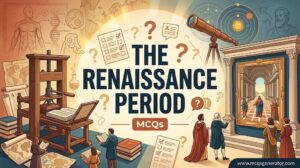
9. Who famously painted the ceiling of the Sistine Chapel?
Correct Answer: c) Michelangelo
Explanation:
Michelangelo painted the Sistine Chapel ceiling between 1508 and 1512, a cornerstone work of High Renaissance art.
10. Which explorer is credited with being the first to circumnavigate the globe, although he died during the journey?
Correct Answer: b) Ferdinand Magellan
Explanation:
Ferdinand Magellan organized the Spanish expedition to the East Indies from 1519 to 1522, which resulted in the first circumnavigation of the Earth.
11. The fall of Constantinople in 1453 marked the end of which empire?
Correct Answer: c) Byzantine Empire
Explanation:
Constantinople, the capital of the Byzantine Empire, fell to the invading Ottoman army led by Mehmed the Conqueror in 1453.
12. Who initiated the Protestant Reformation by nailing his Ninety-five Theses to a church door in 1517?
Correct Answer: c) Martin Luther
Explanation:
Martin Luther, a German monk, initiated the Protestant Reformation in 1517 by challenging the Catholic Church's practices.
13. What was the name of the ship that brought the Pilgrims to North America in 1620?
Correct Answer: b) Mayflower
Explanation:
The Mayflower was the English ship that transported a group of English families, known today as the Pilgrims, to the New World in 1620.
14. Which monarch ruled Great Britain during the American Revolution?
Correct Answer: b) King George III
Explanation:
King George III was the King of Great Britain and Ireland during the American Revolutionary War.
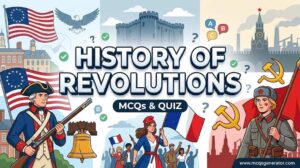
15. The French Revolution began in 1789 with the storming of which notorious prison?
Correct Answer: c) The Bastille
Explanation:
The Storming of the Bastille on July 14, 1789, was a flashpoint of the French Revolution, symbolizing the fall of the monarchy's absolute power.
16. Who was the principal author of the United States Declaration of Independence?
Correct Answer: d) Thomas Jefferson
Explanation:
Thomas Jefferson was the principal author of the Declaration of Independence, adopted by the Continental Congress on July 4, 1776.
17. In which battle was Napoleon Bonaparte finally defeated in 1815?
Correct Answer: c) Battle of Waterloo
Explanation:
Napoleon Bonaparte was decisively defeated at the Battle of Waterloo in Belgium on June 18, 1815, ending his rule as Emperor of the French.
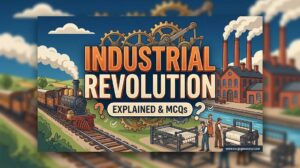
18. The Industrial Revolution began in which country?
Correct Answer: d) Great Britain
Explanation:
The Industrial Revolution originated in Great Britain in the mid-18th century before spreading to the rest of Europe and the Americas.
19. Who was the President of the United States during the American Civil War?
Correct Answer: b) Abraham Lincoln
Explanation:
Abraham Lincoln served as the 16th US President from 1861 until his assassination in 1865, leading the nation through the Civil War.
20. Which inventor is credited with developing the first practical telephone?
Correct Answer: b) Alexander Graham Bell
Explanation:
Alexander Graham Bell is credited with patenting the first practical telephone in 1876.
21. The assassination of Archduke Franz Ferdinand in 1914 triggered which global conflict?
Correct Answer: c) World War I
Explanation:
The assassination of Archduke Franz Ferdinand of Austria-Hungary in Sarajevo led to a chain of events that started World War I.
22. Who led the Bolshevik Revolution in Russia in 1917?
Correct Answer: c) Vladimir Lenin
Explanation:
Vladimir Lenin led the Bolsheviks to power in the October Revolution of 1917, establishing the world's first communist state.
23. Which treaty officially ended World War I between the Allied Powers and Germany?
Correct Answer: b) Treaty of Versailles
Explanation:
The Treaty of Versailles, signed in 1919, officially ended the state of war between Germany and the Allied Powers.
24. The stock market crash that initiated the Great Depression occurred in which year?
Correct Answer: c) 1929
Explanation:
The Wall Street Crash of October 1929 signaled the beginning of the Great Depression, the longest and most severe economic downturn of the 20th century.
25. Which country was invaded by Germany on September 1, 1939, sparking World War II?
Correct Answer: d) Poland
Explanation:
The German invasion of Poland on September 1, 1939, prompted Britain and France to declare war on Germany, starting WWII.
26. Who was the Prime Minister of the United Kingdom during most of World War II?
Correct Answer: b) Winston Churchill
Explanation:
Winston Churchill served as Prime Minister of the UK from 1940 to 1945, famously leading the country through the darkest days of WWII.
27. The United States entered World War II following the attack on which naval base?
Correct Answer: c) Pearl Harbor
Explanation:
The surprise Japanese attack on the US naval base at Pearl Harbor on December 7, 1941, led to the US entry into WWII.
28. The systemic, state-sponsored genocide of six million Jews by the Nazi regime is known as:
Correct Answer: b) The Holocaust
Explanation:
The Holocaust (or the Shoah) was the genocide of European Jews by Nazi Germany and its collaborators between 1941 and 1945.
29. Which two Japanese cities were the targets of atomic bombs dropped by the US in 1945?
Correct Answer: b) Hiroshima and Nagasaki
Explanation:
The United States dropped atomic bombs on the Japanese cities of Hiroshima (August 6) and Nagasaki (August 9) in 1945, forcing Japan's surrender.
30. The United Nations was established in what year, immediately following WWII?
Correct Answer: b) 1945
Explanation:
The United Nations was founded on October 24, 1945, to promote international cooperation and prevent future global conflicts.
31. The geopolitical tension between the Soviet Union and the United States after WWII was known as:
Correct Answer: b) The Cold War
Explanation:
The Cold War was a period of geopolitical tension between the US (and its allies) and the Soviet Union (and its satellite states) from roughly 1947 to 1991.
32. Who led the Indian independence movement against British rule using nonviolent civil disobedience?
Correct Answer: c) Mahatma Gandhi
Explanation:
Mahatma Gandhi was the primary leader of India's independence movement, utilizing nonviolent resistance to ultimately end British rule in 1947.
33. Mao Zedong was the founding father of which state established in 1949?
Correct Answer: b) People's Republic of China
Explanation:
Mao Zedong proclaimed the founding of the communist People's Republic of China on October 1, 1949, following the Chinese Civil War.
34. The Korean War began in 1950 when which event occurred?
Correct Answer: c) North Korea invaded South Korea
Explanation:
The Korean War started on June 25, 1950, when the North Korean People's Army crossed the 38th parallel to invade South Korea.
35. Who was the first human to journey into outer space?
Correct Answer: b) Yuri Gagarin
Explanation:
Soviet cosmonaut Yuri Gagarin became the first human in space when he orbited the Earth in the Vostok 1 spacecraft on April 12, 1961.
36. The 1962 crisis that brought the US and USSR to the brink of nuclear war was centered in which country?
Correct Answer: b) Cuba
Explanation:
The Cuban Missile Crisis of 1962 was a 13-day confrontation arising from the Soviet deployment of nuclear missiles in Cuba.
37. Which civil rights leader delivered the famous 'I Have a Dream' speech in 1963?
Correct Answer: c) Martin Luther King Jr.
Explanation:
Dr. Martin Luther King Jr. delivered his 'I Have a Dream' speech during the March on Washington for Jobs and Freedom on August 28, 1963.
38. The fall of the Berlin Wall, symbolizing the end of the Cold War, occurred in what year?
Correct Answer: b) 1989
Explanation:
The Berlin Wall fell on November 9, 1989, paving the way for German reunification and the collapse of Soviet communism.
39. Who was the first Black president of South Africa, elected in 1994 after the end of apartheid?
Correct Answer: d) Nelson Mandela
Explanation:
Nelson Mandela was elected president in South Africa's first fully representative democratic election in 1994, after spending 27 years in prison.
40. The Soviet Union was officially dissolved in which year?
Correct Answer: c) 1991
Explanation:
The Soviet Union was formally dissolved on December 26, 1991, resulting in 15 independent post-Soviet states.
41. What ancient civilization was located between the Tigris and Euphrates rivers?
Correct Answer: b) Mesopotamia
Explanation:
Mesopotamia, meaning 'land between the rivers' in Greek, is widely considered one of the cradles of civilization.
42. The Code of Hammurabi is one of the oldest deciphered writings of significant length. It originated in which empire?
Correct Answer: b) Babylonian
Explanation:
Hammurabi was the sixth king of the First Babylonian dynasty, known for his comprehensive legal code created around 1754 BC.
43. Which Macedonian king conquered the Persian Empire and spread Greek culture into Asia and Egypt?
Correct Answer: c) Alexander the Great
Explanation:
Alexander the Great built one of the largest empires of the ancient world by the age of 30, stretching from Greece to northwestern India.
44. The Colosseum, an iconic ancient amphitheater, was built during the reign of which Roman imperial dynasty?
Correct Answer: b) Flavian
Explanation:
The Colosseum, also known as the Flavian Amphitheatre, was built by Emperor Vespasian and completed by his son Titus, both of the Flavian dynasty.
45. Who crossed the Rubicon river in 49 BC, effectively ending the Roman Republic and sparking a civil war?
Correct Answer: c) Julius Caesar
Explanation:
Julius Caesar's crossing of the Rubicon with his army was an act of treason that sparked a Roman civil war, leading to his dictatorship.
46. Which emperor made Christianity a legal religion in the Roman Empire with the Edict of Milan in 313 AD?
Correct Answer: d) Constantine the Great
Explanation:
Constantine the Great issued the Edict of Milan, which decriminalized Christian worship in the Roman Empire.
47. The Mauryan Empire in ancient India reached its greatest territorial extent under which ruler?
Correct Answer: c) Ashoka
Explanation:
Ashoka the Great expanded the Mauryan Empire to cover most of the Indian subcontinent before converting to Buddhism and promoting peace.
48. Which Mesoamerican civilization is known for its highly accurate calendar and complex hieroglyphic writing system?
Correct Answer: c) Maya
Explanation:
The Maya civilization, located in present-day Mexico and Central America, is renowned for its advancements in astronomy, calendrics, and writing.
49. The Great Schism of 1054 resulted in the division of which major religion?
Correct Answer: c) Christianity
Explanation:
The East-West Schism of 1054 formalized the split between the Eastern Orthodox Church and the Roman Catholic Church.
50. The Crusades were a series of religious wars sanctioned by the Latin Church. What was their primary initial goal?
Correct Answer: b) To recover the Holy Land from Islamic rule
Explanation:
The First Crusade was launched in 1095 by Pope Urban II with the primary objective of recapturing Jerusalem and the Holy Land from Muslim control.
51. The Hundred Years' War was a prolonged conflict between which two European nations?
Correct Answer: b) England and France
Explanation:
The Hundred Years' War (1337-1453) was fought between the Kingdom of England and the Kingdom of France over control of the French throne.
52. Joan of Arc is a national heroine of which country for her role during the Lancastrian phase of the Hundred Years' War?
Correct Answer: c) France
Explanation:
Joan of Arc, a peasant girl, claimed divine guidance and led the French army to several important victories during the Hundred Years' War.
53. The city of Tenochtitlan was the capital of which pre-Columbian empire?
Correct Answer: d) Aztec Empire
Explanation:
Tenochtitlan, located on an island in Lake Texcoco (modern-day Mexico City), was the capital of the Aztec Empire until its fall in 1521.
54. Who was the Spanish conquistador that conquered the Inca Empire?
Correct Answer: b) Francisco Pizarro
Explanation:
Francisco Pizarro led the Spanish conquest of the Inca Empire in the 1530s, capturing the Inca emperor Atahualpa.
55. The printing press with movable metal type, which revolutionized the spread of information, was invented in Europe by whom?
Correct Answer: a) Johannes Gutenberg
Explanation:
Johannes Gutenberg, a German blacksmith, introduced printing to Europe with his mechanical movable-type printing press around 1440.
56. Which English monarch established the Church of England after breaking away from the authority of the Pope?
Correct Answer: c) King Henry VIII
Explanation:
Henry VIII initiated the English Reformation, separating the Church of England from papal authority, largely to annul his marriage to Catherine of Aragon.
57. The Spanish Armada was famously defeated by the English navy in what year?
Correct Answer: c) 1588
Explanation:
In 1588, the Spanish Armada, sent by King Philip II of Spain to overthrow Queen Elizabeth I, was defeated by the English and poor weather.
58. Which astronomer formulated the heliocentric model, placing the Sun at the center of the universe?
Correct Answer: b) Nicolaus Copernicus
Explanation:
Nicolaus Copernicus published 'De revolutionibus orbium coelestium' in 1543, proposing that the Earth and other planets revolve around the Sun.
59. The Taj Mahal was commissioned in 1632 by which Mughal emperor to house the tomb of his favorite wife?
Correct Answer: c) Shah Jahan
Explanation:
Mughal Emperor Shah Jahan commissioned the Taj Mahal in Agra, India, as a mausoleum for his beloved wife, Mumtaz Mahal.
60. The Thirty Years' War (1618-1648), one of the most destructive conflicts in European history, was ended by which treaty?
Correct Answer: b) Peace of Westphalia
Explanation:
The Peace of Westphalia in 1648 ended the Thirty Years' War and established the modern concept of sovereign statehood.
61. Who was the primary leader of the Haitian Revolution, which led to the first successful slave rebellion creating a free state?
Correct Answer: b) Toussaint Louverture
Explanation:
Toussaint Louverture was a former slave who became the preeminent leader of the Haitian Revolution against French colonial rule.
62. The Louisiana Purchase in 1803 involved the United States buying a vast territory from which country?
Correct Answer: c) France
Explanation:
The US acquired the Louisiana Territory from Napoleonic France in 1803, doubling the size of the country.
63. Which South American leader is known as 'El Libertador' for his role in leading several countries to independence from the Spanish Empire?
Correct Answer: c) Simon Bolivar
Explanation:
Simon Bolivar led the independence movements for present-day Venezuela, Colombia, Ecuador, Peru, and Bolivia.
64. The Opium Wars were fought in the mid-19th century between China's Qing dynasty and which Western power?
Correct Answer: c) Great Britain
Explanation:
The Opium Wars were fought primarily between Great Britain and China over British trade of opium and China's sovereignty.
65. Who wrote 'The Communist Manifesto' along with Friedrich Engels in 1848?
Correct Answer: c) Karl Marx
Explanation:
Karl Marx and Friedrich Engels published 'The Communist Manifesto' in 1848, laying the foundational theories of communism.
66. The Meiji Restoration of 1868 brought about the modernization and westernization of which country?
Correct Answer: c) Japan
Explanation:
The Meiji Restoration restored practical imperial rule to Japan under Emperor Meiji and spurred its rapid transformation into a modern industrial state.
67. The unification of Germany into the German Empire in 1871 was heavily orchestrated by which Prussian statesman?
Correct Answer: b) Otto von Bismarck
Explanation:
Otto von Bismarck, the Minister President of Prussia, used 'Blood and Iron' policies to unify the German states into a single empire in 1871.
68. The Scramble for Africa, which formalized European colonization of the continent, was regulated by which 1884 conference?
Correct Answer: c) Berlin Conference
Explanation:
The Berlin Conference of 1884-1885 regulated European colonization and trade in Africa during the New Imperialism period.
69. What was the name of the ship that sank in 1912 after hitting an iceberg on its maiden voyage?
Correct Answer: b) RMS Titanic
Explanation:
The RMS Titanic, a British passenger liner, sank in the North Atlantic Ocean on April 15, 1912, after striking an iceberg.
70. The Spanish Flu pandemic, one of the deadliest in history, occurred in the immediate aftermath of which event?
Correct Answer: b) World War I
Explanation:
The 1918 influenza pandemic, known as the Spanish Flu, spread rapidly globally in the closing months of and just after World War I.
71. Which political leader famously implemented the 'Five-Year Plans' to rapidly industrialize the Soviet Union?
Correct Answer: b) Joseph Stalin
Explanation:
Joseph Stalin introduced the First Five-Year Plan in 1928, aiming to rapidly industrialize the USSR and collectivize its agriculture.
72. The invasion of which territory by Japan in 1931 is often cited as an early precursor to World War II?
Correct Answer: a) Manchuria
Explanation:
The Japanese invasion of Manchuria in 1931 highlighted the weakness of the League of Nations and set Japan on an expansionist path.
73. During World War II, the D-Day landings on June 6, 1944, took place in which region of France?
Correct Answer: b) Normandy
Explanation:
The Allied invasion of Western Europe during WWII began with the Normandy landings (Operation Overlord) on June 6, 1944.
74. The Marshall Plan was an American initiative to aid the rebuilding of economies in which region after WWII?
Correct Answer: c) Western Europe
Explanation:
The Marshall Plan (1948) provided over $15 billion to help finance rebuilding efforts in Western Europe after World War II.
75. Which war was fought between 1955 and 1975, resulting in the communist takeover of the entire country?
Correct Answer: b) The Vietnam War
Explanation:
The Vietnam War ended in 1975 with the fall of Saigon to North Vietnamese forces, leading to a unified communist Vietnam.
76. The 'Space Race' saw the first artificial satellite launched into space in 1957. What was its name?
Correct Answer: c) Sputnik 1
Explanation:
Sputnik 1 was launched by the Soviet Union on October 4, 1957, becoming the first artificial Earth satellite.
77. Which scandal led to the resignation of US President Richard Nixon in 1974?
Correct Answer: c) Watergate
Explanation:
The Watergate scandal, involving a break-in at the Democratic National Committee headquarters and a subsequent cover-up, forced Nixon to resign in 1974.
78. The Iranian Revolution of 1979 resulted in the overthrow of which monarch?
Correct Answer: c) Mohammad Reza Pahlavi (The Shah)
Explanation:
The 1979 Iranian Revolution led to the overthrow of the Shah, Mohammad Reza Pahlavi, and the establishment of an Islamic republic under Ayatollah Khomeini.
79. Which Soviet leader introduced the policies of glasnost and perestroika in the 1980s?
Correct Answer: c) Mikhail Gorbachev
Explanation:
Mikhail Gorbachev introduced glasnost (openness) and perestroika (restructuring) to reform the Soviet system, which ultimately contributed to its collapse.
80. In 1994, a horrific genocide took place in which African country, resulting in the deaths of approximately 800,000 Tutsis and moderate Hutus?
Correct Answer: b) Rwanda
Explanation:
The Rwandan genocide occurred in 1994 when extremist Hutus slaughtered an estimated 800,000 ethnic Tutsis and moderate Hutus in about 100 days.
81. The September 11 attacks in 2001 were orchestrated by which terrorist organization?
Correct Answer: b) Al-Qaeda
Explanation:
The September 11 attacks were coordinated by Al-Qaeda, a militant Islamist network led by Osama bin Laden.
82. The ancient city of Petra, known for its rock-cut architecture, is located in which modern-day country?
Correct Answer: c) Jordan
Explanation:
Petra is a historical and archaeological city in southern Jordan, originally the capital of the Nabataean Kingdom.
83. What was the capital of the Byzantine Empire?
Correct Answer: c) Constantinople
Explanation:
Constantinople (modern-day Istanbul) served as the capital of the Byzantine Empire for over a thousand years.
84. The Domesday Book was a comprehensive survey of England commissioned in 1085 by which monarch?
Correct Answer: c) William the Conqueror
Explanation:
Following the Norman Conquest of 1066, William the Conqueror commissioned the Domesday Book to assess the land and resources of England for taxation.
85. Which civilization built the ancient city of Machu Picchu?
Correct Answer: c) Inca
Explanation:
Machu Picchu is a 15th-century Inca citadel set high in the Andes Mountains in Peru.
86. The Treaty of Tordesillas (1494) divided the newly discovered lands outside Europe between which two empires?
Correct Answer: a) Spain and Portugal
Explanation:
The Pope-mediated Treaty of Tordesillas divided the non-European world into Spanish and Portuguese spheres of influence.
87. Who was the English king during the English Civil War that was tried and executed in 1649?
Correct Answer: b) Charles I
Explanation:
King Charles I was executed for high treason in 1649 after losing the English Civil War to Parliamentarian forces.
88. Which French King was known as the 'Sun King' and built the Palace of Versailles?
Correct Answer: b) Louis XIV
Explanation:
Louis XIV, known as the Sun King, ruled France for 72 years and centralized power around his court at Versailles.
89. The 'Boston Tea Party' of 1773 was a protest against the policies of which organization?
Correct Answer: c) The British East India Company
Explanation:
American colonists protested the Tea Act of 1773, which gave the British East India Company a monopoly on tea sales in the colonies.
90. Maximilien Robespierre was a prominent figure during which phase of the French Revolution?
Correct Answer: c) The Reign of Terror
Explanation:
Robespierre was a leading member of the Committee of Public Safety, which oversaw the bloody Reign of Terror from 1793 to 1794.
91. The Monroe Doctrine, articulated in 1823, stated that the United States would oppose:
Correct Answer: b) European colonialism in the Americas
Explanation:
The Monroe Doctrine warned European nations that the US would not tolerate further colonization or puppet monarchs in the Western Hemisphere.
92. In 1853, Commodore Matthew Perry arrived with a fleet to open trade with which isolationist country?
Correct Answer: c) Japan
Explanation:
US Commodore Matthew Perry led naval ships into Tokyo Harbor to force Japan to end its policy of isolation and open to Western trade.
93. The Crimean War (1853-1856) primarily pitted the Russian Empire against an alliance that included Britain, France, and which other empire?
Correct Answer: b) The Ottoman Empire
Explanation:
The Crimean War was fought by Russia against an alliance of the Ottoman Empire, France, Britain, and Sardinia, largely to check Russian expansion.
94. The Emancipation Proclamation, which declared slaves in Confederate territory free, was issued in what year?
Correct Answer: b) 1863
Explanation:
President Abraham Lincoln issued the Emancipation Proclamation on January 1, 1863, during the American Civil War.
95. Who was the Queen of the United Kingdom and Empress of India for most of the 19th century?
Correct Answer: c) Queen Victoria
Explanation:
Queen Victoria ruled from 1837 to 1901, an era of vast British industrial and imperial expansion known as the Victorian Era.
96. The completion of the Suez Canal in 1869 connected the Mediterranean Sea to which other body of water?
Correct Answer: c) Red Sea
Explanation:
The Suez Canal in Egypt provides a direct shipping route between the Mediterranean Sea and the Red Sea, significantly reducing travel time to Asia.
97. The Boxer Rebellion (1899-1901) was an anti-foreign and anti-imperialist uprising in which country?
Correct Answer: c) China
Explanation:
The Boxer Rebellion took place in China, aiming to drive out foreign influence, but was ultimately suppressed by an eight-nation alliance.
98. Which event is considered the immediate cause of the 1905 Russian Revolution?
Correct Answer: b) Bloody Sunday
Explanation:
On 'Bloody Sunday' in January 1905, unarmed demonstrators in St. Petersburg were fired upon by the Imperial Guard, triggering a wave of strikes and mutinies.
99. The Zimmerman Telegram, which helped draw the US into WWI, was a proposed alliance between Germany and which country?
Correct Answer: c) Mexico
Explanation:
The 1917 Zimmerman Telegram proposed a military alliance between Germany and Mexico if the US entered WWI against Germany.
100. The League of Nations was founded after WWI as part of which treaty?
Correct Answer: b) Treaty of Versailles
Explanation:
The League of Nations, the first worldwide intergovernmental organization for peace, was founded in 1920 as a result of the Paris Peace Conference and the Treaty of Versailles.
101. In 1922, Benito Mussolini became the Prime Minister of Italy after leading which event?
Correct Answer: a) The March on Rome
Explanation:
Mussolini's fascist Blackshirts marched on Rome in October 1922, leading King Victor Emmanuel III to appoint him Prime Minister.
102. The Spanish Civil War (1936-1939) ended with a victory for which Nationalist general?
Correct Answer: b) Francisco Franco
Explanation:
General Francisco Franco led the Nationalist forces to victory against the Republicans in the Spanish Civil War, establishing a dictatorship.
103. Which battle is widely considered the turning point of WWII on the Eastern Front?
Correct Answer: c) Battle of Stalingrad
Explanation:
The Battle of Stalingrad (1942-1943) resulted in a catastrophic defeat for Nazi Germany and stopped the German advance into the Soviet Union.
104. The Bretton Woods Conference in 1944 led to the creation of which two international institutions?
Correct Answer: b) The IMF and the World Bank
Explanation:
The Bretton Woods Conference established the International Monetary Fund (IMF) and the International Bank for Reconstruction and Development (which became the World Bank).
105. The NATO alliance was formed in 1949 primarily to counter the threat of which country?
Correct Answer: c) The Soviet Union
Explanation:
The North Atlantic Treaty Organization (NATO) was established by the US, Canada, and Western European nations to provide collective security against the Soviet Union.
106. The partition of India in 1947 resulted in the creation of India and which other independent nation?
Correct Answer: c) Pakistan
Explanation:
The British Indian Empire was partitioned in 1947 into two independent dominions: the Hindu-majority Union of India and the Muslim-majority Dominion of Pakistan.
107. Who was the leader of the Cuban Revolution that overthrew Fulgencio Batista in 1959?
Correct Answer: b) Fidel Castro
Explanation:
Fidel Castro led the 26th of July Movement, which ousted US-backed dictator Fulgencio Batista in 1959, establishing a communist state.
108. The Cultural Revolution, a sociopolitical movement that caused massive upheaval in China, was initiated by whom?
Correct Answer: c) Mao Zedong
Explanation:
Mao Zedong launched the Cultural Revolution in 1966 to reassert his authority and purge capitalist and traditional elements from Chinese society.
109. Which 1978 agreement brokered by US President Jimmy Carter led to a peace treaty between Egypt and Israel?
Correct Answer: c) Camp David Accords
Explanation:
The Camp David Accords were signed by Egyptian President Anwar Sadat and Israeli Prime Minister Menachem Begin, leading to a 1979 peace treaty.
110. The Chernobyl disaster, the worst nuclear accident in history, occurred in 1986 in which Soviet republic?
Correct Answer: c) Ukraine
Explanation:
The Chernobyl nuclear power plant is located near the city of Pripyat in the north of the Ukrainian SSR.
111. The Maastricht Treaty, signed in 1992, officially created which international organization?
Correct Answer: b) The European Union
Explanation:
The Maastricht Treaty established the European Union, introducing European citizenship and paving the way for the Euro currency.