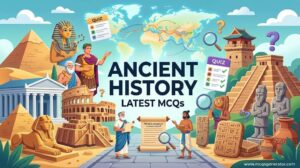
The ancient history timeline charts humanity’s monumental transition from nomadic prehistory and the invention of writing (c. 3000 BCE) to the fall of the Western Roman Empire in 476 CE. Spanning over three millennia, this chronological arc captures the rise of fertile river valley civilizations in Mesopotamia and Egypt, the classical intellectual peaks of Greece and Rome, and the grand dynastic expansions of ancient China and India. Mastering this historical sequence provides crucial structural perspective on how ancient societies evolved, interacted, and laid the permanent foundation for the modern world.
1. Which ancient civilization is credited with inventing cuneiform, one of the earliest known systems of writing, around 3200 BCE?
Correct Answer: b) Sumerians
Explanation:
The Sumerians in Mesopotamia developed cuneiform writing around 3200 BCE, using wedge-shaped marks on clay tablets.
2. Around 3100 BCE, which pharaoh is traditionally credited with uniting Upper and Lower Egypt?
Correct Answer: c) Narmer
Explanation:
Narmer (also identified with Menes) is widely credited by historians with uniting Upper and Lower Egypt into a single kingdom.
3. Which of the following was a major city of the ancient Indus Valley Civilization?
Correct Answer: b) Mohenjo-Daro
Explanation:
Mohenjo-Daro, built around 2500 BCE, was one of the largest and most advanced settlements of the Indus Valley Civilization.
4. The Great Pyramid of Giza was constructed as a tomb for which Old Kingdom pharaoh?
Correct Answer: c) Khufu
Explanation:
The Great Pyramid, built around 2560 BCE, was constructed as a tomb for the Fourth Dynasty Egyptian pharaoh Khufu.
5. Who created the first known empire in history, the Akkadian Empire, around 2334 BCE?
Correct Answer: b) Sargon the Great
Explanation:
Sargon of Akkad united the Sumerian and Akkadian speakers of Mesopotamia under a single empire around 2334 BCE.
6. The Code of Hammurabi, one of the oldest deciphered writings of significant length, was created by the king of which empire?
Correct Answer: a) Babylonian
Explanation:
Hammurabi was the sixth king of the First Babylonian Dynasty, reigning from 1792 to 1750 BCE, and is famous for his legal code.
7. Which was the first historically confirmed dynasty of ancient China, ruling the Yellow River valley?
Correct Answer: b) Shang
Explanation:
While the Xia is considered the first in myth, the Shang Dynasty (c. 1600-1046 BCE) is the first supported by extensive archaeological evidence.
8. The Minoan civilization, a Bronze Age culture centered on the island of Crete, is famous for which palatial complex?
Correct Answer: c) Knossos
Explanation:
Knossos was the largest Bronze Age archaeological site on Crete and is considered Europe's oldest city and the center of Minoan culture.
9. Which ancient civilization dominated mainland Greece during the late Bronze Age (c. 1600-1100 BCE)?
Correct Answer: b) Mycenaeans
Explanation:
The Mycenaean civilization was the first advanced civilization in mainland Greece, known for its palatial states and warrior culture.
10. Which female pharaoh ruled Egypt during the 18th Dynasty and is known for a major trading expedition to the Land of Punt?
Correct Answer: c) Hatshepsut
Explanation:
Hatshepsut reigned as pharaoh in the New Kingdom and re-established trade networks that had been disrupted, most notably to Punt.
11. Which Egyptian pharaoh introduced a monotheistic-style religion centered on the sun disk, Aten?
Correct Answer: c) Akhenaten
Explanation:
Akhenaten (formerly Amenhotep IV) famously abandoned traditional Egyptian polytheism to worship the Aten.
12. Whose nearly intact tomb was discovered in the Valley of the Kings by Howard Carter in 1922?
Correct Answer: c) Tutankhamun
Explanation:
The tomb of the boy-king Tutankhamun (KV62) was discovered by Howard Carter, providing unprecedented insight into royal Egyptian burials.
13. The Battle of Kadesh (c. 1274 BCE) was fought between the Egyptian Empire under Ramses II and which other major power?
Correct Answer: b) The Hittite Empire
Explanation:
The Battle of Kadesh is one of the earliest battles in recorded history where details of tactics and formations are known, fought between Egypt and the Hittites.
14. The sudden collapse of multiple Eastern Mediterranean civilizations around 1200 BCE is generally known as what?
Correct Answer: c) The Late Bronze Age Collapse
Explanation:
The Late Bronze Age collapse was a period of widespread societal collapse, bringing down the Hittites, Mycenaeans, and weakening Egypt.
15. Which Mesoamerican civilization, known for colossal head sculptures, began to flourish around 1200 BCE?
Correct Answer: d) Olmec
Explanation:
The Olmec civilization is often considered the 'mother culture' of Mesoamerica, famous for their giant carved stone heads.
16. The historical era following the Bronze Age, characterized by the widespread use of a new metal for tools and weapons, is called the:
Correct Answer: b) Iron Age
Explanation:
The Iron Age followed the Bronze Age, marked by the prevalent use of iron or steel for tools and weapons, starting around 1200 BCE in the Near East.
17. According to biblical tradition, who succeeded King David and built the First Temple in Jerusalem?
Correct Answer: c) Solomon
Explanation:
King Solomon, the son of David, is credited with constructing the First Temple in Jerusalem in the 10th century BCE.
18. Which ancient seafaring people are credited with creating the first phonetic alphabet, which later influenced the Greek and Latin alphabets?
Correct Answer: b) Phoenicians
Explanation:
The Phoenicians developed a 22-letter phonetic alphabet around 1050 BCE that became the ancestor of most modern alphabets.
19. The powerful city-state of Carthage was founded in the 9th century BCE by colonists from which civilization?
Correct Answer: c) Phoenicians
Explanation:
Carthage was founded by Phoenician colonists from Tyre, located in modern-day Lebanon.
20. In what year were the first recorded ancient Olympic Games held in Greece?
Correct Answer: a) 776 BCE
Explanation:
The first traditionally dated Olympic Games were held in 776 BCE in Olympia, Greece, dedicated to Zeus.
21. According to Roman tradition, in what year was the city of Rome founded by Romulus?
Correct Answer: a) 753 BCE
Explanation:
According to tradition and the Roman historian Livy, Rome was founded on April 21, 753 BCE.
22. Which ancient Greek poet is traditionally credited with composing the epic poems the Iliad and the Odyssey?
Correct Answer: c) Homer
Explanation:
Homer is the legendary author of the Iliad and the Odyssey, the foundational works of ancient Greek literature.
23. Under which king did the Neo-Assyrian Empire reach its greatest territorial extent in the 7th century BCE?
Correct Answer: b) Ashurbanipal
Explanation:
Ashurbanipal was the last strong king of the Neo-Assyrian Empire, ruling it at its peak and assembling the Library of Ashurbanipal.
24. Who founded the Achaemenid Empire in 550 BCE, the first Persian Empire?
Correct Answer: c) Cyrus the Great
Explanation:
Cyrus the Great founded the Achaemenid Empire by conquering the Median, Lydian, and Neo-Babylonian empires.
25. The decree of Cyrus the Great in 539 BCE allowed the Jews to return to Jerusalem, ending which historical period?
Correct Answer: b) The Babylonian Captivity
Explanation:
Cyrus conquered Babylon and subsequently issued a decree allowing the exiled Jews to return to Judah.
26. Which Athenian leader is often referred to as 'the father of Athenian democracy' for his reforms in 508 BCE?
Correct Answer: b) Cleisthenes
Explanation:
Cleisthenes reorganized Athenian society into demes and established the foundation for democratic government in Athens.
27. The Roman Republic was established around 509 BCE following the overthrow of which last Roman king?
Correct Answer: c) Lucius Tarquinius Superbus
Explanation:
Tarquin the Proud (Superbus) was the seventh and final king of Rome before the Republic was established.
28. At which 490 BCE battle did a smaller Athenian army successfully defeat the first Persian invasion of Greece?
Correct Answer: d) Battle of Marathon
Explanation:
The Battle of Marathon was a decisive victory for the Greeks over the Persians, halting King Darius I's invasion.
29. King Leonidas of Sparta famously led a small Greek force against the massive Persian army of Xerxes at which 480 BCE battle?
Correct Answer: b) Battle of Thermopylae
Explanation:
At the Battle of Thermopylae, Leonidas and 300 Spartans (along with other Greeks) held the narrow pass against the Persian army.
30. Which naval battle in 480 BCE effectively ended the threat of Persian naval dominance in Greece?
Correct Answer: a) Battle of Salamis
Explanation:
The Battle of Salamis was a decisive naval victory for the allied Greek city-states under Themistocles against the Persian fleet.
31. Who was the prominent and influential Greek statesman, orator, and general during the Golden Age of Athens?
Correct Answer: c) Pericles
Explanation:
Pericles oversaw a golden age of Athenian art, literature, and democracy, and commissioned the Parthenon.
32. The devastating Peloponnesian War (431–404 BCE) was primarily fought between which two Greek city-states?
Correct Answer: b) Athens and Sparta
Explanation:
The Peloponnesian War reshaped the ancient Greek world, pitting the Delian League (Athens) against the Peloponnesian League (Sparta).
33. Which ancient Greek philosopher was sentenced to death in 399 BCE by drinking hemlock?
Correct Answer: d) Socrates
Explanation:
Socrates was convicted by an Athenian jury of 'corrupting the youth' and 'impiety' and sentenced to death by drinking poison hemlock.
34. Who was the King of Macedon that unified Greece and laid the groundwork for his son's conquests?
Correct Answer: a) Philip II
Explanation:
Philip II of Macedon reformed the Macedonian army and conquered most of the Greek city-states, setting the stage for his son, Alexander the Great.
35. In 334 BCE, Alexander the Great began his massive campaign against which empire?
Correct Answer: c) The Achaemenid Persian Empire
Explanation:
Alexander crossed the Hellespont in 334 BCE to begin his invasion of the Achaemenid Persian Empire, then ruled by Darius III.
36. At which decisive battle in 331 BCE did Alexander the Great effectively destroy the Persian army?
Correct Answer: d) Battle of Gaugamela
Explanation:
The Battle of Gaugamela was the final, decisive confrontation between Alexander and Darius III, leading to the fall of the Persian Empire.
37. In what year did Alexander the Great die in Babylon at the age of 32?
Correct Answer: b) 323 BCE
Explanation:
Alexander the Great died in 323 BCE. His sudden death led to the division of his empire among his generals (the Diadochi).
38. The death of Alexander the Great marks the traditional beginning of which historical period?
Correct Answer: c) The Hellenistic Period
Explanation:
The Hellenistic Period began with Alexander's death in 323 BCE and saw the spread of Greek culture across the Mediterranean and Near East.
39. Who founded the Maurya Empire in ancient India around 322 BCE?
Correct Answer: b) Chandragupta Maurya
Explanation:
Chandragupta Maurya overthrew the Nanda Dynasty and established the Maurya Empire, the first empire to unify most of the Indian subcontinent.
40. Which Mauryan emperor famously converted to Buddhism and propagated peace after the bloody Kalinga War?
Correct Answer: d) Ashoka the Great
Explanation:
Ashoka the Great embraced Buddhism after witnessing the mass deaths of the Kalinga War and erected pillars spreading his edicts of Dhamma.
41. The First Punic War (264–241 BCE) was fought primarily over the control of which island?
Correct Answer: c) Sicily
Explanation:
The First Punic War was fought between Rome and Carthage, largely as a naval conflict for supremacy and control over the strategic island of Sicily.
42. Who was the first Emperor of a unified China, establishing the Qin Dynasty in 221 BCE?
Correct Answer: b) Qin Shi Huang
Explanation:
Qin Shi Huang conquered all the Warring States and unified China in 221 BCE, becoming the first Emperor and initiating the Great Wall.
43. Which Carthaginian general famously crossed the Alps with war elephants during the Second Punic War?
Correct Answer: c) Hannibal Barca
Explanation:
Hannibal Barca led an audacious march across the Alps into Italy in 218 BCE, inflicting massive defeats on the Roman army.
44. At which battle in 202 BCE did Scipio Africanus finally defeat Hannibal, effectively ending the Second Punic War?
Correct Answer: c) Battle of Zama
Explanation:
The Battle of Zama saw Roman forces under Scipio Africanus defeat Hannibal's army near Carthage, ending the Second Punic War.
45. In 146 BCE, Rome destroyed the city of Carthage, concluding the Third Punic War. In the same year, they also destroyed which major Greek city?
Correct Answer: c) Corinth
Explanation:
In 146 BCE, Rome simultaneously destroyed Carthage (ending the Punic Wars) and Corinth (cementing Roman control over Greece).
46. Which Chinese dynasty followed the short-lived Qin Dynasty and ruled for over 400 years, often considered a golden age?
Correct Answer: a) Han Dynasty
Explanation:
The Han Dynasty (202 BCE – 220 CE) followed the Qin and established the cultural and political norms for imperial China for millennia.
47. In the late 2nd century BCE, which two Roman brothers attempted popular land reforms but were assassinated by conservative senators?
Correct Answer: b) The Gracchi Brothers
Explanation:
Tiberius and Gaius Gracchus (the Gracchi) sought to redistribute land to the poor but met violent ends, signaling the beginning of the Republic's fall.
48. Who led a massive slave uprising against the Roman Republic from 73 to 71 BCE, known as the Third Servile War?
Correct Answer: b) Spartacus
Explanation:
Spartacus, a Thracian gladiator, led tens of thousands of escaped slaves in a major rebellion against the Roman Republic.
49. The First Triumvirate, an informal political alliance in late Republican Rome, consisted of Julius Caesar, Pompey the Great, and who else?
Correct Answer: c) Crassus
Explanation:
Marcus Licinius Crassus, the wealthiest man in Rome, formed the First Triumvirate with Caesar and Pompey in 60 BCE.
50. In 49 BCE, Julius Caesar ignited the Great Roman Civil War by famously crossing which river with his army?
Correct Answer: c) The Rubicon
Explanation:
By crossing the Rubicon river in northern Italy, Caesar broke Roman law, famously declaring 'alea iacta est' (the die is cast).
51. On what date was Julius Caesar assassinated in the Theatre of Pompey by a group of rebellious senators?
Correct Answer: a) March 15, 44 BCE
Explanation:
Caesar was murdered on the Ides of March (March 15) in 44 BCE by senators calling themselves the Liberatores, led by Brutus and Cassius.
52. Which decisive 31 BCE naval battle saw Octavian's forces defeat the combined fleets of Mark Antony and Cleopatra?
Correct Answer: b) Battle of Actium
Explanation:
The Battle of Actium resulted in the final defeat of Mark Antony and Cleopatra, leaving Octavian as the sole master of the Roman world.
53. In 27 BCE, the Roman Senate granted Octavian a new title, marking the effective end of the Republic. What was this title?
Correct Answer: b) Augustus
Explanation:
Octavian was granted the title 'Augustus' (the revered one) in 27 BCE, becoming the first Roman Emperor.
54. What is the term for the approximately 200-year period of relative peace and stability across the Roman Empire starting with Augustus?
Correct Answer: a) Pax Romana
Explanation:
The Pax Romana (Roman Peace) was a long period of peacefulness and minimal expansion by Roman military force spanning from 27 BCE to 180 CE.
55. During the reign of which Roman Emperor was Jesus of Nazareth crucified in Judea (c. 30-33 CE)?
Correct Answer: b) Tiberius
Explanation:
Jesus was crucified in Jerusalem under the authority of Pontius Pilate during the reign of the Emperor Tiberius.
56. In 60-61 CE, which Queen of the Iceni tribe led a major revolt against Roman rule in Britain?
Correct Answer: c) Boudica
Explanation:
Boudica led an uprising of British tribes against the Roman Empire, successfully destroying Camulodunum, Londinium, and Verulamium before being defeated.
57. The Roman civil war known as the 'Year of the Four Emperors' took place in which year?
Correct Answer: b) 69 CE
Explanation:
After Nero's suicide in 68 CE, Rome saw a year of civil war in 69 CE where Galba, Otho, Vitellius, and finally Vespasian held power.
58. In 70 CE, Roman legions led by the future emperor Titus captured Jerusalem and destroyed what major structure?
Correct Answer: b) The Second Temple
Explanation:
During the First Jewish-Roman War, Titus successfully besieged Jerusalem and destroyed the Second Temple in 70 CE.
59. Which Roman emperor was in power during the eruption of Mount Vesuvius in 79 CE that destroyed Pompeii and Herculaneum?
Correct Answer: c) Titus
Explanation:
Titus had just become emperor two months before the catastrophic eruption of Mount Vesuvius in 79 CE.
60. The Flavian Amphitheatre, better known as the Colosseum, was completed in 80 CE under which emperor?
Correct Answer: b) Titus
Explanation:
Construction was started under Vespasian but the Colosseum was completed and inaugurated with 100 days of games under his son, Titus.
61. Under which emperor (r. 98–117 CE) did the Roman Empire reach its greatest territorial extent?
Correct Answer: c) Trajan
Explanation:
Trajan was a successful soldier-emperor who presided over the greatest military expansion in Roman history, annexing Dacia, Arabia Petraea, and Mesopotamia.
62. Which Roman emperor ordered the construction of a 73-mile wall across northern Britain in 122 CE?
Correct Answer: b) Hadrian
Explanation:
Hadrian visited Britain in 122 CE and ordered the construction of Hadrian's Wall to secure the province's northern frontier.
63. The devastating pandemic that struck the Roman Empire from 165 to 180 CE, brought back by troops from the Near East, is known as the:
Correct Answer: b) Antonine Plague
Explanation:
The Antonine Plague, likely smallpox or measles, devastated the Roman population and army during the reign of Marcus Aurelius (of the Antonine dynasty).
64. The period from 235 to 284 CE, characterized by civil war, economic collapse, and barbarian invasions, is known as the:
Correct Answer: a) Crisis of the Third Century
Explanation:
During this 50-year period, the Empire nearly collapsed under the combined pressures of invasion, civil war, plague, and economic depression.
65. Which empire, founded by Ardashir I in 224 CE, succeeded the Parthians as the major rival to Rome in the East?
Correct Answer: c) The Sassanid Empire
Explanation:
The Sassanid (or Sasanian) Empire was the last pre-Islamic Persian empire, serving as a superpower alongside Rome and Byzantium.
66. Which Roman emperor ended the Crisis of the Third Century by establishing the Tetrarchy (rule of four) in 293 CE?
Correct Answer: b) Diocletian
Explanation:
Diocletian realized the empire was too large for one man to rule and divided it into East and West, each ruled by an Augustus and a Caesar.
67. Who became the sole Roman Emperor in 324 CE and is known for being the first Christian Roman Emperor?
Correct Answer: b) Constantine the Great
Explanation:
Constantine reunited the empire, legalized Christianity, and founded a new eastern capital at Byzantium.
68. At which 312 CE battle did Constantine reportedly see a vision of the Christian cross in the sky, leading to his conversion?
Correct Answer: a) Battle of the Milvian Bridge
Explanation:
Before the Battle of the Milvian Bridge against Maxentius, Constantine is said to have seen a vision ('In this sign, conquer'), prompting him to adopt Christian symbols.
69. The Edict of Milan, which officially granted religious tolerance to Christianity within the Roman Empire, was issued in what year?
Correct Answer: a) 313 CE
Explanation:
In 313 CE, Constantine and Licinius issued the Edict of Milan, ending state-sanctioned persecution of Christians.
70. Which major church council, convened by Constantine in 325 CE, established the Nicene Creed and addressed the Arian controversy?
Correct Answer: c) First Council of Nicaea
Explanation:
The First Council of Nicaea was the first ecumenical council of the Christian church, convened to establish theological consensus.
71. In 330 CE, Constantine dedicated the new eastern capital of the Roman Empire, which was later named after him. What was its original name?
Correct Answer: c) Byzantium
Explanation:
Constantine built his 'New Rome' on the site of the ancient Greek city of Byzantium, which later became known as Constantinople.
72. Which Roman emperor (r. 361–363 CE) famously attempted to reject Christianity and revive traditional Roman paganism?
Correct Answer: b) Julian the Apostate
Explanation:
Julian was the last non-Christian emperor of Rome, earning the nickname 'the Apostate' for his efforts to restore traditional Roman religion.
73. In 378 CE, the Roman army suffered a catastrophic defeat by Gothic rebels, resulting in the death of Emperor Valens, at which battle?
Correct Answer: b) Battle of Adrianople
Explanation:
The Battle of Adrianople was a devastating defeat for the Eastern Roman Empire against the Goths, often seen as the beginning of the end for the Western Empire.
74. Which emperor made Nicene Christianity the official state religion of the Roman Empire in 380 CE?
Correct Answer: b) Theodosius I
Explanation:
Theodosius I issued the Edict of Thessalonica in 380 CE, making Nicene Christianity the sole authorized religion of the empire.
75. Upon the death of Theodosius I in 395 CE, what permanent change occurred to the Roman Empire?
Correct Answer: b) It was formally divided into East and West between his two sons
Explanation:
Theodosius was the last emperor to rule both halves of the empire. Upon his death, it was split permanently between his sons Arcadius (East) and Honorius (West).
76. In 410 CE, the city of Rome was sacked for the first time in 800 years by which group led by Alaric?
Correct Answer: c) Visigoths
Explanation:
Alaric led the Visigoths in the Sack of Rome in 410 CE, a massive psychological blow to the empire.
77. Known as the 'Scourge of God,' which leader of the Huns repeatedly invaded the Roman Empire in the mid-5th century?
Correct Answer: c) Attila
Explanation:
Attila the Hun ruled a vast empire from 434 to 453 CE and was one of the most feared enemies of both the Western and Eastern Roman Empires.
78. A combined Roman-Visigothic army halted the advance of Attila the Hun at which 451 CE battle in Gaul?
Correct Answer: a) Battle of Chalons (Catalaunian Plains)
Explanation:
The Roman general Aetius and Visigothic king Theodoric I allied to defeat Attila at the Battle of the Catalaunian Plains in modern-day France.
79. Which Germanic tribe, who had established a kingdom in North Africa, brutally sacked Rome in 455 CE?
Correct Answer: b) The Vandals
Explanation:
Under King Genseric, the Vandals sailed from North Africa and sacked Rome for 14 days in 455 CE (hence the term 'vandalism').
80. In what year is the Western Roman Empire traditionally considered to have fallen, when Romulus Augustulus was deposed?
Correct Answer: c) 476 CE
Explanation:
In 476 CE, the Germanic chieftain Odoacer deposed the last Western Roman Emperor, Romulus Augustulus, marking the traditional end of the Western Empire.
81. Which king united the Frankish tribes under one ruler around 509 CE and became the first Catholic king of the Franks?
Correct Answer: c) Clovis I
Explanation:
Clovis I founded the Merovingian dynasty, united the Franks, and converted to Catholic Christianity, profoundly shaping post-Roman Europe.
82. Which Byzantine Emperor (r. 527–565 CE) attempted to reconquer the lost western half of the historical Roman Empire?
Correct Answer: c) Justinian I
Explanation:
Justinian I launched ambitious campaigns under generals like Belisarius to reclaim North Africa, Italy, and parts of Spain for the empire.
83. What massive riot broke out in Constantinople in 532 CE, nearly overthrowing Emperor Justinian?
Correct Answer: a) The Nika Riots
Explanation:
The Nika Riots were sparked by chariot racing factions (Blues and Greens) and resulted in the destruction of much of Constantinople before being violently suppressed.
84. Following the Nika Riots, Justinian rebuilt a magnificent church in Constantinople, which stood as the world's largest cathedral for nearly a thousand years. What is its name?
Correct Answer: c) Hagia Sophia
Explanation:
The Hagia Sophia ('Holy Wisdom') was completed in 537 CE and was an architectural marvel of the Byzantine Empire.
85. The Classic Period of which Mesoamerican civilization, known for advanced mathematics and astronomy, roughly spans 250 to 900 CE?
Correct Answer: c) Maya
Explanation:
The Classic Period of Maya civilization saw the peak of large scale construction and urbanism, the recording of monumental inscriptions, and significant intellectual development.
86. Which ancient Mesoamerican city, known for the Pyramid of the Sun, reached its peak around 450 CE and was the largest city in the pre-Columbian Americas?
Correct Answer: d) Teotihuacan
Explanation:
Teotihuacan, located near modern-day Mexico City, was a massive metropolis whose influence extended throughout Mesoamerica.
87. The period from roughly 319 to 467 CE in India, characterized by extensive inventions and discoveries in science, technology, engineering, art, and literature, is called the Golden Age of India under which empire?
Correct Answer: b) Gupta Empire
Explanation:
The Gupta Empire provided a period of peace and prosperity that fostered a 'Golden Age' of classical Indian culture.
88. Who was the leading mathematician and astronomer of the classical age of Indian mathematics, active in the 5th century CE?
Correct Answer: c) Aryabhata
Explanation:
Aryabhata (476–550 CE) produced seminal works in mathematics and astronomy, including the concept of zero as a number and approximating pi.
89. Following the fall of the Han Dynasty in 220 CE, China entered a bloody era of division known as the:
Correct Answer: c) Three Kingdoms Period
Explanation:
The Three Kingdoms period (Wei, Shu, and Wu) followed the collapse of the Han Dynasty, immortalized in Chinese literature and history.
90. Which Chinese dynasty briefly reunited the nation in 280 CE after the Three Kingdoms period before fracturing again?
Correct Answer: b) Jin Dynasty
Explanation:
The Jin Dynasty briefly unified China after conquering Eastern Wu, though it soon lost control of northern China to nomadic uprisings.
91. Which ancient kingdom in modern-day Ethiopia and Eritrea became a major trading power and adopted Christianity under King Ezana in the 4th century CE?
Correct Answer: c) Axum (Aksum)
Explanation:
The Axumite Empire was a powerful trading nation in East Africa that converted to Christianity around 325 CE.
92. Around 300 CE, Japan transitioned from the Yayoi period into a new era characterized by large, keyhole-shaped burial mounds. What is this period called?
Correct Answer: b) Kofun period
Explanation:
The Kofun period (c. 300–538 CE) is named after the large kofun (megalithic tombs or tumuli) built during this era of state formation in Japan.
93. During the Han Dynasty around 105 CE, a court official named Cai Lun is traditionally credited with the invention of:
Correct Answer: c) Papermaking
Explanation:
Cai Lun is widely regarded as the inventor of the modern papermaking process using mulberry bark, rags, and hemp.
94. Which vast network of trade routes was established during the Han Dynasty (from 130 BCE), connecting China to the Mediterranean?
Correct Answer: d) The Silk Road
Explanation:
The Silk Road was an ancient network of trade routes formally established during the Han Dynasty by Zhang Qian's expeditions.
95. The ancient city of Petra, famous for its rock-cut architecture, was the capital of which nomadic Arab people?
Correct Answer: b) Nabataeans
Explanation:
Petra was the political and economic center of the Nabataean Kingdom, flourishing in the 1st century BCE to 1st century CE.
96. Which historic artifact, carved in 196 BCE and later found in 1799, proved crucial in deciphering Egyptian hieroglyphs?
Correct Answer: c) The Rosetta Stone
Explanation:
The Rosetta Stone features the same decree inscribed in three scripts: Hieroglyphic, Demotic, and Ancient Greek, allowing scholars to translate hieroglyphs.
97. Founded in the 3rd century BCE under the Ptolemaic Kingdom, which institution became one of the largest and most significant libraries of the ancient world?
Correct Answer: d) Library of Alexandria
Explanation:
The Library of Alexandria in Egypt was dedicated to the Muses and amassed hundreds of thousands of papyrus scrolls.
98. One of the world's oldest continuously practiced religions, founded in ancient Iran, centers on the teachings of a prophet and the deity Ahura Mazda. What is it?
Correct Answer: b) Zoroastrianism
Explanation:
Zoroastrianism, founded by the prophet Zoroaster in ancient Persia, was the state religion of the Achaemenid, Parthian, and Sassanid empires.
99. Who was the 24th Tirthankara of Jainism, living in ancient India in the 6th or 5th century BCE, who reorganized the religion?
Correct Answer: b) Mahavira
Explanation:
Mahavira (Vardhamana) was a contemporary of the Buddha and the 24th Tirthankara who revived and reorganized Jain philosophy.
100. Who was the historical figure known as the Buddha, whose teachings founded Buddhism in the 6th or 5th century BCE?
Correct Answer: b) Siddhartha Gautama
Explanation:
Siddhartha Gautama was a prince who renounced his wealth, attained enlightenment, and founded Buddhism.