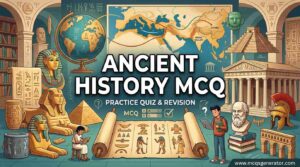
Ancient Egyptian civilization flourished for over three millennia along the fertile banks of the Nile River, developing one of the world’s most enduring and sophisticated cultures. Characterized by monumental stone architecture like the Pyramids of Giza, complex polytheistic religion centered on eternal life, and hieroglyphic writing, Egypt was politically unified under dynastic pharaohs across the Old, Middle, and New Kingdoms. Their advanced achievements in astronomy, mathematics, medicine, and engineering continue to captivate global historical study and archaeological research today.
1. Which river was central to the survival and development of Ancient Egyptian civilization?
Correct Answer: c) Nile
Explanation:
The Nile River provided water, fertile soil from annual flooding, and a major transportation route, making life in ancient Egypt possible.
2. What did the ancient Egyptians call their land, meaning 'The Black Land'?
Correct Answer: a) Kemet
Explanation:
The Egyptians called their country Kemet, or 'Black Land', referring to the dark, fertile soil deposited by the Nile's annual floods.
3. Which pharaoh is traditionally credited with uniting Upper and Lower Egypt?
Correct Answer: b) Narmer
Explanation:
Narmer (also identified as Menes) is credited with unifying Upper and Lower Egypt around 3100 BCE, founding the First Dynasty.
4. During which kingdom were the Great Pyramids of Giza built?
Correct Answer: a) Old Kingdom
Explanation:
The Old Kingdom (c. 2700-2200 BCE) is known as the 'Age of the Pyramids', during which the Great Pyramids of Giza were constructed.
5. Who was the architect of the first step pyramid built for Pharaoh Djoser?
Correct Answer: b) Imhotep
Explanation:
Imhotep was a polymath and the chief architect who designed the Step Pyramid at Saqqara for Pharaoh Djoser.
6. What is the ancient Egyptian writing system that uses picture-like symbols called?
Correct Answer: c) Hieroglyphics
Explanation:
Hieroglyphics was the formal writing system used in Ancient Egypt, comprising a mix of logographic, syllabic, and alphabetic elements.
7. Which artifact was crucial in deciphering Egyptian hieroglyphs?
Correct Answer: b) The Rosetta Stone
Explanation:
Discovered in 1799, the Rosetta Stone contained the same decree in three scripts (Hieroglyphic, Demotic, and Greek), enabling Jean-François Champollion to decipher it.
8. Which ancient Egyptian god was associated with the underworld, the afterlife, and agriculture?
Correct Answer: c) Osiris
Explanation:
Osiris was the god of the afterlife, death, resurrection, and agriculture, widely worshipped throughout Egyptian history.
9. Who was the jackal-headed god associated with mummification and guiding souls to the afterlife?
Correct Answer: c) Anubis
Explanation:
Anubis was the god of mummification and the afterlife, usually depicted with the head of a jackal.
10. Which pharaoh attempted to change Egypt's polytheistic religion to the monotheistic worship of the Aten?
Correct Answer: a) Akhenaten
Explanation:
Akhenaten, originally Amenhotep IV, shifted the state religion to focus solely on the Aten, the sun disk, during the Amarna Period.
11. What was the name of Akhenaten's famous Great Royal Wife?
Correct Answer: c) Nefertiti
Explanation:
Nefertiti was the Great Royal Wife of Akhenaten and played a prominent role in the religious revolution of the Aten.
12. Whose tomb was famously discovered mostly intact by Howard Carter in 1922?
Correct Answer: b) Tutankhamun
Explanation:
Tutankhamun's nearly intact tomb (KV62) was discovered in 1922 by British archaeologist Howard Carter, revealing immense treasures.
13. Which female pharaoh ruled successfully for over 20 years and is famous for her mortuary temple at Deir el-Bahari?
Correct Answer: c) Hatshepsut
Explanation:
Hatshepsut was one of the most successful female pharaohs, expanding trade and initiating massive building projects, including her temple at Deir el-Bahari.
14. The concept of 'Ma'at' represented what fundamental idea in ancient Egypt?
Correct Answer: b) Truth, balance, order, and justice
Explanation:
Ma'at was the ancient Egyptian concept of truth, balance, order, harmony, law, morality, and justice, often personified as a goddess.
15. In the 'Weighing of the Heart' ceremony, the deceased's heart was weighed against what object?
Correct Answer: b) A feather of Ma'at
Explanation:
To enter the afterlife, the heart of the deceased was weighed against the feather of Ma'at (truth and justice) to determine their moral worth.
16. What is the collective name for the jars used during mummification to store the internal organs?
Correct Answer: c) Canopic jars
Explanation:
Canopic jars were used by ancient Egyptians to store and preserve the internal organs (stomach, intestines, lungs, and liver) for the afterlife.
17. Which naturally occurring salt was used extensively in the mummification process to dry out the body?
Correct Answer: b) Natron
Explanation:
Natron, a natural blend of sodium carbonate and sodium bicarbonate, was used to absorb moisture and preserve the body during mummification.
18. Which pharaoh is considered the greatest builder of the New Kingdom, erecting monuments like Abu Simbel?
Correct Answer: a) Ramses II
Explanation:
Ramses II (Ramses the Great) ruled for 66 years, leading vast building programs, including the temples at Abu Simbel and expansions at Karnak.
19. The famous Battle of Kadesh was fought between the Egyptians and which major regional power?
Correct Answer: c) The Hittites
Explanation:
The Battle of Kadesh (c. 1274 BCE) was fought between Ramses II of Egypt and the Hittite Empire under Muwatalli II.
20. Which foreign invaders ruled northern Egypt during the Second Intermediate Period?
Correct Answer: c) The Hyksos
Explanation:
The Hyksos, a people of mixed Semitic-Asiatic origin, settled in the Nile Delta and ruled Egypt during the Second Intermediate Period.
21. What military innovation is often credited to the Hyksos when they invaded Egypt?
Correct Answer: c) Horse-drawn chariots
Explanation:
The Hyksos are credited with introducing the horse-drawn chariot and the composite bow to Egyptian warfare.
22. Which pharaoh is known as the 'Napoleon of Egypt' for his extensive military campaigns and empire building?
Correct Answer: a) Thutmose III
Explanation:
Thutmose III conducted numerous successful military campaigns, expanding the Egyptian empire to its greatest territorial extent.
23. What material was used by Egyptians to make paper-like writing material?
Correct Answer: b) Papyrus
Explanation:
Papyrus, made from the pith of the papyrus plant which grew abundantly along the Nile, was the standard writing material in ancient Egypt.
24. Who was the highest-ranking official under the pharaoh, acting as a prime minister?
Correct Answer: b) Vizier
Explanation:
The vizier was the highest executive official in ancient Egypt, responsible for the administration of the country under the pharaoh.
25. The administrative districts or provinces of ancient Egypt were known as:
Correct Answer: a) Nomes
Explanation:
Egypt was divided into administrative regions called nomes, which were governed by officials known as nomarchs.
26. Which ancient Egyptian city was known as 'Waset' and served as the capital during the New Kingdom?
Correct Answer: b) Thebes
Explanation:
Thebes (ancient Waset) was the religious and political capital of Egypt during much of the Middle and New Kingdoms.
27. Which god was primarily worshipped at the massive Karnak Temple Complex?
Correct Answer: b) Amun
Explanation:
The Karnak Temple Complex in Thebes was dedicated primarily to Amun (often syncretized as Amun-Ra), the king of the gods during the New Kingdom.
28. What was the capital of Egypt during the Old Kingdom?
Correct Answer: c) Memphis
Explanation:
Memphis was founded around 3100 BCE and served as the primary capital of Egypt throughout the Old Kingdom.
29. The Great Sphinx of Giza features the body of a lion and the head of which pharaoh?
Correct Answer: b) Khafre
Explanation:
Most Egyptologists believe the Great Sphinx was built during the reign of Khafre and that its face represents him.
30. Which major astronomical event marked the beginning of the ancient Egyptian calendar year?
Correct Answer: b) The heliacal rising of Sirius
Explanation:
The Egyptian calendar year began with the heliacal rising of the star Sirius (Sopdet), which roughly coincided with the start of the Nile's annual flood.
31. What was the primary function of the ancient text known as the 'Book of the Dead'?
Correct Answer: c) Spells and incantations to guide the deceased in the afterlife
Explanation:
The Book of the Dead was a funerary text consisting of magic spells intended to assist a dead person's journey through the Duat (underworld) into the afterlife.
32. In Egyptian mythology, what is the name of the paradisiacal afterlife where worthy souls lived?
Correct Answer: c) The Field of Reeds (Aaru)
Explanation:
Aaru, or the Field of Reeds, was the heavenly paradise in Egyptian mythology where souls who passed the Weighing of the Heart could live eternally.
33. Who was the ibis-headed god of wisdom, writing, and magic?
Correct Answer: c) Thoth
Explanation:
Thoth was the god of knowledge, writing, hieroglyphs, and science, frequently depicted with the head of an ibis.
34. What is the name of the sacred beetle often used in Egyptian amulets?
Correct Answer: b) Scarab
Explanation:
The scarab beetle was highly sacred in ancient Egypt, symbolizing the sun, creation, and rebirth, associated with the god Khepri.
35. What famous monument was relocated in the 1960s to prevent it from being submerged by Lake Nasser?
Correct Answer: c) Abu Simbel
Explanation:
The twin temples of Abu Simbel were cut into large blocks and moved to higher ground during the construction of the Aswan High Dam.
36. The ankh is an ancient Egyptian symbol that represents:
Correct Answer: c) Life
Explanation:
The ankh, often called the 'key of life', is the ancient Egyptian hieroglyphic character that read 'life' and is widely used as a symbol for eternal life.
37. Which pharaoh is noted for building the first true, smooth-sided pyramid, known as the Red Pyramid?
Correct Answer: b) Sneferu
Explanation:
Sneferu, the founder of the Fourth Dynasty, built three pyramids, culminating in the Red Pyramid, the first successful true smooth-sided pyramid.
38. Which foreign dynasty ruled Egypt as the 25th Dynasty?
Correct Answer: c) Nubian (Kushite)
Explanation:
The 25th Dynasty was a line of pharaohs who originated in the Kingdom of Kush (Nubia) and ruled Egypt for nearly a century.
39. Who was the last active ruler of the Ptolemaic Kingdom of Egypt?
Correct Answer: b) Cleopatra VII
Explanation:
Cleopatra VII Philopator was the last active ruler of the Ptolemaic Kingdom, after which Egypt became a province of the Roman Empire.
40. The Ptolemaic dynasty was of what ethnic origin?
Correct Answer: c) Macedonian Greek
Explanation:
The Ptolemaic dynasty was founded by Ptolemy I Soter, a Macedonian Greek general under Alexander the Great.
41. Which city, founded by Alexander the Great, became the capital of Egypt during the Ptolemaic period?
Correct Answer: c) Alexandria
Explanation:
Alexandria became a major center of Hellenistic culture and the capital of Ptolemaic Egypt.
42. The famous Lighthouse of Alexandria was built on which island?
Correct Answer: a) Pharos
Explanation:
The Lighthouse of Alexandria, one of the Seven Wonders of the Ancient World, was constructed on the island of Pharos.
43. What is the ancient Egyptian term for the spiritual life force or soul?
Correct Answer: b) Ka
Explanation:
In ancient Egyptian religion, the 'Ka' was the vital essence or life force that distinguished a living person from a dead one.
44. The 'Ba' in ancient Egyptian beliefs is best described as:
Correct Answer: c) The individual's personality or mobility after death
Explanation:
The Ba is often represented as a bird with a human head, symbolizing the aspect of the soul that could travel between the underworld and the tomb.
45. Who was the mother goddess, wife of Osiris, and protector of Horus?
Correct Answer: c) Isis
Explanation:
Isis was an incredibly important deity, revered as the ideal mother and wife, and the protector of her son Horus.
46. Which Egyptian god of chaos, desert, and storms murdered his brother Osiris?
Correct Answer: c) Seth
Explanation:
Seth (or Set) was the god of chaos, storms, and the desert, infamous in mythology for killing his brother, Osiris.
47. Which goddess was represented as a fierce lioness and associated with war and healing?
Correct Answer: b) Sekhmet
Explanation:
Sekhmet was a warrior goddess and goddess of healing, depicted as a lioness, fiercely protective of the pharaoh.
48. The goddess Bastet was most commonly associated with which animal?
Correct Answer: b) Cat
Explanation:
Bastet was the goddess of home, domesticity, and cats, originally depicted as a lioness but later as a domestic cat.
49. Who was the primary sun god worshipped extensively throughout ancient Egypt?
Correct Answer: a) Ra
Explanation:
Ra was the preeminent ancient Egyptian sun god, believed to ride a solar barque across the sky daily and through the underworld at night.
50. What is a 'cartouche' in ancient Egyptian culture?
Correct Answer: b) An oval enclosing a pharaoh's name
Explanation:
A cartouche is an oval with a horizontal line at one end, indicating that the text enclosed is a royal name.
51. Which artifact contains the earliest known historical narrative relief in ancient Egypt?
Correct Answer: b) The Narmer Palette
Explanation:
The Narmer Palette (c. 3100 BCE) shows King Narmer conquering his enemies and is considered one of the earliest known historical documents.
52. What was the purpose of small figurines known as 'ushabti' placed in tombs?
Correct Answer: c) To act as magical servants for the deceased in the afterlife
Explanation:
Ushabti (or shabti) figures were placed in tombs to perform manual labor for the deceased in the afterlife.
53. What is the term for the ancient Egyptian form of simplified hieroglyphics used for everyday writing?
Correct Answer: c) Hieratic
Explanation:
Hieratic was a cursive writing system used for monumental inscriptions, administrative documents, and literary texts, simpler than formal hieroglyphics.
54. Which script replaced hieratic for everyday administration in the Late Period?
Correct Answer: c) Demotic
Explanation:
Demotic script emerged around 650 BCE and became the most widely used script for legal, administrative, and commercial documents.
55. Which animal was considered a manifestation of the god Sobek?
Correct Answer: b) Crocodile
Explanation:
Sobek was the ancient Egyptian god of crocodiles, the Nile, and military prowess, depicted as a crocodile or a man with a crocodile head.
56. The Apis bull was sacred to which god of Memphis?
Correct Answer: b) Ptah
Explanation:
The Apis bull was revered as a herald or earthly manifestation of Ptah, the creator god and patron of craftsmen in Memphis.
57. Which monumental structure is the only surviving Wonder of the Ancient World?
Correct Answer: c) The Great Pyramid of Giza
Explanation:
The Great Pyramid of Giza, built for Pharaoh Khufu, is the oldest and only surviving of the original Seven Wonders of the Ancient World.
58. What was the 'Valley of the Kings' used for?
Correct Answer: c) A royal burial ground for pharaohs and nobles
Explanation:
During the New Kingdom, pharaohs and powerful nobles were buried in rock-cut tombs in the Valley of the Kings to deter grave robbers.
59. Where is the Valley of the Kings located?
Correct Answer: b) Near modern-day Luxor (ancient Thebes)
Explanation:
The Valley of the Kings is located on the west bank of the Nile, opposite modern-day Luxor (ancient Thebes).
60. What is a 'mastaba'?
Correct Answer: a) A flat-roofed, rectangular tomb structure
Explanation:
A mastaba is an early type of ancient Egyptian tomb with a flat roof and sloping sides, which later evolved into the step pyramid.
61. What was the primary function of the 'Nilometer'?
Correct Answer: b) To measure the water level of the Nile during the flood season
Explanation:
Nilometers were structures used to measure the Nile River's clarity and water level during the annual flood season to predict harvest size and set taxes.
62. Which of the following describes the ancient Egyptian season of 'Akhet'?
Correct Answer: c) The season of inundation (flooding)
Explanation:
Akhet was the first season of the Egyptian calendar, marking the time when the Nile flooded, leaving behind fertile silt.
63. What did the ancient Egyptians call the season of planting and growing?
Correct Answer: b) Peret
Explanation:
Peret was the 'season of emergence', when the floodwaters retreated, and crops were planted and grown.
64. The 'Shemu' season in ancient Egypt was dedicated to:
Correct Answer: a) Harvesting crops
Explanation:
Shemu was the 'season of low water' or harvest, during which farmers reaped the crops planted in the Peret season.
65. What was the 'khopesh'?
Correct Answer: b) A sickle-shaped sword
Explanation:
The khopesh was an Egyptian sickle-sword that evolved from battle axes, widely used during the New Kingdom.
66. The double crown of Egypt, representing the unification of Upper and Lower Egypt, was called:
Correct Answer: d) Pschent
Explanation:
The Pschent was the double crown worn by pharaohs, combining the White Crown (Hedjet) of Upper Egypt and the Red Crown (Deshret) of Lower Egypt.
67. What was the 'Nemes' in ancient Egyptian culture?
Correct Answer: a) A striped headcloth worn by pharaohs
Explanation:
The Nemes was the striped royal headdress worn by pharaohs, famously seen on the gold mask of Tutankhamun.
68. Who were the 'Medjay' in ancient Egypt?
Correct Answer: b) An elite paramilitary police force
Explanation:
The Medjay originally referred to a nomadic Nubian group but later evolved into an elite paramilitary police force in the New Kingdom.
69. Which text is an ancient Egyptian literary classic about a courtier who flees Egypt and later returns?
Correct Answer: a) The Story of Sinuhe
Explanation:
The Story of Sinuhe is considered one of the masterpieces of ancient Egyptian literature, dating to the Middle Kingdom.
70. What does the 'Tale of the Eloquent Peasant' primarily illustrate about ancient Egypt?
Correct Answer: c) The importance of Ma'at and social justice
Explanation:
This Middle Kingdom story highlights the concept of Ma'at (justice), showing a peasant eloquently pleading his case before high officials.
71. Which color represented life, growth, and rebirth in ancient Egyptian art?
Correct Answer: c) Green
Explanation:
Green (wadj) was the color of vegetation and new life, heavily associated with Osiris, the god of resurrection.
72. Which material, heavily prized by Egyptians for making jewelry and statues, was imported extensively from Nubia and Sinai?
Correct Answer: c) Turquoise
Explanation:
Turquoise was mined by the ancient Egyptians in the Sinai Peninsula and was highly valued for jewelry and amulets.
73. Lapis Lazuli, famously used in Tutankhamun's mask, was primarily imported from which distant region?
Correct Answer: b) Modern-day Afghanistan
Explanation:
Lapis lazuli was highly prized and traded over immense distances, primarily originating from the Badakhshan region in modern-day Afghanistan.
74. Which fabled land did Hatshepsut famously send a massive trading expedition to?
Correct Answer: b) Punt
Explanation:
Hatshepsut's expedition to the Land of Punt (likely modern-day Somalia/Eritrea area) successfully returned with myrrh, frankincense, and exotic animals.
75. What was 'faience' in the context of ancient Egyptian art?
Correct Answer: b) A glazed non-clay ceramic material
Explanation:
Egyptian faience is a sintered-quartz ceramic displaying surface vitrification, known for its bright blue or green colors, used for jewelry and small vessels.
76. Who was the ancient Egyptian god of craftsmen, builders, and architects?
Correct Answer: a) Ptah
Explanation:
Ptah was the patron god of craftsmen, metalworkers, and builders, and the chief deity of the city of Memphis.
77. What role did women generally have in ancient Egyptian society compared to other ancient cultures?
Correct Answer: c) They had significant legal rights, including owning property and initiating divorce
Explanation:
Compared to many ancient civilizations, Egyptian women enjoyed broad legal rights, including owning property, running businesses, and participating in court cases.
78. Which ancient Egyptian medical text is the oldest known surgical treatise on trauma?
Correct Answer: c) Edwin Smith Papyrus
Explanation:
The Edwin Smith Papyrus (c. 1600 BCE) is a highly rational, scientific ancient text detailing anatomical observations and treatments for injuries.
79. What was the most common clothing material for ancient Egyptians due to the hot climate?
Correct Answer: b) Linen
Explanation:
Linen, made from the flax plant, was the primary fabric in ancient Egypt as it was light, cool, and easy to produce.
80. Which animal was considered an abomination to eat by priests due to its association with Seth?
Correct Answer: c) Pig
Explanation:
Pigs were largely considered unclean and associated with Seth, the god of chaos, though commoners occasionally ate them.
81. What popular ancient Egyptian board game was believed to have religious significance related to the afterlife?
Correct Answer: c) Senet
Explanation:
Senet was a highly popular board game; its gameplay represented the journey of the soul through the underworld toward the afterlife.
82. How did the ancient Egyptians generally view the heart (ib)?
Correct Answer: b) As the center of intelligence, emotion, and memory
Explanation:
The Egyptians believed the heart was the seat of intelligence, emotion, and the soul, which is why it was carefully left in the body during mummification.
83. During mummification, how was the brain typically removed?
Correct Answer: c) Through the nose using a hooked tool
Explanation:
Embalmers typically extracted the brain through the nasal cavity using a special metal hook, as the brain was not considered important for the afterlife.
84. Which pharaoh was the father of Ramses the Great (Ramses II)?
Correct Answer: a) Seti I
Explanation:
Seti I was a highly successful pharaoh of the 19th Dynasty who consolidated the empire and fathered Ramses II.
85. The 'Amarna Period' is characterized by which of the following?
Correct Answer: c) A drastic change in art style and the shift to monotheism
Explanation:
Initiated by Akhenaten, the Amarna period featured a unique, more naturalistic art style and the exclusive worship of the Aten.
86. Who was the sky goddess whose body was often depicted arching over the earth?
Correct Answer: b) Nut
Explanation:
Nut was the goddess of the sky, stars, and cosmos, often depicted as a woman bending over the earth god Geb.
87. What relation did Cleopatra VII have with Julius Caesar and Mark Antony?
Correct Answer: c) She formed romantic and political alliances with both
Explanation:
Cleopatra formed famous strategic romantic alliances with Julius Caesar (bearing him a son, Caesarion) and later Mark Antony.
88. Which Roman Emperor annexed Egypt after defeating Mark Antony and Cleopatra?
Correct Answer: d) Octavian (Augustus)
Explanation:
After the Battle of Actium in 31 BCE, Octavian (later Augustus) defeated Antony and Cleopatra, making Egypt a Roman province.
89. What is 'electrum', a material often used for capping obelisks and pyramids?
Correct Answer: a) A natural alloy of gold and silver
Explanation:
Electrum, a naturally occurring alloy of gold and silver, was highly valued in Egypt and used to cap pyramids and obelisks so they would shine.
90. The 'Colossi of Memnon' are two massive stone statues representing which pharaoh?
Correct Answer: a) Amenhotep III
Explanation:
The Colossi of Memnon represent Amenhotep III and originally stood at the entrance to his ruined mortuary temple in Thebes.
91. Which social class made up the vast majority of the ancient Egyptian population?
Correct Answer: c) Farmers and laborers
Explanation:
Peasant farmers and laborers formed the lowest and largest tier of the social hierarchy, producing the food and labor that sustained the society.
92. How did the ancient Egyptians generally pay their taxes?
Correct Answer: c) In goods (like grain) and labor (corvée)
Explanation:
Egypt lacked a coined money economy for most of its history. Taxes were paid in kind (grain, livestock) and through drafted labor known as the corvée system.
93. What was the 'Opet Festival'?
Correct Answer: b) A religious festival renewing the pharaoh's divine right to rule
Explanation:
The Opet Festival was a major New Kingdom festival where the statues of Amun, Mut, and Khonsu traveled from Karnak to Luxor to rejuvenate the pharaoh's divine kingship.
94. Who deciphered the Rosetta Stone in 1822?
Correct Answer: c) Jean-François Champollion
Explanation:
The French scholar Jean-François Champollion published the first correct translation of the Rosetta Stone's hieroglyphs in 1822.
95. Which of the following was NOT a function of an ancient Egyptian temple?
Correct Answer: c) Public worship center for commoners
Explanation:
Unlike modern churches or mosques, Egyptian temples were the 'houses' of gods, accessible only to priests and royalty. Commoners worshipped at smaller shrines or outside the temple gates.
96. What is an obelisk?
Correct Answer: b) A tall, four-sided, narrow tapering monument which ends in a pyramidion
Explanation:
Obelisks were prominent in ancient Egyptian architecture, symbolizing the sun god Ra, often placed in pairs at temple entrances.
97. What is the primary material used to build the Great Pyramids?
Correct Answer: c) Limestone
Explanation:
The core of the pyramids was built using locally quarried limestone, while higher-quality white limestone was used for the outer casing.
98. Which king's reign is associated with the construction of the Labyrinth at Hawara?
Correct Answer: a) Amenemhat III
Explanation:
Pharaoh Amenemhat III of the Middle Kingdom constructed a massive mortuary temple at Hawara, known to classical authors as the 'Labyrinth' due to its complexity.
99. The Coptic language, still used in liturgical settings today, evolved from which ancient script?
Correct Answer: b) Demotic Egyptian
Explanation:
Coptic is the final phase of the ancient Egyptian language, written in the Greek alphabet with added letters derived from Demotic.
100. What was the role of the 'Lector Priest' in ancient Egypt?
Correct Answer: b) To recite spells and hymns during rituals
Explanation:
Lector priests were literate religious officials tasked with reciting sacred texts, hymns, and magical spells during temple rituals and funerary rites.