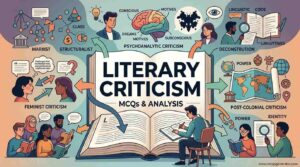
Literary criticism encompasses a diverse array of methodological lenses and theoretical frameworks used to interpret, analyze, and evaluate literary texts. Different schools of criticism focus on distinct aspects of literature: formalists examine autonomous textual structures, Marxist critics analyze socioeconomic class struggle, feminist critics interrogate patriarchal representation, psychoanalytic critics decode unconscious desires, and post-colonial critics examine imperial power structures. Mastering these various types of literary criticism is essential for advanced literary scholarship, theoretical research, and academic examinations across the humanities.
1. Which type of literary criticism focuses on the life, times, and psychological state of the author to interpret a text?
Correct Answer: a) Biographical criticism
Explanation:
Biographical criticism investigates the author's life history, letters, and historical environment to shed light on the creation and meaning of a literary work.
2. Which critical approach treats a literary work as a self-contained, autonomous verbal object, paying close attention to diction, imagery, and meter without outside context?
Correct Answer: a) New Criticism / Formalism
Explanation:
Formalism and New Criticism prioritize close reading and internal textual mechanics over historical or biographical background.
3. What is the primary focus of Marxist literary criticism?
Correct Answer: a) The socio-economic conditions, class struggles, and ideological power structures embedded in texts
Explanation:
Marxist criticism examines how literature reflects or challenges capitalist economic systems, social classes, and political ideology.
4. Which literary school analyzes texts through the lens of gender roles, patriarchal oppression, and the recovery of female literary traditions?
Correct Answer: a) Feminist literary criticism
Explanation:
Feminist criticism interrogates how gender is represented, exposes patriarchal biases, and champions women writers.
5. What is the core emphasis of Reader-Response criticism?
Correct Answer: a) The active role of the reader in creating and experiencing the meaning of a text
Explanation:
Reader-response criticism shifts the critical spotlight from the static text or author to the reader's psychological and interpretive process.
6. Which critical approach, pioneered by Edward Said, examines how Western literature and colonial discourses constructed patronizing representations of the 'Orient'?
Correct Answer: a) Post-colonial criticism
Explanation:
Post-colonial criticism analyzes the cultural legacies, power dynamics, and imperialist assumptions of colonialism and globalization.
7. What does Psychoanalytic literary criticism primarily investigate?
Correct Answer: a) Psychoanalytic criticism
Explanation:
Drawing on Freud and Lacan, psychoanalytic criticism reads texts like dreams to uncover latent psychological trauma and desire.
8. Which critical methodology examines literary works in dialogue with historical documents, cultural discourses, and institutional power dynamics of their era?
Correct Answer: a) New Historicism
Explanation:
New Historicism views literature as a participant in historical power networks rather than a passive reflection of history.
9. What is the central premise of Deconstructive criticism, associated with Jacques Derrida?
Correct Answer: a) Language is inherently unstable, contradictory, and incapable of securing a single, fixed meaning
Explanation:
Deconstruction demonstrates how texts inevitably undermine their own binary oppositions and stable arguments.
10. Which critical school studies literature through recurring universal symbols, myths, and patterns derived from anthropology and Jungian psychology?
Correct Answer: a) Archetypal (Mythic) criticism
Explanation:
Archetypal criticism (championed by Northrop Frye) connects literary plots and characters to seasonal myths and collective human patterns.
11. What does Eco-criticism (Environmental literary criticism) investigate?
Correct Answer: a) Eco-criticism
Explanation:
Eco-criticism explores how nature is represented in texts and addresses environmental degradation and climate consciousness.
12. Which critical approach critiques heteronormativity and examines sexual fluidity, identity performance, and non-conforming desires?
Correct Answer: a) Queer theory
Explanation:
Queer theory interrogates rigid binary categories of sex and gender in cultural and literary texts.
13. What is the focus of Structuralist literary criticism?
Correct Answer: a) Structuralism
Explanation:
Structuralism applies linguistic models (like Saussure's semiotics) to uncover the universal systems underlying literature.
14. Which critical approach examines how a text incorporates, echoes, or transforms prior texts through allusion, quotation, and cultural codes?
Correct Answer: a) Intertextual criticism
Explanation:
Intertextuality views every text as a mosaic of prior cultural discourses and literary works.
15. What is Moral (Ethical) criticism primarily concerned with?
Correct Answer: a) Moral / Ethical criticism
Explanation:
Ethical criticism assesses the human and moral impact of the ideas, behaviors, and worldviews depicted in literature.
16. Which critical perspective examines literature through the lens of large computing datasets, quantitative text mining, and 'distant reading'?
Correct Answer: a) Digital Humanities
Explanation:
Digital humanities applies computational tools and quantitative data analysis to large corpuses of literature.
17. What does Phenomenological literary criticism focus on?
Correct Answer: a) Phenomenological criticism
Explanation:
Phenomenological criticism explores how human consciousness encounters and constitutes literary reality.
18. Which critical approach analyzes how race, systemic racism, and white supremacy are maintained and contested through cultural narratives?
Correct Answer: a) Critical Race Theory
Explanation:
Critical Race Theory investigates how racial hierarchies operate implicitly through literature, legal frameworks, and culture.
19. What is the primary objective of Stylistic criticism?
Correct Answer: a) Stylistics
Explanation:
Stylistics bridges linguistics and literary criticism by analyzing precise grammatical and structural choices in texts.
20. Which critical method examines how stories are structured, categorizing plot mechanics, focalization, and narrative pacing?
Correct Answer: a) Narratology
Explanation:
Narratology is the structural study of how narratives operate, including point of view, time, and plot mechanics.
21. What is Post-humanist literary criticism?
Correct Answer: a) Post-humanist criticism
Explanation:
Post-humanism challenges the traditional Western definition of the autonomous human subject in light of technology and ecology.
22. Which critical school, originating in Chicago in the mid-20th century, revived Aristotelian formal analysis of genres and plot construction?
Correct Answer: a) The Chicago School (Neo-Aristotelians)
Explanation:
The Chicago School (including Wayne Booth and R.S. Crane) focused on formal narrative mechanics, rhetoric, and genre.
23. What is Cultural Materialism (or British Cultural Studies) primarily concerned with?
Correct Answer: a) Cultural Materialism
Explanation:
Cultural materialism examines how cultural artifacts and literature participate in political power struggles and social structures.
24. Which psychoanalytic-feminist approach champions 'écriture féminine' (women's writing), urging women to reclaim bodily expression in literature?
Correct Answer: a) French Feminism
Explanation:
French feminist literary critics explored how patriarchal language represses the female body and called for revolutionary female writing styles.
25. What is 'Gynocriticism', a term coined by Elaine Showalter?
Correct Answer: a) Gynocriticism
Explanation:
Gynocriticism focuses on the history, themes, and structures of literature authored by women.
26. What does Trauma theory in literary criticism investigate?
Correct Answer: a) Trauma theory
Explanation:
Trauma theory examines narrative fragmentation, memory, and the difficulty of articulating extreme historical violence.
27. Which critical framework analyzes texts through the lens of evolutionary psychology and human adaptive behaviors?
Correct Answer: a) Darwinian literary criticism
Explanation:
Evolutionary literary criticism examines how literature reflects universal human motivations, mate selection, and survival strategies.
28. What is 'Impressionistic criticism'?
Correct Answer: a) Impressionistic criticism
Explanation:
Impressionistic criticism (championed by figures like Anatole France) treats literary appreciation as a subjective aesthetic adventure.
29. Which critical approach examines how financial sponsorship, royal patronage, and publishing markets shape the creation of literature?
Correct Answer: a) Materialist / Production criticism
Explanation:
Production criticism studies the material, economic, and institutional conditions under which books are published and consumed.
30. What is the primary focus of Subaltern Studies in post-colonial criticism?
Correct Answer: a) Subaltern Studies
Explanation:
Subaltern studies focuses on the agency and silenced voices of the oppressed in post-colonial societies.
31. Which critical method examines how myths are transformed and updated in modern literature?
Correct Answer: a) Myth-criticism
Explanation:
Myth-criticism explores how ancient mythological patterns persist and are resignified in modern narratives.
32. What is 'Practical Criticism', pioneered by I.A. Richards?
Correct Answer: a) Practical Criticism
Explanation:
I.A. Richards gave students poems without titles or author names to test their pure interpretive capabilities.
33. Which philosophical school, associated with the Frankfurt School, critiqued mass culture and the 'culture industry' through critical theory?
Correct Answer: a) Frankfurt School
Explanation:
Adorno, Horkheimer, and Benjamin critiqued how capitalism turns art into standardized mass-market entertainment.
34. What is 'Genetic criticism' (critique génétique)?
Correct Answer: a) Genetic criticism
Explanation:
Genetic criticism examines pre-textual materials (drafts, revisions) to understand how a literary work came into being.
35. Which critical approach applies economic theories of globalization, migration, and diaspora to literary texts?
Correct Answer: a) Diaspora and Globalization criticism
Explanation:
This approach analyzes transnational migration, displacement, and cultural hybridity in modern world literature.
36. What is the primary concern of Stylometric literary criticism?
Correct Answer: a) Stylometry
Explanation:
Stylometry uses quantitative statistics to analyze linguistic fingerprints for authorship attribution.
37. Which critical perspective examines literature through the lens of disability studies and corporeal difference?
Correct Answer: a) Disability criticism
Explanation:
Disability studies in literature critiques how physical and mental differences are stigmatized, represented, or marginalized in texts.
38. What is 'Geocriticism' (Spatial literary criticism)?
Correct Answer: a) Geocriticism
Explanation:
Geocriticism explores how literary texts construct, represent, and interact with real and imaginary spaces and places.
39. Which critical approach views literature as a communicative speech act governed by pragmatic rules of context and intention?
Correct Answer: a) Speech-act criticism
Explanation:
Speech-act criticism (drawing on Austin and Searle) analyzes literary texts as performative utterances that execute social actions.
40. What is 'Affective Stylistics', developed by Stanley Fish?
Correct Answer: a) Affective Stylistics
Explanation:
Affective stylistics tracks the temporal unfolding of the reader's interpretive response to a text line by line.
41. Which critical framework investigates the representation of aging, longevity, and generational transition in literature?
Correct Answer: a) Age Studies / Gerontological criticism
Explanation:
Gerontological literary criticism examines how old age, mortality, and generational dynamics are depicted in texts.
42. What is the core focus of 'Book History' (Bibliographical criticism)?
Correct Answer: a) Book History / Bibliographical criticism
Explanation:
Book history investigates how the physical manufacture and circulation of books shape literary meaning.
43. Which critical approach combines literary theory with cognitive science to study how the human brain processes fictional worlds?
Correct Answer: a) Cognitive Literary Studies
Explanation:
Cognitive criticism uses theories of mind, neuroscience, and blending to explain how readers imagine stories.
44. What is 'Dialogic criticism', based on the theories of Mikhail Bakhtin?
Correct Answer: a) Dialogic criticism
Explanation:
Bakhtinian dialogism views literature as an arena where diverse socio-ideological voices interact, clash, and converse.
45. Which critical theory examines how texts construct childhood, adolescence, and socialization?
Correct Answer: a) Childhood studies in literature
Explanation:
This approach analyzes how literature conceptualizes youth, education, innocence, and generational maturation.
46. What is 'Reception Aesthetics' (Rezeptionsästhetik)?
Correct Answer: a) Reception aesthetics
Explanation:
Pioneered by Jauss and Iser, reception aesthetics explores the historical 'horizon of expectations' of readers.
47. Which critical approach examines food, culinary practices, dining rituals, and hunger as symbolic motifs in literature?
Correct Answer: a) Food Studies
Explanation:
Food studies in literature analyzes how culinary habits signify class, gender, culture, and power.
48. What does 'Anxiety of Influence' criticism, founded by Harold Bloom, explore?
Correct Answer: a) Anxiety of Influence
Explanation:
Bloom analyzed poetic history through Freudian revisionary ratios where poets wrestle with their literary ancestors.
49. Which critical methodology applies economic concepts to analyze literary markets, literary value, and cultural capital?
Correct Answer: a) Bourdieuian literary sociology
Explanation:
Pierre Bourdieu's sociology of culture analyzes fields of cultural production, habitus, and symbolic capital.
50. What is 'Post-critique' in contemporary literary studies?
Correct Answer: a) Post-critique
Explanation:
Post-critique responds to 'suspicious reading' by advocating for reparative, surface, and attuned aesthetic engagement with texts.
51. Which critical approach analyzes maritime themes, oceans, ships, and naval history in literature?
Correct Answer: a) Oceanic criticism
Explanation:
Oceanic literary criticism explores the sea, maritime commerce, empire, and aquatic metaphors in world literature.
52. What is 'Animal Studies' criticism focused on?
Correct Answer: a) Animal Studies criticism
Explanation:
Animal studies interrogates speciesism and the literary depiction of non-human creatures.
53. Which critical approach studies the literary representation of disease, medicine, epidemics, and the human body?
Correct Answer: a) Medical Humanities
Explanation:
Medical humanities explores how literature portrays illness, medical ethics, hospitals, and bodily vulnerability.
54. What is 'Digital Philology'?
Correct Answer: a) Digital Philology
Explanation:
Digital philology combines traditional textual scholarship with digital archives and computational text analysis.
55. Which critical framework explores the intersection of literature with science, mathematics, and technological theory?
Correct Answer: a) Literature and Science studies
Explanation:
This interdisciplinary field examines how scientific paradigms and technological discoveries influence literature and vice versa.
56. What is 'World Literature' as an institutional critical framework?
Correct Answer: a) World Literature
Explanation:
World literature examines global literary circulation, translation politics, and cross-cultural literary economies.
57. Which critical approach analyzes the rhetorical strategies, metaphors, and persuasion techniques used in political and literary texts?
Correct Answer: a) Rhetorical criticism
Explanation:
Rhetorical criticism evaluates how texts persuade audiences through tropes, arguments, and stylistic appeals.
58. What is 'Translation Studies' as a branch of literary criticism?
Correct Answer: a) Translation Studies
Explanation:
Translation studies views translation as an active, culturally mediated process of rewriting and interpretation.
59. Which critical approach examines how the Gothic genre explores societal anxieties, repressed secrets, and architectural monstrosity?
Correct Answer: a) Gothic criticism
Explanation:
Gothic criticism analyzes uncanny spaces, psychological doubling, and the return of the repressed in dark literature.
60. What is 'Marxist Cultural Studies' focused on?
Correct Answer: a) Marxist Cultural Studies
Explanation:
Marxist cultural studies analyzes how cultural forms perpetuate or challenge capitalist power relations.
61. Which critical method examines how poems and novels use sound, rhythm, and meter to create aesthetic meaning?
Correct Answer: a) Prosody
Explanation:
Prosody is the formal study of poetic meter, rhyme, stanzaic form, and acoustic patterns.
62. What is 'Energy Humanities' in contemporary literary criticism?
Correct Answer: a) Energy Humanities
Explanation:
Energy humanities investigates how cultural narratives and texts engage with fossil fuels, power grids, and climate transitions.
63. Which critical framework analyzes the intersection of class, gender, and race within feminist theory, avoiding monolithic views of womanhood?
Correct Answer: a) Intersectionality
Explanation:
Intersectionality examines how overlapping social identities (race, class, gender) compound systems of oppression in literature.
64. What is 'Phenomenological Reading'?
Correct Answer: a) Phenomenological reading
Explanation:
Phenomenological criticism treats reading as an active encounter between human consciousness and textual structures.
65. Which critical approach investigates the representation of madness, psychiatry, and mental illness in literature?
Correct Answer: a) Mad Studies / Critical psychiatry criticism
Explanation:
This approach critiques how psychological distress and psychiatric institutions are portrayed or pathologized in texts.
66. What is 'Spatial Turn' in literary criticism?
Correct Answer: a) Spatial Turn
Explanation:
The spatial turn revitalized literary criticism by emphasizing geography, cartography, and spatial politics.
67. Which critical method examines how humor, satire, irony, and carnival subvert official authorities in literature?
Correct Answer: a) Bakhtinian Carnival criticism
Explanation:
Bakhtin's carnivalisation theory explores how grotesque humor and satire temporarily invert hierarchical social orders.
68. What is 'Affect Theory' in literary criticism?
Correct Answer: a) Affect Theory
Explanation:
Affect theory focuses on bodily visceral intensities and emotional circulations that precede conscious emotion in texts.
69. Which critical framework studies the literary legacy of the Roman Empire and classical antiquity on later European literature?
Correct Answer: a) Classical Reception studies
Explanation:
Classical reception examines how Greco-Roman texts, myths, and traditions are reinterpreted across later historical eras.
70. What is 'Surface Reading'?
Correct Answer: a) Surface Reading
Explanation:
Surface reading counters symptomatic 'deep reading' by attending to explicit patterns, styles, and literal text elements.
71. Which critical approach analyzes sports, athleticism, and games as cultural narratives in literature?
Correct Answer: a) Sports Literature criticism
Explanation:
Sports criticism examines how athletics embody cultural values, nationalism, class mobility, and bodily performance.
72. What is 'Post-classical Narratology'?
Correct Answer: a) Post-classical Narratology
Explanation:
Post-classical narratology broadens classical structuralist narrative theory by integrating cognitive, feminist, and cultural frameworks.
73. Which critical perspective examines literature through the lens of human rights, political oppression, and legal testimony?
Correct Answer: a) Human Rights literary criticism
Explanation:
This approach analyzes how literature bears witness to political violence, genocide, exile, and human rights violations.
74. What is 'Genetic Structuralism', associated with Lucien Goldmann?
Correct Answer: a) Genetic structuralism
Explanation:
Lucien Goldmann combined Marxism and structuralism to argue that collective class worldviews shape literary forms.
75. Which critical approach explores the interaction between literature, visual art, photography, and film?
Correct Answer: a) Intermedial / Ekphrastic criticism
Explanation:
Intermedial criticism investigates how literature incorporates, dialogues with, or translates visual arts and media technologies.
76. What is 'Symptomatic Reading'?
Correct Answer: a) Symptomatic Reading
Explanation:
Symptomatic reading unmasks ideological contradictions and repressed social tensions operating beneath a text's manifest content.
77. Which critical framework analyzes the impact of digital media, hypertexts, and internet culture on literary forms?
Correct Answer: a) Electronic Literature criticism
Explanation:
Electronic literature criticism evaluates born-digital works, hypertext fiction, interactive poetry, and digital narrative aesthetics.
78. What is 'New Philology'?
Correct Answer: a) New Philology
Explanation:
New philology treats medieval manuscripts as fluid material objects shaped by scribal culture rather than fixed authorial creations.
79. Which critical approach examines how the domestic sphere, housekeeping, and family labor are represented in literature?
Correct Answer: a) Domestic criticism
Explanation:
Domestic criticism analyzes how home life, gendered labor, and domestic spaces signify cultural values and power relations.
80. What is 'Comparative Racialization' in literary criticism?
Correct Answer: a) Comparative Racialization
Explanation:
This approach analyzes how distinct racial groups are differentially minoritized and positioned within global literary discourses.
81. Which critical framework investigates the literary representation of work, labor history, and industrial production?
Correct Answer: a) Working-class literary criticism
Explanation:
Labor criticism examines how working-class experiences, industrial exploitation, and trade unionism are depicted in literature.
82. What is 'Stylistic Morphing' in computational narratology?
Correct Answer: a) Computational stylistic evolution
Explanation:
Computational stylistics uses digital algorithms to map long-term historical shifts in literary style and genre conventions.
83. Which critical approach evaluates the philosophical implications of time, memory, and duration in modernist fiction?
Correct Answer: a) Temporal / Bergsonian criticism
Explanation:
Drawing on Henri Bergson, this approach analyzes psychological duration (durée) and stream-of-consciousness time in literature.
84. What is 'Ethno-criticism'?
Correct Answer: a) Ethno-criticism
Explanation:
Ethno-criticism (pioneered by Arnold Krupat) bridges literary study and anthropology, focusing on Native American and minority oral texts.
85. Which critical framework examines how texts construct and subvert national identities and patriotism?
Correct Answer: a) Nationalism criticism
Explanation:
This approach analyzes how literature invents 'imagined communities', national myths, and patriotic ideology.
86. What is 'Microhistory' applied to literary texts?
Correct Answer: a) Literary Microhistory
Explanation:
Microhistorical criticism zooms in on archival minutiae and obscure historical episodes to recontextualize literary texts.
87. Which critical approach investigates the representation of urban modernization, crowds, flaneurs, and cityscapes in literature?
Correct Answer: a) Urban literary criticism
Explanation:
Urban criticism examines how metropolitan centers, industrial alienation, and street life shape modern literature.
88. What is 'Secular Criticism', as advocated by Edward Said?
Correct Answer: a) Secular Criticism
Explanation:
Edward Said championed secular criticism as a worldly, historically engaged practice conscious of political power.
89. Which critical methodology applies game theory and ludic concepts to analyze narrative choices and reader interaction?
Correct Answer: a) Ludology / Game criticism
Explanation:
Ludic criticism analyzes interactive fiction, video game narratives, and branching plot choices through game theory.
90. What is 'New Aestheticism' in contemporary literary criticism?
Correct Answer: a) New Aestheticism
Explanation:
New aestheticism reclaims the value of literary form, beauty, and affective pleasure against mandatory ideological critique.
91. Which critical framework analyzes how clothing, fashion, and bodily adornment function as semiotic signs in literature?
Correct Answer: a) Sartorial criticism
Explanation:
Sartorial criticism examines how dress and fashion signify social class, identity, and moral character in novels.
92. What is 'Epistro-criticism' (Epistolary literary analysis)?
Correct Answer: a) Epistolary criticism
Explanation:
Epistolary criticism investigates how letters, diaries, and fragmented documents shape narrative intimacy and point of view.
93. Which critical approach explores the literary representation of sleep, dreams, insomnia, and nocturnal consciousness?
Correct Answer: a) Oneiric / Sleep criticism
Explanation:
Oneiric criticism analyzes dreams, nightmares, and somnambulism as narrative devices exploring the unconscious.
94. What is 'Deep Reading' in cognitive and literary critical debate?
Correct Answer: a) Deep Reading
Explanation:
Deep reading champions focused, contemplative literary interpretation in an era of digital distraction.
95. Which critical methodology examines the politics of translation, linguistic imperialism, and untranslatability in world literature?
Correct Answer: a) Post-colonial translation criticism
Explanation:
This approach analyzes how unequal global power relations shape what gets translated, domesticated, or silenced across cultures.
96. What is 'Cynical Reason' or critique of ideology in postmodern literary theory?
Correct Answer: a) Critique of cynical reason
Explanation:
Drawing on Sloterdijk and Zizek, this criticism exposes enlightened false consciousness and systemic irony in modern culture.
97. Which critical framework analyzes the intersection of religion, theology, and secular literature?
Correct Answer: a) Religion and Literature criticism
Explanation:
This interdisciplinary field examines theological motifs, scripture reception, and spiritual dilemmas in secular and sacred texts.
98. What is 'Macroanalysis' in digital literary studies?
Correct Answer: a) Macroanalysis
Explanation:
Macroanalysis (advocated by Jockers and Moretti) uses computational algorithms to study broad trends across vast digital literary archives.
99. Which critical approach examines how domestic pets and companion animals are represented in literature?
Correct Answer: a) Human-Animal Studies
Explanation:
This field explores the emotional and cultural significance of companion animals and human-animal bonds in narrative art.
100. What is 'Reparative Reading', a concept introduced by Eve Kosofsky Sedgwick?
Correct Answer: a) Reparative Reading
Explanation:
Reparative reading moves away from suspicious, paranoid critique toward nurturing, sustenance-seeking literary engagement.
101. Which critical framework analyzes the literary expression of silence, unsaid meanings, and narrative ellipses?
Correct Answer: a) Aesthetics of Silence
Explanation:
This approach explores how narrative gaps, omissions, and deliberate silences convey profound thematic meaning.
102. What is 'Paranoid Reading', as critiqued by Eve Kosofsky Sedgwick?
Correct Answer: a) Paranoid Reading
Explanation:
Sedgwick characterized traditional ideological critique as paranoid because it treats exposure and suspicion as its sole modes of knowledge.
103. Which critical methodology investigates the literary representation of waste, garbage, refuse, and discard culture?
Correct Answer: a) Waste / Garbage literary criticism
Explanation:
Waste studies examines how refuse, landfills, and dirt signify social hierarchy, pollution, and consumer capitalism in literature.
104. What is 'Radical Philology'?
Correct Answer: a) Radical Philology
Explanation:
Radical philology politicizes textual editing and historical linguistics, exposing ideological biases in standard editions.
105. Which critical framework analyzes the literary use of maps, cartography, and imaginary topographies?
Correct Answer: a) Cartographic Literary Criticism
Explanation:
Cartographic criticism investigates how maps, fictional atlases, and spatial orientation structure narrative meaning.
106. What is 'Speculative Fiction Criticism'?
Correct Answer: a) Speculative Fiction criticism
Explanation:
Speculative fiction criticism validates non-realistic genres as vital explorations of philosophy, ethics, and futurity.
107. Which critical approach studies the literary representation of noise, soundscapes, music, and acoustic environments?
Correct Answer: a) Sound Studies / Sonic criticism
Explanation:
Sonic criticism explores auditory landscapes, musical echoes, and the politics of listening in literary texts.
108. What is 'Vernacular Criticism'?
Correct Answer: a) Vernacular Criticism
Explanation:
Vernacular criticism champions local dialects, oral folk traditions, and regional literatures over standard elite canons.
109. Which critical methodology examines how corporate capitalism, advertising, and consumer culture shape contemporary fiction?
Correct Answer: a) Consumer Culture theory
Explanation:
This approach analyzes how brands, shopping malls, commodities, and advertising saturate modern narrative texts.
110. What is 'Post-theory' in contemporary literary studies?
Correct Answer: a) Post-theory
Explanation:
Post-theory reflects a pragmatic fatigue with dogmatic grand-theory systems, favoring flexible, pluralistic interpretive tools.