Aristotle's Poetics and Literary Theory MCQs
Aristotle’s Poetics (c. 335 BC) stands as the foundational cornerstone of Western literary criticism, offering the first systematic analysis of…
October 18, 2026By MCQs Generator

We have detected that you are using extensions to block ads. Please support us by disabling these ads blocker.

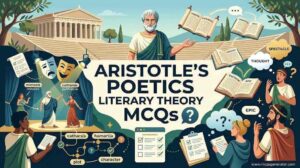
Aristotle’s Poetics (c. 335 BC) stands as the foundational cornerstone of Western literary criticism, offering the first systematic analysis of…
October 18, 2026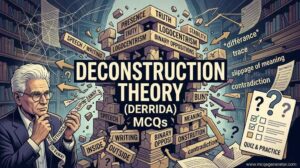
Deconstruction is a post-structuralist critical approach formulated by French philosopher Jacques Derrida in the late 1960s, designed to dismantle the…
October 18, 2026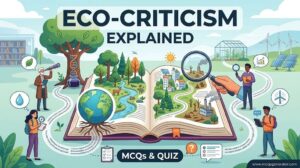
Ecocriticism is an interdisciplinary branch of literary and cultural studies that investigates the relationship between literature and the physical environment.…
October 18, 2026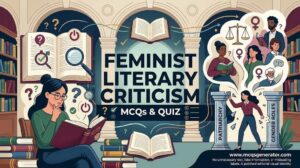
Feminist literary criticism is a critical school of thought that examines how literature reflects, reinforces, or challenges patriarchal structures, gender…
October 18, 2026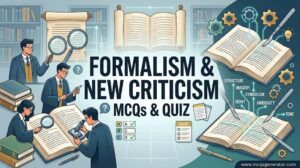
Formalism and New Criticism represent 20th-century critical movements that revolutionized literary studies by shifting analytical focus away from authorial biography,…
October 18, 2026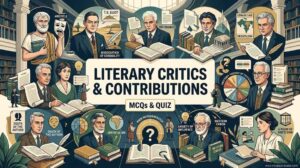
The history of literary criticism spans from classical antiquity to contemporary post-modern thought, tracking how thinkers have defined the function,…
October 18, 2026
Literary criticism is the systematic evaluation, interpretation, and analysis of literary texts through diverse theoretical, philosophical, and historical frameworks. Spanning…
October 18, 2026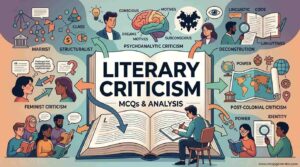
Literary criticism involves the disciplined analysis, interpretation, evaluation, and theoretical modeling of literary texts. Tracing back to classical foundational figures…
August 23, 2026
Literary theory forms a core component of competitive examinations in English literature, such as the UGC NET, SET, and university…
October 18, 2026
Marxist literary criticism evaluates texts through the theoretical lens of Karl Marx and Friedrich Engels, investigating how literature reflects, shapes,…
October 18, 2026
New Historicism is a major late-20th-century literary theory that rejects both the isolated text-focused approach of New Criticism and the…
October 18, 2026
Northrop Frye (1912–1991) was a towering Canadian literary critic whose monumental 1957 work Anatomy of Criticism revolutionized structural and archetypal…
October 18, 2026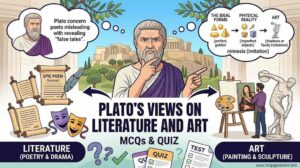
Plato’s views on literature and art, primarily articulated in dialogues such as The Republic and Ion, laid the foundational groundwork…
October 18, 2026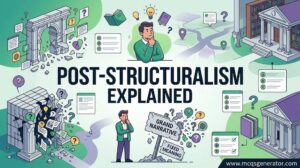
Post-Structuralism emerged in France during the late 1960s as a rigorous critique and radical evolution of structuralist certainty. While structuralists…
October 18, 2026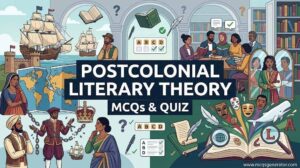
Postcolonial literary theory is a critical framework that examines the cultural, political, and psychological impacts of European imperialism and colonial…
October 18, 2026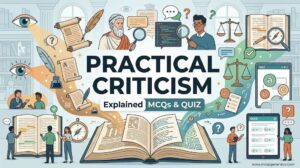
Practical criticism is a method of literary analysis that emphasizes close, objective reading of a text stripped of its historical,…
October 18, 2026
Psychoanalytic literary criticism applies the principles of psychoanalysis pioneered by Sigmund Freud, Carl Jung, and Jacques Lacan to interpret the…
October 18, 2026
Queer theory in literature is a critical framework that emerged in the early 1990s, building upon feminist theory, gay and…
October 18, 2026
Reader-Response criticism is a critical framework that shifts the locus of literary meaning from the author or the text itself…
October 18, 2026
Structuralism in literary theory emerged in the mid-20th century, shifting critical focus away from individual authorial intent and subjective impressionism…
October 18, 2026
Literary criticism encompasses a diverse array of methodological lenses and theoretical frameworks used to interpret, analyze, and evaluate literary texts.…
October 18, 2026
