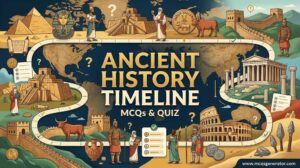
The Silk Road comprised an extensive network of Eurasian trade routes active from the Han Dynasty of China until the Ottoman Empire boycotted trade with the West in the 15th century. Spanning over 4,000 miles, these overland and maritime corridors linked East Asia to the Mediterranean basin, facilitating the exchange of silk, spices, porcelain, glass, and precious metals. Beyond physical commodities, the Silk Road served as a vital vector for the cross-cultural transmission of religions like Buddhism, scientific innovations such as papermaking, and philosophical ideas that permanently integrated ancient civilizations.
1. Who is credited with coining the term 'Silk Road' (Seidenstraße)?
Correct Answer: b) Ferdinand von Richthofen
Explanation:
German geographer Ferdinand von Richthofen coined the term 'Seidenstraße' (Silk Road) in 1877 to describe the ancient trade networks connecting China and the West.
2. During which Chinese dynasty was the Silk Road officially opened for trade?
Correct Answer: b) Han Dynasty
Explanation:
The Silk Road was officially opened during the Han Dynasty (specifically under Emperor Wu) in the 2nd century BCE, following the diplomatic missions of Zhang Qian.
3. Who was the Chinese envoy sent by Emperor Wu of Han to establish alliances in Central Asia, effectively pioneering the Silk Road?
Correct Answer: c) Zhang Qian
Explanation:
Zhang Qian was an imperial envoy sent by Emperor Wu in 138 BCE to seek an alliance with the Yuezhi against the Xiongnu. His travels provided the Han court with detailed information about Central Asia.
4. What was the primary military reason the Han Dynasty wanted to establish routes to the Fergana Valley?
Correct Answer: a) To acquire 'blood-sweating' horses
Explanation:
The Han Dynasty sought the superior, strong 'heavenly horses' (often described as sweating blood) of the Fergana Valley to build a formidable cavalry against the nomadic Xiongnu.
5. Which ancient Chinese capital served as the traditional eastern starting point of the Silk Road?
Correct Answer: c) Chang'an
Explanation:
Chang'an (modern-day Xi'an) was the capital of several major Chinese dynasties, including the Han and Tang, and served as the primary eastern terminus of the Silk Road.
6. The vast, arid desert in western China that Silk Road travelers had to navigate around is the:
Correct Answer: b) Taklamakan Desert
Explanation:
The Taklamakan Desert, located in the Tarim Basin, is one of the world's largest sandy deserts. The Silk Road split into northern and southern routes to skirt its deadly interior.
7. What does the name 'Taklamakan' popularly translate to in local Uyghur folklore?
Correct Answer: d) Once you go in, you don't come out
Explanation:
In local folklore, Taklamakan is often translated to mean 'Once you go in, you don't come out' or 'Place of no return,' reflecting its extreme and harsh conditions.
8. Which vital geographic bottleneck connected China proper to the Tarim Basin?
Correct Answer: b) The Hexi Corridor
Explanation:
The Hexi Corridor is a string of oases in modern Gansu province that served as the primary, highly contested route connecting central China to the western regions.
9. Which Middle Eastern empire acted as the primary middlemen between the Roman Empire and Han China?
Correct Answer: b) The Parthian Empire
Explanation:
During the Han Dynasty, the Parthian Empire controlled the trade routes in Persia and Mesopotamia, acting as lucrative middlemen between Rome and China.
10. By what name did the ancient Romans know China?
Correct Answer: c) Seres
Explanation:
The Romans referred to China as 'Seres,' which translates to 'the land of silk,' named after the primary commodity they acquired from the region.
11. What was a major concern of Roman leaders, like Pliny the Elder, regarding the silk trade?
Correct Answer: b) It drained the empire of its gold and silver reserves
Explanation:
Roman moralists and statesmen complained that the immense popularity of silk among Roman women was causing a massive outflow of bullion (gold and silver) to the East.
12. Which animal was considered the most reliable pack animal for crossing the harsh deserts and mountains of the Silk Road?
Correct Answer: c) The Bactrian Camel
Explanation:
The two-humped Bactrian camel was the 'ship of the desert' for the Central Asian Silk Road, capable of enduring extreme cold, heat, and carrying heavy loads.
13. What is the name of the roadside inns built along the Silk Road to provide safe lodging and supplies for merchants?
Correct Answer: b) Caravanserais
Explanation:
Caravanserais were fortified inns strategically placed roughly a day's journey apart to protect and resupply merchants and their pack animals.
14. Who were the primary merchants of the ancient Silk Road, known for establishing a vast trade network and making their language a lingua franca?
Correct Answer: c) The Sogdians
Explanation:
The Sogdians, an Iranian people from Transoxiana, were the preeminent traders of the Silk Road from the 4th to 8th centuries, and their language became the language of trade.
15. Which major Central Asian city, located in modern-day Uzbekistan, became a legendary hub of trade and Islamic culture along the route?
Correct Answer: a) Samarkand
Explanation:
Samarkand was one of the most important and prosperous cities on the Silk Road, renowned for its diverse culture, trade, and later, stunning Islamic architecture.
16. Which Chinese oasis town is famous for the Mogao Caves, which house centuries of Buddhist art and manuscripts?
Correct Answer: c) Dunhuang
Explanation:
Dunhuang was a critical junction where the northern and southern routes of the Taklamakan split. The Mogao Caves there contain invaluable Buddhist art and Silk Road documents.
17. The transmission of which major religion from India to China was facilitated by the Silk Road?
Correct Answer: b) Buddhism
Explanation:
Buddhism spread from India into Central Asia and China along the Silk Road, carried by monks, merchants, and missionaries.
18. Which famous Chinese Buddhist monk traveled along the Silk Road to India in the 7th century to obtain authentic Buddhist scriptures?
Correct Answer: c) Xuanzang
Explanation:
Xuanzang was a Tang dynasty monk who traveled for 17 years along the Silk Road to India and back, bringing hundreds of Buddhist scriptures to China.
19. What vital technology was purportedly transmitted from China to the Islamic world following the Battle of Talas in 751 CE?
Correct Answer: b) Papermaking
Explanation:
According to historical tradition, Chinese prisoners of war captured at the Battle of Talas by the Abbasid Caliphate introduced the secret of papermaking to the Islamic world.
20. Which Byzantine emperor successfully smuggled silkworm eggs out of China, breaking the Chinese monopoly on silk production?
Correct Answer: b) Justinian I
Explanation:
In the mid-6th century, Emperor Justinian I ordered monks to smuggle silkworm eggs from Asia inside hollow bamboo canes, establishing a Byzantine silk industry.
21. Besides silk, what was one of the most sought-after manufactured exports from the Roman Empire to the East?
Correct Answer: b) Glassware
Explanation:
Roman blown glass was highly prized in China and along the Silk Road, as the Chinese had not yet developed advanced glassblowing techniques.
22. The Kingdom of Khotan, an important oasis state on the southern edge of the Taklamakan Desert, was famous for exporting which precious stone to China?
Correct Answer: c) Jade
Explanation:
Khotan was the premier source of nephrite jade, a highly valued material in Chinese culture for carving and ritual use.
23. Lapis lazuli, a deep-blue metamorphic rock traded extensively along the Silk Road, was primarily mined in which modern-day country?
Correct Answer: b) Afghanistan
Explanation:
The Sar-i Sang mines in the Badakhshan region of Afghanistan were the ancient world's primary source of lapis lazuli.
24. Which empire created a period of unprecedented stability and safety across Eurasia in the 13th and 14th centuries, often called the 'Pax Mongolica'?
Correct Answer: c) The Mongol Empire
Explanation:
The Mongol Empire unified much of Eurasia, creating the 'Pax Mongolica' (Mongol Peace), which drastically reduced the cost and danger of cross-continental trade.
25. Who was the Venetian merchant who traveled the Silk Road to China and served in the court of Kublai Khan?
Correct Answer: b) Marco Polo
Explanation:
Marco Polo traveled to Asia in the late 13th century and wrote a detailed account of his travels, which introduced Europeans to the wealth and vastness of China.
26. What was the 'Yam' system established by the Mongol Empire along the Silk Road?
Correct Answer: b) A mounted courier and postal network
Explanation:
The Yam was an efficient, relay-based postal system using fast horses and relay stations, allowing for rapid communication and intelligence gathering across the vast Mongol Empire.
27. What is the term for the metal passport or medallion issued by the Mongols to protect merchants and diplomats traveling the Silk Road?
Correct Answer: c) Paiza
Explanation:
A Paiza (or Gerege) was a tablet of authority granted by Mongol rulers to officials and merchants to ensure they received safe passage, food, and horses along the routes.
28. Which devastating pandemic spread across Eurasia in the 14th century, likely facilitated by the connected networks of the Silk Road?
Correct Answer: c) The Black Death
Explanation:
The Black Death (bubonic plague) spread from Central/East Asia through Silk Road trade routes and Mongol armies, devastating the populations of the Middle East and Europe.
29. Which religion, founded in Persia by a prophet who combined elements of Christianity, Zoroastrianism, and Buddhism, spread extensively along the Silk Road?
Correct Answer: b) Manichaeism
Explanation:
Manichaeism, founded by the prophet Mani, was a major syncretic religion that spread rapidly along the Silk Road, even becoming the state religion of the Uyghur Khaganate.
30. The 'Nestorian Stele' discovered in Xi'an proves that which religion had reached China via the Silk Road by the Tang Dynasty?
Correct Answer: c) Christianity
Explanation:
The Nestorian Stele, erected in 781 CE, details the arrival and presence of the Church of the East (Nestorian Christianity) in Tang Dynasty China.
31. Which great Moroccan scholar and explorer traveled extensively throughout the Islamic world and the Silk Road, eventually reaching China in the 14th century?
Correct Answer: c) Ibn Battuta
Explanation:
Ibn Battuta is considered one of the greatest travelers of all time, covering much of the Islamic world, Central Asia, India, and making a visit to China during the Yuan Dynasty.
32. Which historic event in 1453 severely restricted European access to overland trade routes and accelerated the decline of the traditional Silk Road?
Correct Answer: c) The Ottoman capture of Constantinople
Explanation:
When the Ottoman Empire captured Constantinople (Istanbul), they gained control of key trade nodes and heavily taxed or blocked European merchants, hastening the search for sea routes.
33. The European search for alternative sea routes to bypass the Ottoman-controlled Silk Road directly led to which historical period?
Correct Answer: b) The Age of Discovery
Explanation:
Desire for direct access to Asian spices and silk motivated explorers like Vasco da Gama and Christopher Columbus, launching the Age of Discovery.
34. Which ancient empire, spanning northern India and Central Asia, played a crucial role as a cultural bridge and patron of Buddhism on the Silk Road?
Correct Answer: a) The Kushan Empire
Explanation:
The Kushan Empire (1st to 3rd centuries CE) straddled the Silk Road network in Central and South Asia, synthesizing Greek, Iranian, and Indian cultures, and significantly patronizing Buddhism.
35. What is the name of the modern infrastructure project initiated by China to recreate and expand upon the ancient Silk Road routes?
Correct Answer: c) The Belt and Road Initiative (BRI)
Explanation:
Announced in 2013, the Belt and Road Initiative aims to invest in infrastructure across Asia, Europe, and Africa to enhance trade and connectivity, inspired by the ancient Silk Road.
36. Which technology, crucial for navigation along the Maritime Silk Road, was invented in China and eventually spread to Europe?
Correct Answer: b) The Magnetic Compass
Explanation:
The magnetic compass was invented in China (initially for divination, later for navigation) and transmitted to the West, revolutionizing maritime travel.
37. The 'Maritime Silk Road' connected China with which major regions?
Correct Answer: b) Southeast Asia, India, the Arabian Peninsula, and East Africa
Explanation:
The Maritime Silk Road was a vast network of sea routes that linked China to Southeast Asia, the Indian subcontinent, the Middle East, and the eastern coast of Africa.
38. Who was the Chinese Muslim eunuch admiral who led seven epic voyages along the Maritime Silk Road in the 15th century?
Correct Answer: a) Zheng He
Explanation:
Zheng He commanded massive treasure fleets during the Ming Dynasty, reaching as far as East Africa to project Chinese power and stimulate trade.
39. Which vital spice, highly sought after by the Romans and later Europeans, was predominantly traded via the maritime routes from India?
Correct Answer: c) Black Pepper
Explanation:
Black pepper, native to the Malabar Coast of India, was one of the most heavily traded and valuable spices in antiquity and the Middle Ages.
40. The An Lushan Rebellion in the 8th century significantly weakened which Chinese dynasty, leading to a loss of control over the Silk Road?
Correct Answer: b) Tang Dynasty
Explanation:
The devastating An Lushan Rebellion (755-763) severely weakened the Tang Dynasty, forcing it to withdraw troops from the Western Regions and losing dominance over the Silk Road.
41. Which high-altitude mountain range did caravans have to cross when traveling from the Tarim Basin towards Afghanistan and India?
Correct Answer: c) The Pamirs
Explanation:
The Pamir Mountains, often called the 'Roof of the World,' presented a formidable, high-altitude barrier that merchants had to cross between China and Central/South Asia.
42. The city of Antioch, a major western terminus of the Silk Road, was located in which modern-day country?
Correct Answer: b) Turkey
Explanation:
Ancient Antioch is located in modern-day Turkey (Antakya). It was a crucial trade hub connecting the overland routes from the East to the Mediterranean Sea.
43. What type of traditional Chinese ceramics became immensely popular in the Islamic world and Europe, resulting in massive export volume?
Correct Answer: b) Celadon and blue-and-white porcelain
Explanation:
Chinese porcelain, particularly the green-glazed celadon and the later blue-and-white wares, was highly prized for its durability and beauty, becoming a major Silk Road export.
44. Which Central Asian kingdom was heavily involved in Silk Road trade and is famous for the 'Tarim mummies' exhibiting Caucasian features?
Correct Answer: a) The Loulan Kingdom
Explanation:
Loulan was an ancient oasis kingdom in the Tarim Basin. Archaeologists have discovered well-preserved mummies there, many exhibiting Indo-European features, reflecting the diverse populations of the Silk Road.
45. What is the name of the ancient city in modern-day Syria that grew fabulously wealthy as a caravan oasis connecting the Roman Empire to Mesopotamia?
Correct Answer: b) Palmyra
Explanation:
Palmyra, known as the 'Bride of the Desert,' was a wealthy oasis city in Syria that controlled lucrative caravan trade before it rebelled against Rome in the 3rd century.
46. Besides luxury goods, the Silk Road facilitated the transfer of major crops. Which fruit originated in Central Asia and was introduced to China and Europe via these routes?
Correct Answer: a) Apple
Explanation:
The ancestor of the domestic apple (Malus sieversii) originated in the mountains of Central Asia (modern Kazakhstan) and spread east and west via the Silk Road.
47. The transmission of gunpowder from China to the Middle East and Europe occurred primarily during the period of:
Correct Answer: c) The Mongol Empire conquests
Explanation:
While gunpowder was invented in China centuries earlier, the Mongol conquests in the 13th century facilitated its rapid spread and militarization across Eurasia.
48. Which nomadic confederation, a major rival of the Han Dynasty, often controlled portions of the Silk Road and exacted tribute?
Correct Answer: a) The Xiongnu
Explanation:
The Xiongnu were a powerful nomadic confederation on the Asian Steppe. The Han Dynasty's push to secure the Silk Road was largely to bypass and combat Xiongnu power.
49. Which material was famously forbidden under penalty of death to be exported from China as raw material or live specimens?
Correct Answer: b) Silkworms and their eggs
Explanation:
To maintain a highly lucrative global monopoly, Chinese imperial law decreed the death penalty for anyone caught smuggling silkworm eggs or mulberry seeds out of the country.
50. What is the name of the massive architectural defense project built and expanded by Chinese dynasties to protect their northern borders and the Silk Road?
Correct Answer: b) The Great Wall
Explanation:
Extensions of the Great Wall, particularly during the Han and Ming dynasties, were constructed explicitly to protect the Hexi Corridor and the Silk Road trade routes from nomadic raids.
51. In the context of the Silk Road, what does the term 'syncretism' refer to?
Correct Answer: a) The blending of different religions, cultures, or schools of thought
Explanation:
Syncretism was a hallmark of the Silk Road, where ideas, art styles, and religions mixed—for example, the Hellenistic influence on Buddhist art (Greco-Buddhism) in Gandhara.
52. Which important branch of the Silk Road connected the Tibetan Plateau to China and India, focusing heavily on the trade of a specific beverage and horses?
Correct Answer: b) The Tea Horse Road
Explanation:
The Tea Horse Road (Chama Dao) was a network of caravan paths through the mountains of Sichuan, Yunnan, and Tibet, exchanging Chinese tea for Tibetan warhorses.
53. What natural barrier lies immediately to the south of the Tarim Basin?
Correct Answer: c) The Kunlun Mountains and Tibetan Plateau
Explanation:
The Tarim Basin is bounded by the Tien Shan mountains to the north and the Kunlun Mountains to the south, the latter forming the northern edge of the Tibetan Plateau.
54. The city of Bukhara, alongside Samarkand, was a major commercial and cultural center in which historical region?
Correct Answer: b) Transoxiana (Sogdia)
Explanation:
Bukhara is located in Transoxiana (the land beyond the Oxus River), which was the historical homeland of the Sogdians and a critical nexus for Silk Road trade.
55. The transmission of which agricultural technology from the Islamic world greatly enhanced farming in Tang and Song dynasty China?
Correct Answer: b) The Noria (water wheel for irrigation)
Explanation:
Advanced hydraulic engineering and irrigation technologies, such as the Noria (water wheel), were shared across the Silk Road, boosting agricultural productivity.
56. Which famous Roman general was defeated at the Battle of Carrhae, where Roman legions supposedly first encountered silk banners used by the Parthians?
Correct Answer: c) Marcus Licinius Crassus
Explanation:
At the Battle of Carrhae in 53 BCE, Crassus was decisively defeated by the Parthians. Legend holds that the brilliant silk banners of the Parthians fascinated the Romans.
57. Which of the following goods was primarily exported FROM Rome and the Mediterranean TOWARDS China?
Correct Answer: b) Gold, silver, and glassware
Explanation:
While China exported silk, tea, and porcelain, the Mediterranean world primarily paid in bullion (gold and silver) and highly prized manufactured goods like blown glass.
58. The Kushan Empire is famous for synthesizing Greek and Indian artistic traditions, creating what style of Buddhist art?
Correct Answer: b) Gandharan art
Explanation:
Gandharan art developed in modern-day Pakistan/Afghanistan under the Kushans, famously depicting the Buddha with Greco-Roman artistic features like realistic drapery.
59. Which Chinese dynasty is famous for its highly cosmopolitan culture, directly resulting from flourishing Silk Road trade in the 7th and 8th centuries?
Correct Answer: c) Tang Dynasty
Explanation:
The Tang Dynasty is considered a golden age of cosmopolitan culture, where foreign merchants, religions, fashion, and music deeply influenced Chinese society.
60. What was the 'Guanxi' pass?
Correct Answer: b) The westernmost gate of the Great Wall, such as the Jade Gate (Yumen Pass)
Explanation:
Passes like the Yumen Pass (Jade Gate) and Yangguan marked the western extremity of the Great Wall and were the traditional entry/exit points for caravans leaving or entering China.
61. Which European explorer's rounding of the Cape of Good Hope signaled the beginning of the end for the overland Silk Road's dominance?
Correct Answer: b) Vasco da Gama
Explanation:
Vasco da Gama's successful voyage to India in 1498 established a direct sea route between Europe and Asia, drastically undercutting the overland Silk Road merchants.
62. Who was William of Rubruck?
Correct Answer: a) A Flemish Franciscan missionary who traveled to the Mongol Empire before Marco Polo
Explanation:
William of Rubruck was a Flemish monk who traveled to the court of the Mongol Great Khan Möngke in the 1250s and wrote one of the most detailed early Western accounts of Asia.
63. Which oasis city in the Tarim Basin was famous for its 'Karez' underground irrigation systems?
Correct Answer: a) Turpan
Explanation:
Turpan, located in a harsh depression, survived and thrived by using Karez—an ingenious system of underground canals that brought melted snow from the mountains without evaporation.
64. What is the historical significance of the 'Paiza' during the Mongol Empire?
Correct Answer: b) It was an imperial medallion providing safe conduct and access to supplies.
Explanation:
The Paiza was a tablet of authority (made of gold, silver, or wood) given to officials, envoys, and merchants, granting them free use of the Yam (postal) relay stations.
65. Which major Asian religion did NOT originate in the Middle East or India, but rather spread from China to its neighbors?
Correct Answer: b) Daoism
Explanation:
Daoism (Taoism) is indigenous to China and influenced neighboring cultures, unlike Buddhism, Islam, or Zoroastrianism, which traveled to China via the Silk Road.
66. The Strait of Malacca was a crucial geographic chokepoint for which trade network?
Correct Answer: c) The Maritime Silk Road
Explanation:
The Strait of Malacca connects the Indian Ocean to the South China Sea, making it one of the most important shipping lanes for the Maritime Silk Road.
67. The 'Buddhas of Bamiyan', destroyed by the Taliban in 2001, were monumental statues located along the Silk Road in:
Correct Answer: b) Afghanistan
Explanation:
The Bamiyan Valley in Afghanistan was a major Buddhist center on the Silk Road, famous for two massive Buddha statues carved directly into the sandstone cliffs in the 6th century.
68. What major shift in currency was pioneered by the Chinese during the Tang and Song dynasties due to the volume of trade?
Correct Answer: c) The invention of paper money
Explanation:
To handle large commercial transactions without transporting heavy copper coins, Chinese merchants and the government developed the world's first true paper money (Jiaozi).
69. Which empire, ruling Persia from the 3rd to 7th centuries CE, heavily regulated the Silk Road trade before falling to the Islamic Caliphates?
Correct Answer: b) The Sassanid Empire
Explanation:
The Sassanid Empire was the last pre-Islamic Persian empire. They strictly controlled the flow of silk to the Byzantine Empire and were a major cultural and economic power on the route.
70. What was the 'Spice Route'?
Correct Answer: b) The maritime network connecting the East Indies, India, and the Middle East
Explanation:
The Spice Route (part of the Maritime Silk Road) refers to the sea-based trade network that brought spices like pepper, cloves, and nutmeg from Southeast Asia and India to the West.
71. The spread of printing technology from China via the Silk Road eventually contributed to what major European development?
Correct Answer: b) The Gutenberg Press and the Renaissance
Explanation:
Chinese woodblock printing and movable type concepts spread westward, influencing the development of Johannes Gutenberg's printing press, which accelerated the Renaissance and Reformation.
72. The ancient city of Merv, once one of the largest cities in the world before its destruction by the Mongols, is located in modern-day:
Correct Answer: b) Turkmenistan
Explanation:
Merv was a major oasis-city in Central Asia on the historical Silk Road, located near today's Mary in Turkmenistan, until it was completely destroyed by the Mongol army in 1221.
73. Which Venetian merchant family famously established trading outposts in the Black Sea and Crimea to tap into the Silk Road trade during the Pax Mongolica?
Correct Answer: a) The Polo Family
Explanation:
Niccolò and Maffeo Polo (Marco's father and uncle) established trade outposts in Crimea and traveled deep into the Mongol Empire, capitalizing on the open routes.
74. The transmission of the bubonic plague along the Silk Road is often linked to the siege of which Genoese trading port by the Mongols in 1346?
Correct Answer: c) Caffa
Explanation:
During the siege of Caffa (in Crimea), the Mongol army purportedly catapulted plague-ridden corpses over the walls. Fleeing Genoese merchants then brought the plague to Europe.
75. Which powerful dynasty rebuilt and reinforced the Great Wall into its current recognizable brick-and-stone form in response to the collapse of the overland Silk Road and Mongol threats?
Correct Answer: c) Ming Dynasty
Explanation:
The Ming Dynasty (1368–1644) constructed the most extensive and durable portions of the Great Wall to keep out the Mongols and protect their borders after abandoning overland expansion.
76. Who was the founder of the Mongol Empire, who began the conquests that eventually unified the Silk Road under one rule?
Correct Answer: b) Genghis Khan
Explanation:
Genghis Khan founded the Mongol Empire in 1206. His rapid conquests across Asia laid the groundwork for the eventual unified control of the Silk Road.
77. Which ruler famously established the Yuan Dynasty in China and welcomed Marco Polo to his court?
Correct Answer: c) Kublai Khan
Explanation:
Kublai Khan, grandson of Genghis Khan, conquered the rest of China, established the Yuan Dynasty, and is famous for his interactions with Marco Polo.
78. What common navigational problem did merchants face when crossing the Gobi and Taklamakan deserts?
Correct Answer: c) Shifting sand dunes that erased trails
Explanation:
In sandy deserts like the Taklamakan, fierce winds constantly shift the sand dunes, making permanent roads impossible and requiring local guides and landmarks to navigate.
79. The spread of Islam along the Silk Road initially occurred through military conquest and was later sustained primarily by:
Correct Answer: b) Sufi missionaries and merchants
Explanation:
While initial Arab conquests brought Islam to Central Asia, it was the peaceful integration by Muslim merchants and the preaching of Sufi mystics that deeply rooted the religion along the Silk Road.
80. Which valuable commodity, derived from the sap of a tree, was traded from Southeast Asia to China and the Middle East for medicinal and aromatic uses?
Correct Answer: b) Camphor
Explanation:
Camphor, obtained from the wood of the camphor tree in Sumatra and Borneo, was highly valued in China and the Islamic world for incense, medicine, and embalming.
81. In 138 BCE, Zhang Qian was captured and held prisoner for a decade by which nomadic group?
Correct Answer: c) The Xiongnu
Explanation:
During his mission to find the Yuezhi, Zhang Qian was intercepted and captured by the Xiongnu. He was held for ten years before escaping to continue his mission.
82. What is the historical significance of the 'Genoese Map' (1457) and the 'Catalan Atlas' (1375)?
Correct Answer: b) They depicted the Silk Road and the vastness of Asia based on merchant accounts.
Explanation:
These medieval European maps incorporated geographic knowledge gained from Silk Road travelers like Marco Polo, showing places like Cathay (China) and major Asian trade hubs.
83. Which Central Asian conqueror claimed descent from Genghis Khan and brutally attempted to restore the Mongol Empire in the 14th century, establishing his capital at Samarkand?
Correct Answer: c) Timur (Tamerlane)
Explanation:
Timur (Tamerlane) was a Turco-Mongol conqueror who devastated parts of Asia to rebuild a vast empire, simultaneously transforming his capital, Samarkand, into a spectacular center of art and architecture.
84. What was a major reason for the decline of overland Silk Road trade during the 16th and 17th centuries?
Correct Answer: b) The rise of faster, cheaper European maritime shipping
Explanation:
As European powers (like the Portuguese, Dutch, and British) established direct maritime trade routes to Asia, the slower and more dangerous overland caravan routes lost their economic dominance.
85. Which European nation was the first to establish a direct, continuous maritime trade route to China, eventually setting up a permanent settlement in Macau in 1557?
Correct Answer: c) Portugal
Explanation:
Following Vasco da Gama's voyage, the Portuguese established maritime dominance in the Indian Ocean and became the first Europeans to lease a trading post (Macau) from the Ming Dynasty.
86. Which of the following describes 'Bactria'?
Correct Answer: b) An ancient region in Central Asia (modern Afghanistan/Tajikistan) that was a crucial Silk Road crossroads
Explanation:
Bactria was a historical region in Central Asia that served as a vital crossroads connecting India, China, and the Middle East, famous for its syncretic Greco-Bactrian culture.
87. The ancient 'Incense Route' primarily transported frankincense and myrrh from which region to the Mediterranean?
Correct Answer: a) Southern Arabia (Yemen/Oman)
Explanation:
While distinct from the Silk Road, the Incense Route connected the fragrant resin-producing regions of southern Arabia to the Mediterranean world, eventually interacting with maritime Silk Road networks.
88. The 'Amber Road' was an ancient trade route connecting which two bodies of water?
Correct Answer: b) The Baltic Sea and the Mediterranean Sea
Explanation:
The Amber Road transported fossilized tree resin (amber) from the Baltic coast down through Europe to the Mediterranean and the Roman Empire.
89. What highly destructive weapon, originally used for fireworks and signaling in China, was traded along the Silk Road and changed global warfare?
Correct Answer: c) Gunpowder
Explanation:
Gunpowder was invented in China and spread westward along the Silk Road, eventually revolutionizing military technology in the Islamic world and Europe.
90. The famous 'Horses of Fergana' were highly prized by the Han Dynasty. Where is the Fergana Valley located today?
Correct Answer: b) Spread across Uzbekistan, Kyrgyzstan, and Tajikistan
Explanation:
The fertile Fergana Valley is located in Central Asia, shared today by Uzbekistan, Kyrgyzstan, and Tajikistan. It was a vital agricultural and equestrian hub.
91. What language family did the nomadic Xiongnu and later Mongol and Turkic tribes primarily belong to?
Correct Answer: c) Altaic (or Mongolic/Turkic)
Explanation:
These nomadic steppe groups spoke languages generally classified as Mongolic or Turkic (often grouped under the controversial Altaic family), distinct from Chinese or Indo-European languages.
92. The Tarim mummies discovered in Xinjiang often wore clothing made of what material, pointing to a Western origin?
Correct Answer: c) Woven wool in tartan patterns
Explanation:
The incredibly preserved Tarim mummies (such as the Chärchän Man) wore woven woolen textiles with twill and tartan patterns remarkably similar to ancient Celtic fabrics.
93. The transmission of which musical instrument from the Middle East via the Silk Road significantly influenced the development of the Chinese pipa?
Correct Answer: b) The Oud (or Lute)
Explanation:
The short-necked lute (like the Persian oud) traveled East along the Silk Road and evolved into the Chinese pipa, a staple of Tang Dynasty music.
94. Which ancient Chinese philosopher's teachings were NOT primarily spread outside of East Asia via the Silk Road, unlike Buddhism?
Correct Answer: b) Confucius
Explanation:
While Buddhism, Islam, and Christianity actively proselytized along the Silk Road, Confucianism remained largely confined to China and its immediate East Asian sphere of influence (Korea, Japan, Vietnam).
95. What does the 'Great Game' refer to in the context of the historical Silk Road regions?
Correct Answer: b) The 19th-century political and diplomatic confrontation between the British and Russian Empires over Central Asia
Explanation:
The 'Great Game' was a geopolitical struggle between Victorian Britain and Tsarist Russia for dominance in Central Asia (the heart of the old Silk Road) and control of the approaches to India.
96. Which international organization inscribed the 'Silk Roads: the Routes Network of Chang'an-Tianshan Corridor' as a World Heritage site in 2014?
Correct Answer: c) UNESCO
Explanation:
In 2014, UNESCO designated a 5,000-kilometer stretch of the Silk Road network extending from Chang'an (Xi'an) to the Tianshan Mountains as a World Heritage site.
97. Which desert animal was highly valued by Silk Road hunters and elites, famously used for hunting via falconry?
Correct Answer: a) The Golden Eagle
Explanation:
Falconry, particularly the use of Golden Eagles for hunting foxes and wolves, was a prestigious and highly developed skill among the nomadic peoples of the Central Asian steppes.
98. Which metal, highly prized for making weapons, was historically produced in India and Sri Lanka and traded extensively along the Silk Road?
Correct Answer: b) Wootz steel (Damascus steel)
Explanation:
Wootz steel, developed in ancient India, was heavily traded into the Middle East, where it was forged into the legendary, ultra-sharp 'Damascus' swords.
99. What natural geographic feature provided the lifeblood for the oasis cities of the Tarim Basin?
Correct Answer: b) Meltwater runoff from the surrounding high mountain ranges
Explanation:
The oasis cities surrounding the Taklamakan Desert survived entirely on rivers and streams fed by the melting glaciers and snowcaps of the Kunlun and Tien Shan mountains.
100. Which of the following best describes the 'Steppe Route'?
Correct Answer: b) An ancient trade route traversing the Eurasian grassy plains north of the deserts and mountains
Explanation:
The Steppe Route predated the formal Silk Road and ran through the vast Eurasian steppes from Manchuria to Hungary, utilized by nomadic pastoralists.