Poetry analysis requires a systematic approach to decoding how form, sound, structure, and figuration create meaning. Through rigorous close reading, readers examine metrical patterns via scansion, identify underlying rhyme schemes, and evaluate rhetorical devices like metaphor, metonymy, and irony. Understanding tone, speaker persona, and syntax allows critics to bridge technical mechanics with thematic interpretation. Mastering these analytical techniques is essential for academic literature examinations, poetry workshops, and profound literary appreciation.
1. Which literary device involves a direct comparison between two unlike things without using 'like' or 'as'?
Correct Answer: b) Metaphor
Explanation:
A metaphor asserts that one thing is another thing, creating a direct comparison without the use of 'like' or 'as'.
2. What is a simile?
Correct Answer: a) A figure of speech comparing two unlike things using 'like' or 'as'
Explanation:
Similes explicitly compare two things using words such as 'like', 'as', or 'than' to highlight a shared quality.
3. When a poet writes 'The wind whispered through the trees', which device is being used?
Correct Answer: c) Personification
Explanation:
Personification gives human traits, such as whispering, to non-human entities like the wind.
4. Which term describes an extreme exaggeration used to make a point or evoke strong feelings?
Correct Answer: b) Hyperbole
Explanation:
Hyperbole is an intentional exaggeration not meant to be taken literally, such as 'I've told you a million times'.
5. If a poem refers to 'all hands on deck', using a part to represent the whole, what is this figure of speech called?
Correct Answer: a) Synecdoche
Explanation:
Synecdoche is a specific type of figurative language where a part of something represents the whole, or vice versa.
6. When 'the crown' is used to refer to a king or queen, which literary device is employed?
Correct Answer: b) Metonymy
Explanation:
Metonymy replaces the name of a thing with the name of something else with which it is closely associated.
7. Which of the following is an example of an oxymoron?
Correct Answer: a) Jumbo shrimp
Explanation:
An oxymoron places two contradictory terms side by side to create a complex or rhetorical effect.
8. A statement that appears self-contradictory but reveals a hidden truth is called a:
Correct Answer: b) Paradox
Explanation:
A paradox is a seemingly absurd or self-contradictory statement that, upon closer examination, makes sense or contains truth.
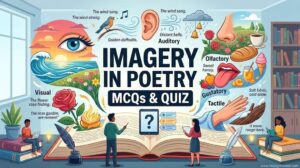
9. What is the primary function of imagery in poetry?
Correct Answer: c) To appeal to the reader's physical senses
Explanation:
Imagery uses descriptive language to represent objects, actions, and ideas in a way that appeals to our physical senses.
10. An indirect or passing reference to a famous historical or literary figure or event is an:
Correct Answer: b) Allusion
Explanation:
An allusion is a brief and indirect reference to a person, place, thing, or idea of historical, cultural, or literary significance.
11. When a speaker directly addresses an abstract concept, an inanimate object, or a person who is not present, this is known as:
Correct Answer: a) Apostrophe
Explanation:
Apostrophe is a figure of speech in which the poet addresses an absent person, an abstract idea, or a thing.
12. A play on words exploiting the different possible meanings of a word or words that sound alike is a:
Correct Answer: a) Pun
Explanation:
Puns rely on words that have multiple meanings or words that sound similar but mean different things, usually for humorous effect.
13. Litotes is a figure of speech characterized by:
Correct Answer: b) Understatement using double negatives
Explanation:
Litotes is a form of understatement that uses a negative to assert a positive, such as 'not bad' meaning 'good'.
14. An extended, elaborate metaphor that compares two highly dissimilar things is called a:
Correct Answer: a) Conceit
Explanation:
A conceit is a fanciful and elaborate extended metaphor, heavily used in metaphysical poetry, linking vastly different concepts.
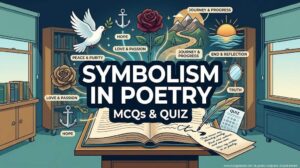
15. Which literary device involves an object or action that means something more than its literal meaning?
Correct Answer: a) Symbol
Explanation:
A symbol is an object, person, or situation that has another meaning other than its literal one, often representing abstract ideas.
16. A narrative poem in which characters and events represent deeper political, historical, or moral concepts is an:
Correct Answer: c) Allegory
Explanation:
An allegory uses a story with surface-level characters and plots to convey a deeper moral or political meaning.
17. When a speaker says the opposite of what they mean, often for sarcastic effect, it is called:
Correct Answer: b) Verbal irony
Explanation:
Verbal irony occurs when the literal meaning of what someone says is completely different from what they actually mean.
18. Ascribing human form or attributes to an animal, plant, or material object (often literalized in a story or poem) is:
Correct Answer: a) Anthropomorphism
Explanation:
Unlike personification which is figurative, anthropomorphism involves non-human entities actually acting or appearing physically human.
19. Describing one kind of sensation in terms of another, such as 'a loud color' or 'a sweet sound', is called:
Correct Answer: a) Synesthesia
Explanation:
Synesthesia is a figurative device that blends different sensory modalities to create vivid imagery.
20. The poetic attribution of human feelings and responses to inanimate things or animals, especially in art and literature, is:
Correct Answer: a) The pathetic fallacy
Explanation:
Coined by John Ruskin, the pathetic fallacy attributes human emotion or responses to nature (e.g., 'weeping clouds').
21. The repetition of the same initial consonant sounds in a sequence of words is called:
Correct Answer: b) Alliteration
Explanation:
Alliteration is the repetition of initial consonant sounds in neighboring words, such as 'Peter Piper picked'.
22. What is assonance?
Correct Answer: a) The repetition of vowel sounds within nearby words
Explanation:
Assonance is the repetition of internal vowel sounds in words that do not end the same, like 'fleet feet sweep by'.
23. The repetition of consonant sounds, especially at the ends of words (e.g., 'blank' and 'think'), is known as:
Correct Answer: b) Consonance
Explanation:
Consonance is the repetition of consonant sounds anywhere in the words, but often specifically at the ends, creating a partial rhyme.
24. Words that sound like the noise they describe, such as 'buzz', 'hiss', or 'bang', are examples of:
Correct Answer: c) Onomatopoeia
Explanation:
Onomatopoeia refers to words whose pronunciation imitates the sound of the object or action they represent.
25. Rhyme that occurs at the end of two or more lines of poetry is called:
Correct Answer: c) End rhyme
Explanation:
End rhyme is the most common form of rhyming in poetry, where the final words of lines rhyme with each other.
26. When rhyming words occur within a single line of poetry, it is called:
Correct Answer: a) Internal rhyme
Explanation:
Internal rhyme occurs when a word in the middle of a line rhymes with a word at the end of the same metrical line.
27. A rhyme in which either the vowels or the consonants of stressed syllables are identical, but not both (e.g., 'shape' and 'keep'), is a:
Correct Answer: b) Slant rhyme
Explanation:
Also known as half, near, or imperfect rhyme, slant rhyme relies on close but not exact matching of sounds.
28. Words that look like they should rhyme based on spelling but do not sound alike (e.g., 'love' and 'move') are called:
Correct Answer: b) Eye rhyme
Explanation:
Eye rhymes appeal to the eye rather than the ear, as their spellings are similar but pronunciations differ.
29. A rhyme involving two or more syllables (e.g., 'motion' and 'ocean') is known as:
Correct Answer: a) Feminine rhyme
Explanation:
Feminine rhyme involves an unstressed syllable following a stressed rhyming syllable, creating a multi-syllabic rhyme.
30. A rhyme that matches up single, stressed syllables (e.g., 'cat' and 'hat') is called:
Correct Answer: b) Masculine rhyme
Explanation:
Masculine rhymes consist of a single stressed rhyming syllable, the most common type of rhyme in English.
31. A line or group of lines repeated at regular intervals in a poem, often at the end of a stanza, is a:
Correct Answer: c) Refrain
Explanation:
A refrain is a phrase, line, or group of lines repeated throughout a poem, similar to a chorus in a song.
32. Language that sounds pleasant, musical, and harmonious to the ear is known as:
Correct Answer: b) Euphony
Explanation:
Euphony uses soothing, pleasant sounds (often long vowels and soft consonants) to create a harmonious effect.
33. The use of harsh, discordant, or unpleasing sounds in poetry is called:
Correct Answer: a) Cacophony
Explanation:
Cacophony refers to a harsh, discordant mixture of sounds, often using explosive consonants like k, t, g, d, p, and b.
34. The pattern of end rhymes in a poem, usually represented by letters (e.g., ABAB), is called the:
Correct Answer: c) Rhyme scheme
Explanation:
A rhyme scheme maps the pattern of end rhymes across a poem using alphabetical letters.
35. A specific type of alliteration involving the repetition of 's' or 'sh' sounds is called:
Correct Answer: a) Sibilance
Explanation:
Sibilance is a specialized literary device that relies on the repetition of hissing sounds, primarily the letter 's'.
36. Unrhymed poetry written in a regular metrical pattern (typically iambic pentameter) is called:
Correct Answer: b) Blank verse
Explanation:
Blank verse has a strict meter (usually iambic pentameter) but lacks a rhyme scheme. It is heavily used in Shakespeare's plays.
37. The use of the exact same word to 'rhyme' with itself at the ends of two lines is called:
Correct Answer: a) Identical rhyme
Explanation:
Identical rhyme involves repeating the exact same word in the rhyming position, rather than using a word with a similar sound.
38. A rhyme using two different words that sound exactly the same (homophones, like 'raise' and 'raze') is called:
Correct Answer: b) Rich rhyme
Explanation:
Rich rhyme (rime riche) uses homophones—words that sound identical but have different meanings and spellings.
39. The repetition of a word or phrase at the beginning of successive clauses or lines is:
Correct Answer: b) Anaphora
Explanation:
Anaphora is a rhetorical device that creates rhythm and emphasizes meaning by repeating words at the start of phrases.
40. The repetition of a word or phrase at the end of successive clauses or lines is:
Correct Answer: c) Epistrophe
Explanation:
Epistrophe (or epiphora) is the counterpart to anaphora, placing the repeated words at the ends of consecutive lines.
41. The process of analyzing a poem's meter by marking its stressed and unstressed syllables is known as:
Correct Answer: b) Scansion
Explanation:
Scansion is the act of reading a poem to determine its metrical pattern, usually marking unstressed (u) and stressed (/) syllables.
42. A metrical foot consisting of one unstressed syllable followed by one stressed syllable (da-DUM) is an:
Correct Answer: a) Iamb
Explanation:
The iamb is the most common metrical foot in English poetry, mimicking a natural heartbeat (e.g., 'to-DAY').
43. A metrical foot consisting of one stressed syllable followed by one unstressed syllable (DUM-da) is a:
Correct Answer: a) Trochee
Explanation:
A trochee is the reverse of an iamb, starting with a heavy stress followed by a light one (e.g., 'TIGER').
44. A metrical foot consisting of two unstressed syllables followed by one stressed syllable (da-da-DUM) is an:
Correct Answer: a) Anapest
Explanation:
An anapest gives a rolling, galloping rhythm, ending on a strong beat (e.g., 'inter-VENE').
45. A metrical foot consisting of one stressed syllable followed by two unstressed syllables (DUM-da-da) is a:
Correct Answer: b) Dactyl
Explanation:
A dactyl creates a falling rhythm, beginning with a stress and trailing off (e.g., 'PO-e-try').
46. A metrical foot containing two consecutive stressed syllables (DUM-DUM) is a:
Correct Answer: a) Spondee
Explanation:
Spondees are often used to slow the rhythm of a line and add weight or emphasis (e.g., 'BASE-BALL').
47. A metrical foot containing two consecutive unstressed syllables (da-da) is known as a:
Correct Answer: a) Pyrrhic
Explanation:
Pyrrhic feet speed up a line because they contain no heavily stressed syllables, often acting as a transition.
48. A line of poetry that contains exactly five metrical feet is called:
Correct Answer: b) Pentameter
Explanation:
Pentameter means 'five measures'. Iambic pentameter consists of five iambs, totaling ten syllables.
49. A line of poetry containing four metrical feet is known as:
Correct Answer: b) Tetrameter
Explanation:
Tetrameter means 'four measures', often creating a brisk, song-like rhythm.
50. An Alexandrine is a specific type of metrical line that consists of:
Correct Answer: c) Six iambs (Iambic hexameter)
Explanation:
The Alexandrine is a 12-syllable line in iambic hexameter, commonly used in traditional French poetry and occasionally in English.
51. A deliberate pause or break within a line of poetry, often marked by punctuation, is called a:
Correct Answer: b) Caesura
Explanation:
A caesura dictates a pause for breath or effect within a metrical line, breaking its rhythm.
52. When a sentence or thought runs over from one line of poetry into the next without a terminal punctuation mark, it is called:
Correct Answer: c) Enjambment
Explanation:
Enjambment pulls the reader into the next line to complete the thought, altering the poem's pace.
53. A line of poetry that concludes with a period, comma, or other punctuation mark indicating a pause is:
Correct Answer: b) End-stopped
Explanation:
End-stopped lines contain a complete thought and end with grammatical punctuation.
54. The dropping of an unstressed syllable at the end of a metrical line, causing the line to end on a strong stress, is known as:
Correct Answer: a) Catalexis
Explanation:
Catalexis makes a line incomplete metrically but often stronger emphatically by ending on a stressed beat.
55. The omission of an unstressed vowel or syllable in order to preserve the meter of a line of poetry is:
Correct Answer: a) Elision
Explanation:
Elision blends words together (like 'o'er' instead of 'over') to maintain the syllable count required by the meter.
56. What is the most common metrical pattern in traditional English poetry?
Correct Answer: b) Iambic pentameter
Explanation:
Iambic pentameter's alternating stress pattern closely mirrors the natural cadence of the English language.
57. A complex, highly irregular poetic rhythm designed by Gerard Manley Hopkins to imitate natural speech is called:
Correct Answer: a) Sprung rhythm
Explanation:
Sprung rhythm counts only the stressed syllables in a line, allowing any number of unstressed syllables between them.
58. Poetry that does not follow a fixed metrical pattern or rhyme scheme is called:
Correct Answer: b) Free verse
Explanation:
Free verse (vers libre) lacks strict meter and rhyme, relying instead on natural speech rhythms and imagery.
59. In poetry, what is 'meter'?
Correct Answer: b) The recurring pattern of stressed and unstressed syllables
Explanation:
Meter is the underlying rhythmic structure or measure of a poem, organized into feet.
60. The study of poetic meter, rhythm, and intonation is generally referred to as:
Correct Answer: c) Prosody
Explanation:
Prosody encompasses the study of all elements of language that contribute to acoustic and rhythmic effects in poetry.
61. A stanza or grouping of two consecutive rhyming lines of poetry is called a:
Correct Answer: b) Couplet
Explanation:
A couplet consists of two lines, usually in the same meter and joined by rhyme, forming a complete unit.
62. A stanza consisting of exactly three lines is known as a:
Correct Answer: b) Tercet
Explanation:
A tercet is a three-line stanza, which can be rhymed or unrhymed, frequently seen in forms like the villanelle.
63. What is a quatrain?
Correct Answer: a) A four-line stanza
Explanation:
A quatrain is the most common stanzaic form in English, containing four lines with various possible rhyme schemes.
64. The final six lines of a Petrarchan sonnet are referred to as the:
Correct Answer: b) Sestet
Explanation:
A traditional Petrarchan sonnet is divided into an eight-line octave followed by a six-line sestet.
65. The first eight lines of a Petrarchan sonnet are referred to as the:
Correct Answer: a) Octave
Explanation:
The octave introduces a problem or conflict that is later resolved or addressed in the sestet.
66. A traditional sonnet consists of how many lines?
Correct Answer: c) 14
Explanation:
Sonnets are rigidly structured 14-line poems, usually written in iambic pentameter.
67. A sonnet that is divided into an octave (ABBAABBA) and a sestet (CDCDCD or CDECDE) is a:
Correct Answer: c) Petrarchan sonnet
Explanation:
Also called the Italian sonnet, the Petrarchan form uses an octave and a sestet to structure its thought process.
68. A sonnet comprising three quatrains and a concluding couplet (ABAB CDCD EFEF GG) is a:
Correct Answer: a) Shakespearean sonnet
Explanation:
The Shakespearean (or English) sonnet allows for more rhymes and saves the concluding twist for the final couplet.
69. A sonnet that uses an interlocking rhyme scheme (ABAB BCBC CDCD EE) is known as a:
Correct Answer: c) Spenserian sonnet
Explanation:
Invented by Edmund Spenser, this form links the quatrains together through overlapping rhymes.
70. A traditional Japanese poetic form consisting of three unrhymed lines of 5, 7, and 5 syllables is a:
Correct Answer: b) Haiku
Explanation:
Haiku focuses on nature and captures a fleeting moment using a strict 5-7-5 syllable structure.
71. An extension of the haiku, this Japanese form consists of five lines with a 5-7-5-7-7 syllable structure. It is called:
Correct Answer: a) Tanka
Explanation:
Tanka poems add two 7-syllable lines to the haiku structure, allowing for more narrative or emotional expression.
72. A humorous, often bawdy five-line poem with an AABBA rhyme scheme and anapestic meter is a:
Correct Answer: a) Limerick
Explanation:
Limericks are light verse with a bouncy rhythm derived from anapestic feet.
73. A highly structured 19-line poem consisting of five tercets and a quatrain, utilizing two repeating lines, is a:
Correct Answer: c) Villanelle
Explanation:
The villanelle obsessively repeats its first and third lines throughout the poem, as seen in Dylan Thomas's 'Do not go gentle into that good night'.
74. A complex poetic form consisting of 39 lines where the end words of the first stanza are repeated in a specific rotating order in the subsequent stanzas is a:
Correct Answer: b) Sestina
Explanation:
The sestina comprises six sestets and a three-line envoi, relying on a strict pattern of repeated end-words rather than rhyme.
75. A formal, often ceremonious lyric poem that addresses and often celebrates a person, place, thing, or idea is an:
Correct Answer: b) Ode
Explanation:
Odes are elevated, formal poems meant to praise or glorify their subject.
76. A somber poem or song expressing lamentation and mourning for the dead is an:
Correct Answer: b) Elegy
Explanation:
Elegies are reflective poems that mourn the loss of someone or something, often moving from grief to consolation.
77. A narrative poem typically written in four-line stanzas with an ABCB rhyme scheme, historically meant to be sung, is a:
Correct Answer: a) Ballad
Explanation:
Ballads tell a story (often tragic, romantic, or heroic) and utilize a simple, musical stanza structure.
78. A lengthy, elevated narrative poem detailing the heroic deeds and adventures of legendary figures is an:
Correct Answer: a) Epic
Explanation:
Epics are massive, culturally significant narrative poems, such as 'The Odyssey' or 'Beowulf'.
79. A brief, witty, and often satirical poem or statement that ends with a humorous twist is an:
Correct Answer: a) Epigram
Explanation:
Epigrams are concise and clever, delivering a quick satirical observation or joke.
80. A poetic form where the second and fourth lines of each stanza become the first and third lines of the next is a:
Correct Answer: b) Pantoum
Explanation:
The pantoum is a Malayan form relying on overlapping lines to create an echoing, forward-and-backward movement.
81. In a sonnet, the pivotal moment where the argument or mood shifts—often before the sestet or the final couplet—is called the:
Correct Answer: a) Volta
Explanation:
The volta (Italian for 'turn') is the emotional or logical shift in a sonnet, essential to resolving its thematic conflict.
82. The voice behind the poem, which should not automatically be assumed to be the author, is known as the:
Correct Answer: b) Speaker
Explanation:
The speaker (or persona) is the character or voice created by the poet to deliver the poem.
83. The poet's or speaker's attitude toward the subject matter, the audience, or themselves is called:
Correct Answer: b) Tone
Explanation:
Tone is conveyed through diction and syntax, reflecting the author's stance (e.g., sarcastic, solemn, joyous).
84. The emotional atmosphere or feeling created in the reader by a poem is called the:
Correct Answer: b) Mood
Explanation:
While tone is the author's attitude, mood is the emotional response elicited from the reader.
85. A poem in which a single imagined speaker addresses a silent listener, revealing their character inadvertently, is a:
Correct Answer: b) Dramatic monologue
Explanation:
In a dramatic monologue, the speaker's one-sided conversation reveals deep psychological insights about themselves.
86. A poet's specific choice of words to create a desired effect is called:
Correct Answer: b) Diction
Explanation:
Diction refers strictly to word choice (e.g., formal vs. informal, abstract vs. concrete).
87. The arrangement of words and phrases into sentences or lines (word order) is known as:
Correct Answer: a) Syntax
Explanation:
Syntax governs grammatical structure and word order, which poets often manipulate for rhyme, meter, or emphasis.
88. The inversion of the usual, normal, or logical order of the parts of a sentence in poetry is called:
Correct Answer: a) Anastrophe
Explanation:
Anastrophe is the technical term for inverted word order (Yoda-speak), often used by poets to maintain meter or achieve a rhyme.
89. A recurring element—such as an image, symbol, or concept—that has symbolic significance in a poem is a:
Correct Answer: a) Motif
Explanation:
A motif is a repeated pattern or image that helps to develop and inform the poem's major themes.
90. The central, underlying, and controlling idea or message of a poem is its:
Correct Answer: c) Theme
Explanation:
The theme is the broad, abstract concept or universal truth explored throughout the poem.
91. A rhetorical device in which words or concepts are repeated in reverse order, in the same or a modified form (e.g., 'Poetry is the record of the best and happiest moments of the happiest and best minds'), is:
Correct Answer: a) Chiasmus
Explanation:
Chiasmus uses an ABBA structure to invert phrases, creating memorable and highly stylized lines.
92. The deliberate omission of conjunctions between a series of related clauses (e.g., 'I came, I saw, I conquered') is called:
Correct Answer: b) Asyndeton
Explanation:
Asyndeton speeds up the rhythm of a phrase by removing conjunctions like 'and' or 'or'.
93. The deliberate use of multiple conjunctions in close succession (e.g., 'And rivers and rocks and trees') is called:
Correct Answer: b) Polysyndeton
Explanation:
Polysyndeton slows down the rhythm and adds weight or overwhelming feeling by repeating conjunctions.
94. A short, concluding stanza in certain poetic forms, often addressed to a specific person or summing up the poem, is an:
Correct Answer: a) Envoi
Explanation:
An envoi (or envoy) serves as a sign-off or summary, required in forms like the sestina or ballade.
95. Which statement correctly distinguishes blank verse from free verse?
Correct Answer: a) Blank verse has meter but no rhyme; free verse has neither strict meter nor rhyme.
Explanation:
Blank verse is strictly metered (usually iambic pentameter) without rhyme. Free verse abandons both strict rhyme and strict meter.
96. A highly intellectualized, strange, and elaborate comparison popular in 17th-century poetry is called a:
Correct Answer: a) Metaphysical conceit
Explanation:
Made famous by poets like John Donne, the metaphysical conceit compares violently disparate things, like two lovers to the legs of a drawing compass.
97. A poem or song welcoming or lamenting the arrival of the dawn, traditionally involving lovers parting at sunrise, is an:
Correct Answer: a) Aubade
Explanation:
An aubade focuses on the dawn, specifically the bittersweet moment when lovers must separate as the sun rises.
98. A brief hymn or song of grief intended to accompany funeral or memorial rites is a:
Correct Answer: a) Dirge
Explanation:
A dirge is shorter and less formal than an elegy, usually intended to be sung at a funeral.
99. A poem that idealizes rural life and landscapes, often featuring shepherds, is classified as:
Correct Answer: a) Pastoral
Explanation:
Pastoral poetry romanticizes country life, portraying it as innocent and untouched by the corruption of the city.
100. A vivid, often dramatic verbal description of a visual work of art within a poem is known as:
Correct Answer: a) Ekphrasis
Explanation:
Ekphrastic poetry is written in response to or about a piece of visual art, like Keats's 'Ode on a Grecian Urn'.