300 Latest Universe MCQs
The universe encompasses all existing matter, energy, space, and time, spanning an estimated diameter of at least 93 billion light-years…
October 20, 2026By MCQs Generator

We have detected that you are using extensions to block ads. Please support us by disabling these ads blocker.


The universe encompasses all existing matter, energy, space, and time, spanning an estimated diameter of at least 93 billion light-years…
October 20, 2026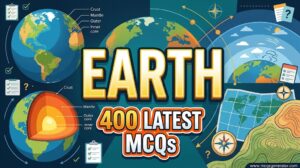
Earth is the third planet from the Sun and the only celestial body known to support life. Structurally, it is…
October 20, 2026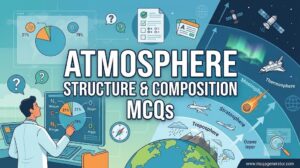
Earth’s atmosphere is a complex envelope of gases held in place by gravity, extending thousands of kilometers above the surface.…
October 18, 2026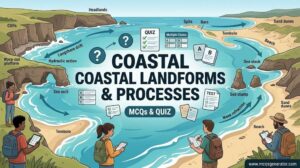
Coastal landforms and processes investigate the dynamic boundary where land meets the sea, shaped continuously by wave action, tides, currents,…
October 18, 2026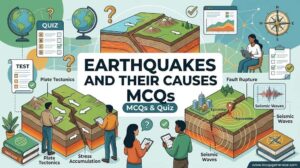
Earthquakes are sudden ground vibrations caused by the release of accumulated strain energy along tectonic faults or volcanic conduits within…
October 18, 2026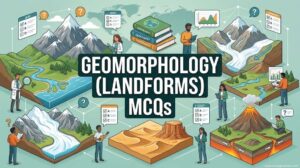
Geomorphology is the scientific study of the origin, evolution, spatial distribution, and physical characteristics of Earth’s landforms and surface topography.…
October 18, 2026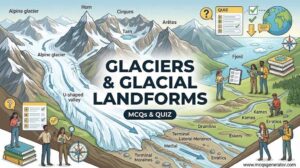
Glaciers are massive, slow-moving rivers of compacted ice that carve striking topographical features across Earth’s high-latitude and high-altitude regions. Divided…
October 18, 2026
A landlocked country is a sovereign state that lacks direct access to an ocean or open sea, with its boundaries…
October 20, 2026
Pakistan shares international land borders with four neighboring countries—India, Afghanistan, Iran, and China—spanning a total land boundary of approximately 6,774…
October 20, 2026
Geographical terms describe the diverse natural features, terrain configurations, and physical processes that shape Earth’s surface. These terms classify landforms…
October 20, 2026
Plains are broad, low-lying, relatively flat landforms that cover over one-third of the Earth’s total land surface across every continent.…
October 20, 2026
Physical geography is a foundational branch of earth sciences that investigates the natural features, processes, and phenomena shaping the Earth’s…
October 18, 2026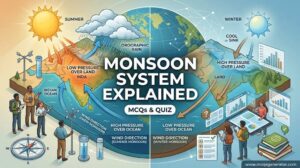
The monsoon system is a large-scale seasonal reversal of prevailing wind directions and precipitation regimes driven by differential thermal heating…
October 18, 2026
A mountain pass is a navigable route or gap through a mountain range or over a ridge, formed naturally by…
October 20, 2026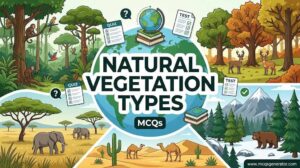
Natural vegetation refers to plant life that grows naturally in an area without direct human intervention, heavily influenced by regional…
October 18, 2026
Mountains are elevated landforms rising sharply above their surrounding terrain, covering approximately 24% of the Earth’s land surface. Formed primarily…
October 20, 2026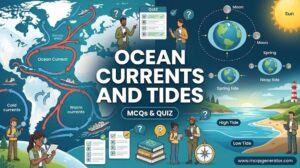
Ocean currents and tides are vital marine hydrodynamic processes that regulate global heat distribution, climate stability, and coastal ecosystems. Surface…
October 18, 2026
Physical geography forms a core component of competitive examinations like UPSC Civil Services, SSC CGL, CDS, and state public service…
October 18, 2026
The physical geography of India encompasses a diverse array of landforms, geological structures, and climatic zones ranging from the towering…
October 18, 2026
Geography is broadly bifurcated into two primary dimensions: physical geography, which investigates natural Earth systems, landforms, and climates, and human…
October 18, 2026
Fluvial geomorphology studies the running water of rivers and streams as primary exogenic agents shaping the Earth’s surface through erosion,…
October 18, 2026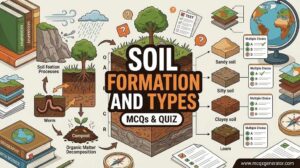
Soil formation, known scientifically as pedogenesis, is the complex result of physical, chemical, and biological weathering acting upon parent rock…
October 18, 2026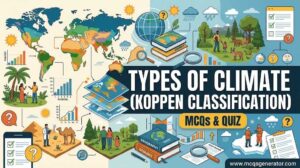
The Koppel climate classification system is the most widely used empirical method for categorizing the Earth’s diverse climates based on…
October 18, 2026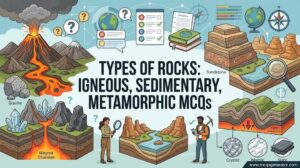
The Earth’s solid crust is composed of rocks, which are classified into three major groups based on their formation processes:…
October 18, 2026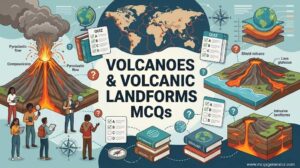
Volcanoes and volcanic landforms are endogenic geological features shaped by the ascent, eruption, and cooling of magma. Ranging from explosive…
October 18, 2026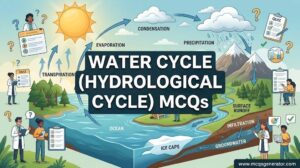
The water cycle, or hydrological cycle, describes the continuous movement of water on, above, and below the surface of the…
October 18, 2026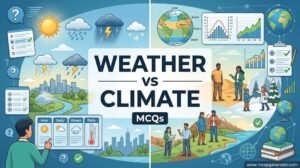
Weather and climate are foundational concepts in physical geography and earth sciences that measure atmospheric conditions over different temporal and…
October 18, 2026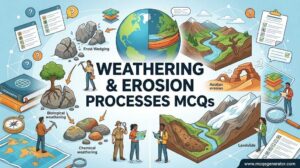
Weathering and erosion are the fundamental exogenic processes that sculpt the Earth’s surface, breaking down rocks and transporting debris across…
October 18, 2026
